A Bullet Meant for No One, a Life Taken from Everyone: The Murder of Sam Abu Haikal
The car seat was behind the driver's seat. The bullet went through the windshield first.
Think about that for a moment. A seven-month-old boy, strapped into his car seat in the back of a family sedan, on a Friday evening in Hebron. His mother holding him. His grandmother beside them. His father at the wheel, hands raised on the steering wheel, the car at a complete stop. A soldier ten metres away, in broad daylight, with a clear line of sight to every face in that vehicle.
And then the shot.
One bullet. Through the windshield. Through the father's hand. Through the baby's face — entering on the right side, exiting on the left. Then into the mother's cheek, shrapnel lodging near her heart. The baby's face, as his grandmother described it, smashed. Destroyed. The child care bag still on the seat beside him.
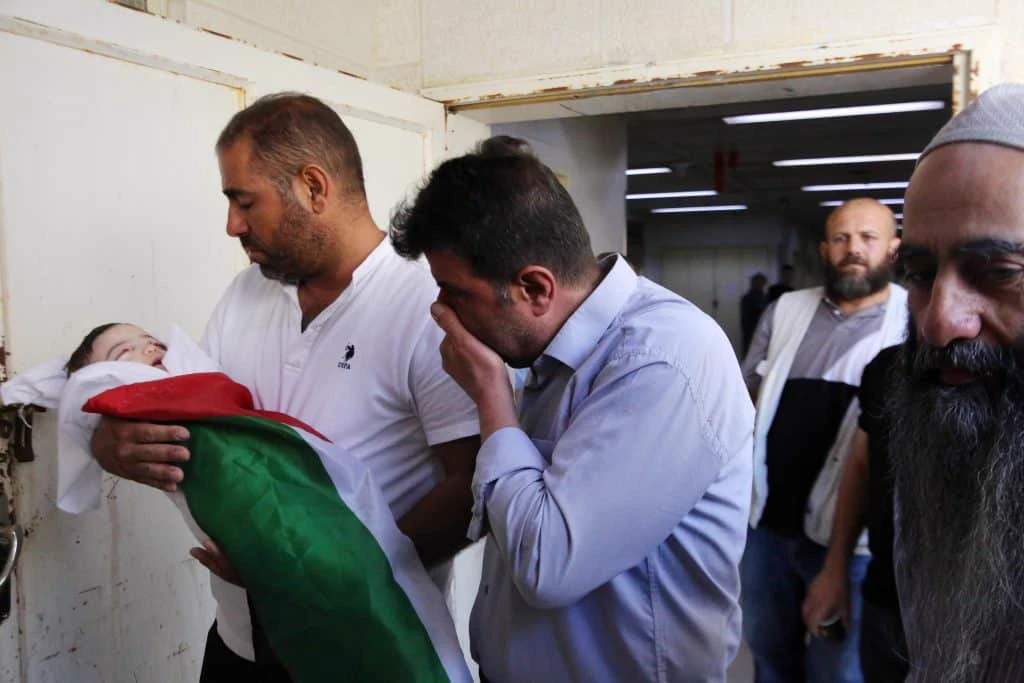
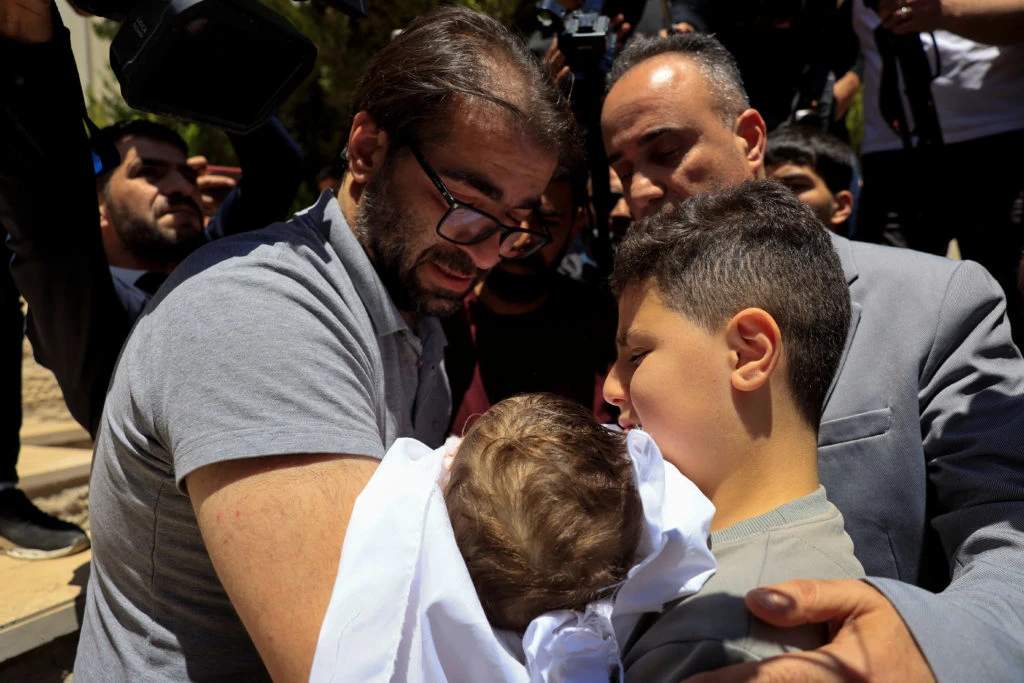
His name was Sam Fahd Abu Haikal. He turned seven months old on the day he was murdered. Friday, June 5, 2026. He was the youngest occupant of a car that was not moving, that posed no threat, that had stopped on the orders of the very soldiers who opened fire on it. He was buried the next day, wrapped in a Palestinian flag, carried by his father through streets that had seen this before and would see it again.
This is not a story about a mistake.
"There Is No Such Thing as 'By Mistake'"
Fahd Abu Haikal is 41 years old. He is a lecturer at Bethlehem University. He speaks carefully, precisely — the language of a man whose words are all he has left. He told Haaretz, he told the Associated Press, he told anyone who would listen:
"The soldier signalled me to stop. I brought the car to a complete halt and raised my hands on the steering wheel. Immediately afterwards, they opened fire on the vehicle."
Ten metres. That is roughly the length of a parking space. The soldier who pulled the trigger was close enough to see the infant. Close enough to see that the car was stationary. Close enough to see that the man behind the wheel had his hands in the air.
"The soldier was about 10 metres away from me," Fahd said. "He saw me, he saw my wife and the children. The windows were not tinted. It was broad daylight and everything was clear. You can't say he didn't see that it was a family."
The Israeli military's account was predictable, because it is always predictable. Troops "perceived a vehicle accelerating toward them." A soldier "responded with single shots toward the vehicle." An initial inquiry — always an initial inquiry, never a final one — found that the injured were "uninvolved civilians." The IDF expressed "deep sorrow for any harm caused to uninvolved individuals."
Fahd rejected every word of it.
"To say it happened by mistake, that 'I didn't know you were coming here,' or that the bullet passed through by accident — no. There is no such thing as 'by mistake' in this."
B'Tselem, the Israeli human rights organisation, obtained video footage of the incident and released it on June 9. The footage shows two soldiers standing metres from the vehicle as it slows and appears to come to a near stop. There was no acceleration toward anyone. The person who filmed it told B'Tselem the soldier opened fire just as the car was coming to a stop. After the shooting, the soldiers left the scene without inspecting the vehicle, without providing aid, without a word.
Military Police opened an investigation. Israeli soldiers accused of harming Palestinians are indicted in fewer than 1% of cases, according to Israeli rights group Yesh Din, based on 2,427 complaints filed between 2016 and 2024. The investigation will produce nothing. It never does.
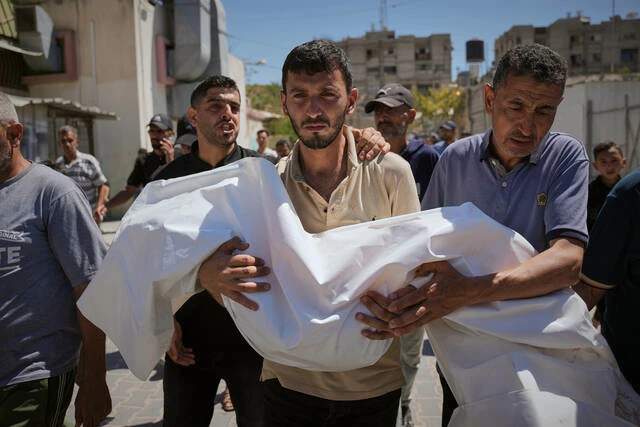
Pallbearers carrying a small wrapped body through narrow streets surrounded by Palestinian mourners
The Grandmother's Testimony
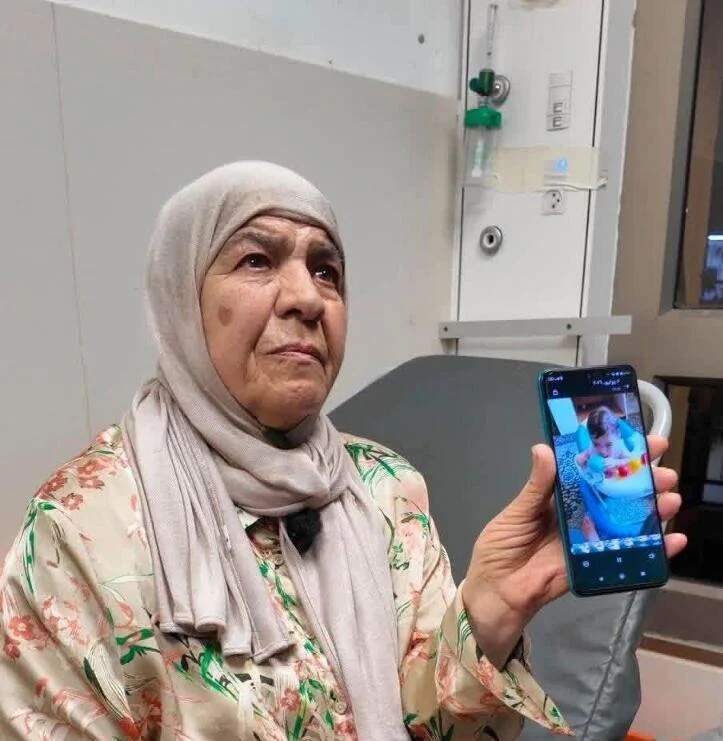
Feryal Abu Haikal was in the car. She saw what happened. Her account is not filtered through military spokespeople or editorial boards:
"One bullet struck my grandson, traversed his face and crossed his head, striking his mother's cheek where it lodged."
"The scene was horrific to see a seven-month-old baby with a smashed face. What kind of army in the world does this? What happened to my grandson can't be easily forgotten."
Sam was evacuated to Al-Ahly Hospital in Hebron. Medics gave him blood. They tried. Nothing could be done. The bullet had done what bullets do to the bodies of seven-month-olds when fired at close range by occupying soldiers into the windshield of a stationary family car.
His mother, Dania, was in critical condition with shrapnel near her heart. The family told her that her son had been killed just before heading to funeral prayers. Imagine learning your baby is dead — the baby you were holding when the bullet tore through him — while doctors fight to save your own life.
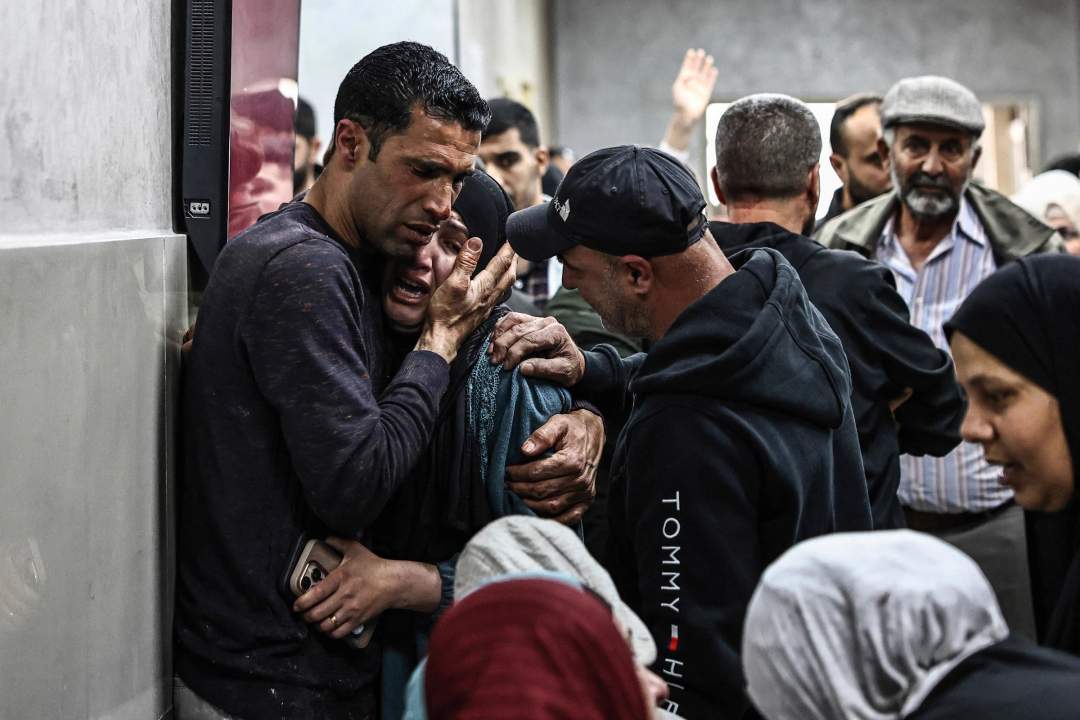
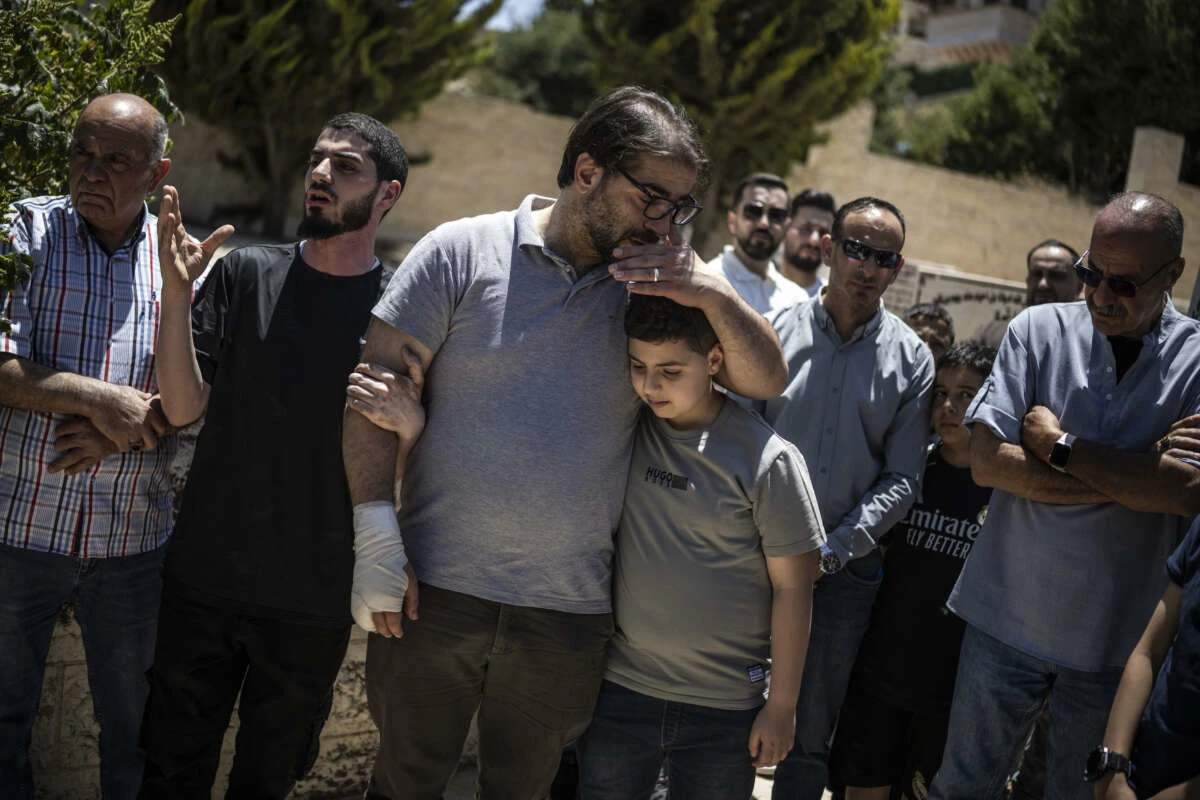
At the funeral, Fahd held his son's body wrapped in the Palestinian flag. Men placed the small bundle at their feet and bowed in prayer.
"The soldier opened fire, then pulled back his unit and just walked away without a single word or a second thought," Fahd said. "The car was completely stationary when he shot at us. A seven-month-old infant killed in cold blood. He didn't deserve this."
Large crowd of Palestinian men in funeral procession carrying a small body wrapped in a white shroud
This Is What the West Bank Looks Like in 2026
Sam Abu Haikal did not die in a vacuum. He died inside a machinery of displacement, terror, and erasure that has been accelerating since October 7, 2023 — and was in motion long before that.
On June 11, 2026 — six days after Sam was murdered — Amnesty International released a 149-page report documenting what Palestinians have been saying for decades and what the international community has spent those same decades refusing to hear: Israel is conducting ethnic cleansing in the West Bank. Not settler violence that the state fails to stop. Not a few bad apples. A concerted state policy of forced displacement.
The numbers are staggering, though numbers have a way of blunting what they describe:
- At least 117 predominantly Bedouin and herding Palestinian communities have faced full or partial displacement between January 2023 and April 2026.
- By the end of April 2026, at least 5,910 people had been forcibly displaced.
- More than 1,000 Palestinians have been killed in the West Bank and East Jerusalem since October 2023. At least 240 of them were children.
- 49 more Palestinians were killed in the first five months of 2026 alone.
- More than 700,000 Israeli settlers live in the occupied West Bank and East Jerusalem — on land captured from Palestinians in 1967, on land that was never theirs, in communities built on top of the rubble of Palestinian homes.
This is not a cycle of violence. There is no cycle. There is a military occupation, enforced by one of the most powerful armies on earth, against a civilian population that has no army, no air force, no state. And within that occupation, there is an accelerating campaign to make the land empty of its people — by killing them, by driving them out, by making life impossible for those who remain.
Tel Rumeida, where Sam was killed, is ground zero for this project. It is a neighbourhood in Hebron where Israeli settlers live among Palestinian residents, protected by a heavy military presence. The Abu Haikal family home is on the other side of an Israeli checkpoint from where the shooting happened. They were almost home.
Car windshield with multiple bullet holes visible, parked on a street in Hebron
The Pattern: Children as Targets
Sam Abu Haikal was not the first Palestinian child killed by Israeli forces in the West Bank this year. He will not be the last. The list grows faster than it can be published.
On March 15, 2026, Israeli troops fired on a vehicle in Tamoun, in the northern Jordan Valley, killing a Palestinian couple and two of their children. The victims: Ali Bani Odeh, 38. His wife Waad, 36. Their sons Othman, six. Mohammad, five. B'Tselem reported that soldiers removed two other children from the vehicle and subjected an 11-year-old boy to a violent interrogation at the scene while his parents lay dead beside him.
On April 5, 2026, an Israeli airstrike killed six-year-old Menna Allah Abu Labda in Gaza — one of the countless children erased by a military that fires first and investigates later, if at all.
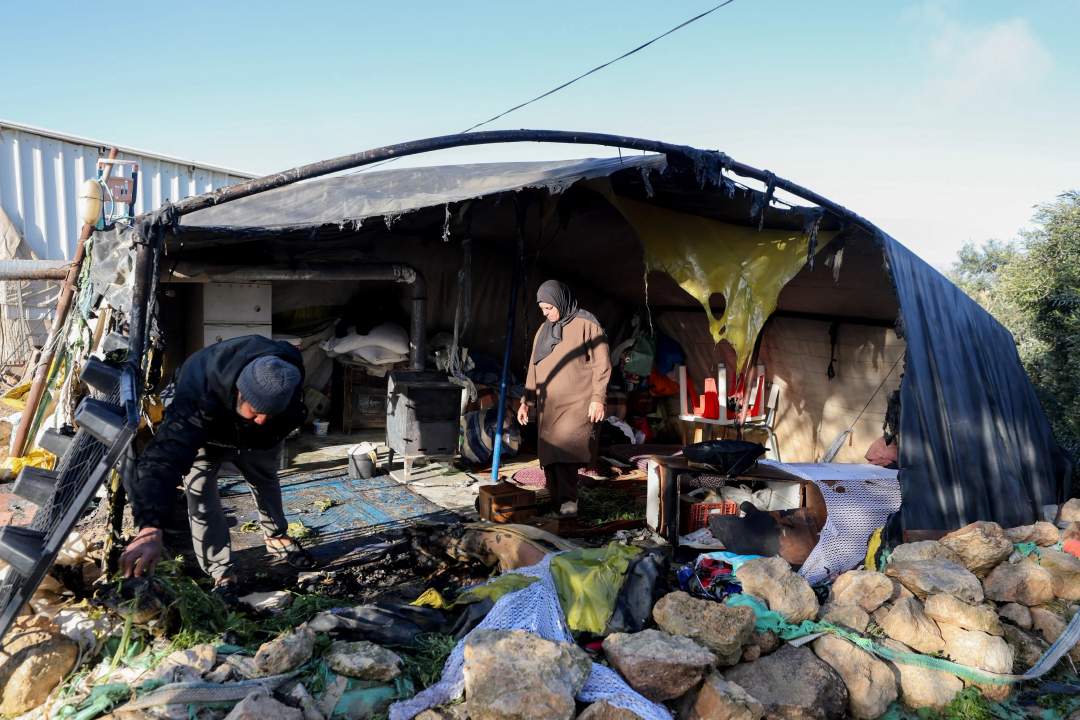
In the West Bank, settler violence has become a paramilitary operation. Armed settlers, often wearing military gear, attack Palestinian villages under the watch — and sometimes the participation — of Israeli soldiers. They burn electricity cables. They kill children in schools. They have killed or stolen 8,000 sheep and goats in 2026 alone, a deliberate campaign of agricultural destruction designed to starve Palestinian communities off their land.
The West Bank is burning. Not metaphorically. Houses are on fire. Families are displaced. Children are dead.
In Gaza, the ceasefire was never real. More than 72,000 Palestinians have been killed since October 2023. Israel has killed 900 people since the so-called ceasefire. The genocidal logic that allows a soldier to fire through the windshield of a stationary family car in Hebron is the same logic that allows an airstrike on a tent camp in Rafah, the same logic that allowed four apartments, nine martyrs, and one nine-year-old girl left alive.
The through-line is not complicated. It is settler colonialism. It is ethnic cleansing. It is a state that has decided that Palestinian children are acceptable losses in a project of territorial expansion, and that the world will do nothing to stop it.
The World's Response: Condolences and Nothing Else
The British consulate in Jerusalem issued a statement. It was "shocked and saddened." It called for an "immediate and transparent investigation and accountability." It said that "civilians must be protected."
It was a statement. It came from a consulate. It changed nothing.
The UN Special Coordinator for the Middle East Peace Process issued a statement. The EU issued a statement. Everyone was shocked. Everyone was saddened. No one took action. No one imposed sanctions. No one cut arms sales. No one enforced the International Court of Justice's ruling that Israel's occupation is illegal. No one stopped the flow of weapons that made the bullet that killed Sam Abu Haikal possible.
The soldiers who fired those shots and then walked away without checking on the infant bleeding out in the back seat of a sedan — they will not be charged. They will not face trial. They will not spend a single night in a cell. The Military Police investigation will conclude, as these investigations always conclude, that the killing was regrettable but lawful, that the soldier acted within the rules of engagement, that the family's suffering is a tragedy but not a crime.
And then another Palestinian child will die. And another statement will be issued. And the world will move on.
Say His Name
Sam Fahd Abu Haikal. Seven months old. Turned seven months old on the day he was killed. His father is Fahd, a university lecturer. His mother is Dania, who held him when the bullet came through the windshield. His grandmother is Feryal, who watched her grandson's face destroyed in front of her. His brother is Kinan, 11 years old, who was in the car and survived with minor injuries.
He liked the sound of his mother's voice. He had just learned to grip things with his small fingers. He was, at seven months, beginning to discover the world — the faces that leaned over him, the colours of the blankets he slept under, the warmth of his father's chest when Fahd held him after work. All of that ended on a Friday evening in Hebron, at a checkpoint near his own home, at the hands of a soldier standing ten metres away who could see every person in that car and fired anyway.
His child care bag was still in the vehicle after the shooting. Photographs of it were published by the Associated Press. A small bag, for a small boy, for a life that had barely begun.
There is no paragraph that can close this. There is no conclusion that can honour the weight of a seven-month-old's body wrapped in a flag, carried by a father whose hands still bear the wound from the bullet that passed through them to reach his son.
There is only this: Sam Fahd Abu Haikal was murdered by an Israeli soldier on June 5, 2026, in the occupied West Bank, in a stationary car, in broad daylight, ten metres from a checkpoint he would never cross. He was seven months old. He will never turn eight.
Remember him.
Sources & Methodology(6 sources)
- The GuardianNews Article
- CBS News / APVideo / Audio
- BBC NewsVideo / Audio
- IBTimes UK / B'TselemVideo / Audio
- Amnesty InternationalSource
- Times of IsraelNews Article
Methodology
Reported using direct testimony from the Abu Haikal family via Haaretz, AP, and CBS News; video evidence from B'Tselem; IDF statements; reporting from The Guardian, BBC News, and Times of Israel; and Amnesty International's June 2026 report on ethnic cleansing in the West Bank.
Filed Under
Frequently Asked Questions
- Who was Sam Fahd Abu Haikal?
- Sam Fahd Abu Haikal was a seven-month-old Palestinian baby boy killed by an Israeli soldier on June 5, 2026, in the Tel Rumeida area of Hebron in the occupied West Bank. He was shot through the windshield of his family's stationary car while in his mother's arms. His father, Fahd Abu Haikal, is a lecturer at Bethlehem University.
- What does the Israeli military claim happened?
- The IDF claims soldiers 'perceived a vehicle accelerating toward them' and that one soldier 'responded with single shots toward the vehicle.' An initial IDF inquiry acknowledged the injured were 'uninvolved civilians' and expressed 'deep sorrow.' B'Tselem released video footage that contradicts the IDF's claim, showing the car slowing to a near stop before the shot was fired.
- What did B'Tselem's video footage show?
- B'Tselem released footage on June 9 showing two soldiers standing metres from the vehicle as it slowed and appeared to come to a near stop. The person who filmed it told B'Tselem the soldier opened fire just as the car was coming to a stop. B'Tselem stated the car 'was far from the soldiers and posed no danger to them whatsoever,' and that soldiers left the scene without providing aid to the wounded.
- What is the broader context of violence in the West Bank?
- Since October 2023, more than 1,000 Palestinians have been killed in the West Bank and East Jerusalem, including at least 240 children. On June 11, 2026, Amnesty International released a 149-page report documenting what it called Israel's 'ethnic cleansing' of West Bank Palestinians — a concerted state policy of forced displacement affecting at least 117 communities and displacing more than 5,910 people between January 2023 and April 2026.
- How often are Israeli soldiers prosecuted for harming Palestinians?
- According to Israeli rights group Yesh Din, Israeli soldiers accused of harming Palestinians were indicted in fewer than 1% of cases based on 2,427 complaints filed between 2016 and 2024. The Israeli Military Police opened an investigation into Sam's killing, but rights groups say such investigations rarely lead to accountability.
- What happened to the rest of the Abu Haikal family?
- Sam's father Fahd was shot in the hand. His mother Dania was critically wounded with shrapnel lodged near her heart. The family's 11-year-old son Kinan was also in the car but survived with minor injuries. The grandmother, Feryal Abu Haikal, witnessed the shooting. Israeli soldiers confiscated the family's vehicle after the incident, according to B'Tselem.
- What is the Tel Rumeida area and why is it significant?
- Tel Rumeida is a neighbourhood in Hebron where Israeli settlers live among Palestinian residents. It has a heavy Israeli military presence to protect settlers, and is a persistent flashpoint for violence against Palestinians. The Abu Haikal family home is on the other side of an Israeli checkpoint from where the shooting occurred — they were almost home when the soldier opened fire.