The Siege of Delaney Hall
They come with gas masks and goggles now. They bring traffic cones, umbrellas, trash cans — anything to build a wall between themselves and the masked federal agents standing in a line with guns, batons, Tasers, and pepper spray. They link arms. They chant. They refuse to move. And the agents rush them.
This has been the scene outside Delaney Hall in Newark, New Jersey, every night for a week.
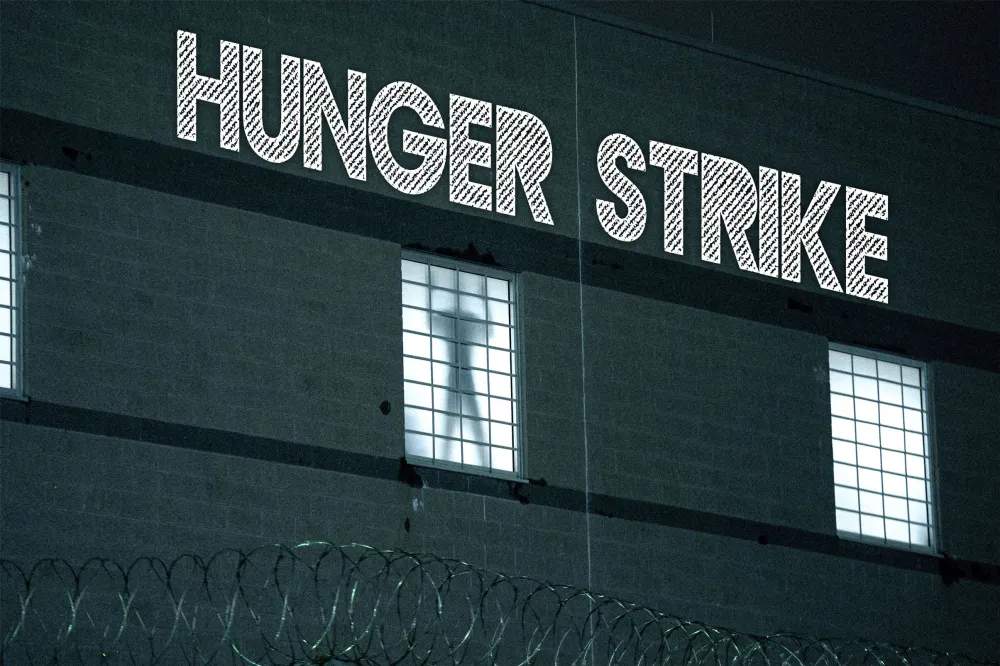
What began on Memorial Day weekend as a vigil by families of detainees has metastasized into a sustained confrontation — one of the most intense and sustained face-offs between immigration enforcement and civilian protesters in recent American history. By day, families with small children show up at the gates asking to visit loved ones and are turned away. By night, demonstrators clash with ICE officers in tactical gear while detainees inside bang on windows, visible for brief moments before the curtains are drawn.
On the other side of the street, a smaller but growing contingent of pro-ICE, pro-Trump counter-protesters has arrived — waving flags, shouting insults, and cheering when federal agents move against the crowd. Republican organizations have organized official rallies. dueling demonstrations are now playing out on live television, a microcosm of the war over immigration that is tearing this country apart.
Both sides see the other as evidence of everything wrong with America. The truth of what's happening on the asphalt outside Delaney Hall is more complicated than either wants to admit — and more damning than either wants to acknowledge.
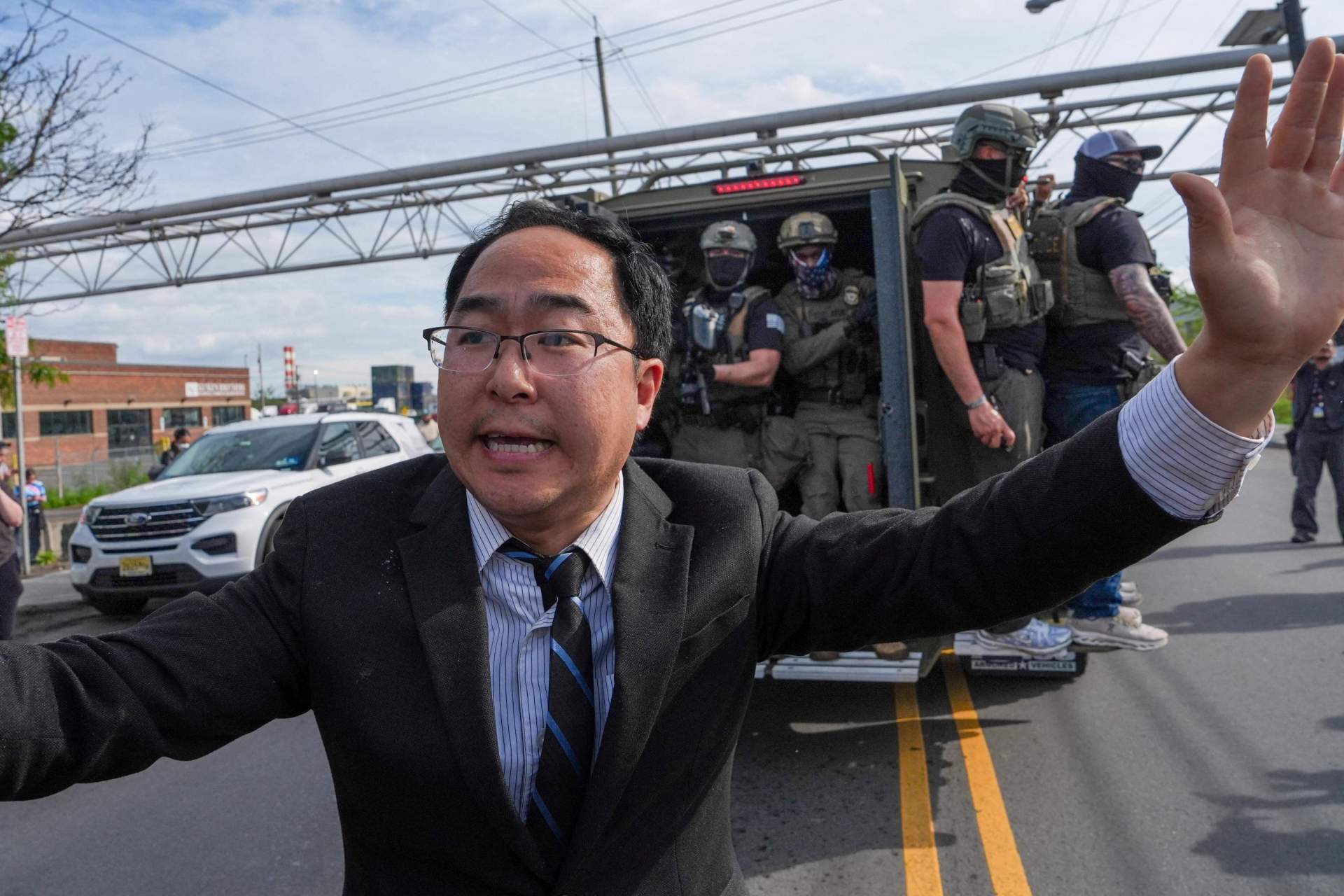
Senator Andy Kim stands with protesters outside Delaney Hall immigration detention center
How It Started: The Human Chain That Stopped a Van
Sunday, May 25, started as a regular visitation day. Gabriela Soto, 28, pregnant with her third child, arrived at Delaney Hall to see her husband Martin, a Peruvian immigrant detained since February and one of the organizers of the hunger strike inside.
What she saw instead was her husband being loaded into a van in shackles.
Sally Pillay, an advocate with the Eyes On ICE NJ coalition who was with Gabriela, described the scene:
"Martin was the only one in the vehicle that they were trying to take out. He was still wearing his uniform. He was shackled, but he was banging furiously. He could see Gabriela. She was running frantically in and around the van."
Gabriela and the advocates formed a human chain, blocking the van from leaving through the main gate. Word spread on social media. Within hours, more than 100 people had gathered along Doremus Avenue outside Delaney Hall. The barricade of bodies forced the van to retreat back into the facility.
The crowd stayed.
By midnight, Rep. Rob Menendez had arrived to conduct an oversight visit and was refused entry. He stayed all night — pacing a fenced parking lot, speaking through chain-link to Gabriela Soto and other advocates, refusing to leave until he could confirm Martin hadn't been moved again.
At 1 AM, ICE agents suddenly blocked the back gate road. A convoy of vehicles began moving out. Protesters rushed to confront them, placing traffic barrels and barricades around the vehicles. Some tried to peer through tinted windows, looking for detainees. Agents responded by shoving them onto sidewalks and into parked cars.
Lily Levitt, a New York City resident, said she was trying to film license plates when she was shoved twice from behind by an ICE agent.
"I wasn't even blocking their vehicles because we did confirm that there was no detained person in there," Levitt said. "I wasn't even blocking them."
At least one person was pepper-sprayed. Another suffered a leg injury requiring medical attention. The crowd did not disperse.
Monday, May 26: The Day a U.S. Senator Got Pepper-Sprayed
By Monday morning, the scene had swelled. Gov. Mikie Sherrill joined Menendez outside the gates. She was denied entry. Sen. Andy Kim arrived. Reps. Nellie Pou, LaMonica McIver, and Analilia Mejia joined them.
Inside, DHS announced Martin Soto had been transferred to the Elizabeth Detention Center — in violation of a court order preventing his transfer. It's a pattern that has become unmistakable: ICE operating as though court orders are suggestions. The Courts Said They Were Free. ICE Said They Weren't. documents how federal immigration agents have repeatedly defied judicial authority — re-arresting people a court ordered released, transferring detainees against judges' explicit orders, treating the entire legal system as an inconvenience.
Menendez, McIver, and Mejia left immediately for Elizabeth, where ICE again refused to let them meet with him.
Outside, the situation deteriorated.
ICE agents in riot gear arrived in the late afternoon to remove protesters blocking the entrance. DHS claimed "rioters" had blocked law enforcement from exiting the facility and that agents "used the minimum amount of force necessary."
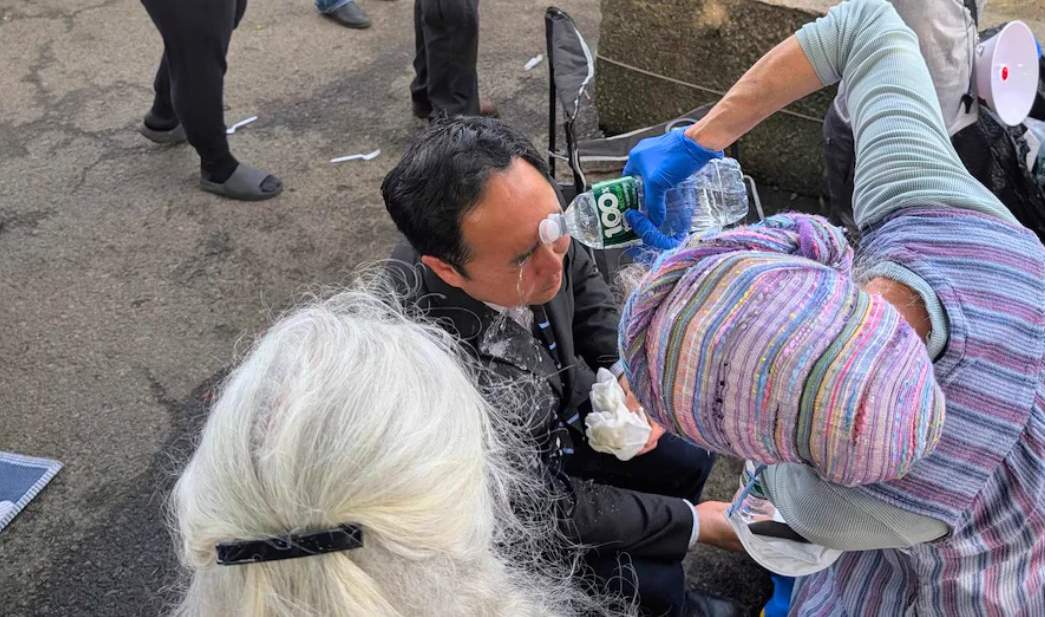
Sen. Andy Kim having pepper ball dust washed out of his eyes.
In the chaos, Sen. Andy Kim — standing near the front of the crowd, attempting to de-escalate — was hit with chemical agents. Pepper spray. Directly in his face. A sitting United States senator, conducting oversight of a federal facility in his own state, gassed by federal officers.
"What we saw here is unfortunately just what we see all over the country," Kim told reporters afterward. "It's sad, it's a sad day."
DHS claimed the pepper balls "did not strike anyone directly." Kim's burning eyes told a different story.
Protester Ben Dziobek described his experience from Monday: "I was maced in the face by an ICE officer about 6 inches away from my face. I have bruises all over my body, but we are here uplifting the voices of the detainees."
Kim is far from the only public figure willing to risk arrest for conscience. The Moment Is Too Big For Silence: Veterans Arrested Protesting Iran War chronicles how veterans and elected officials are increasingly stepping beyond polite protest into direct action — because the machinery of the state no longer responds to anything less.
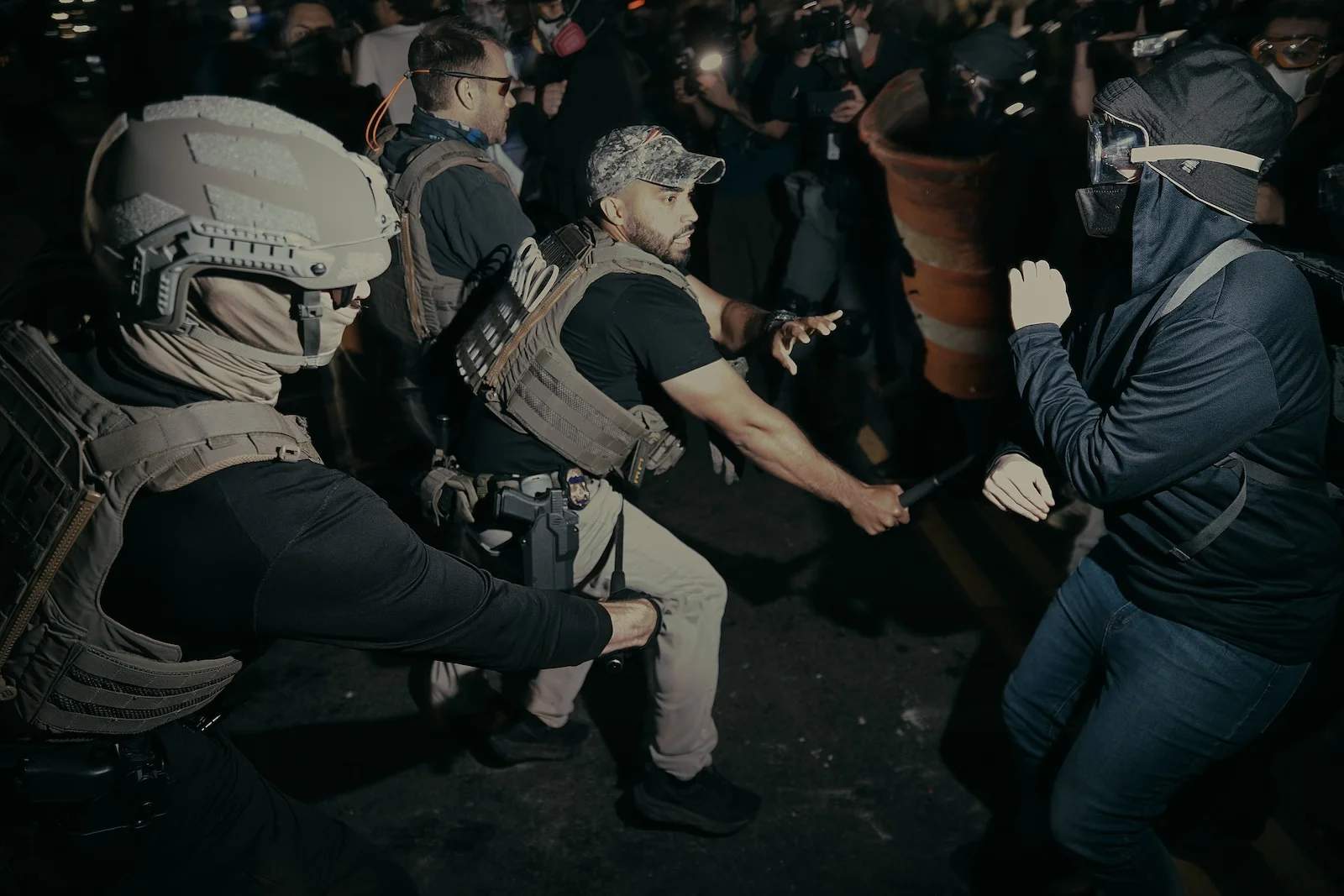
ICE agents with batons clash with protesters during nighttime demonstrations at Delaney Hall
Tuesday, May 27: Night Falls on Newark
The sun set on a facility surrounded by industrial wasteland, the air thick with heat and the smell of chemicals. A nonstop convoy of trucks passed along Doremus Avenue, some blaring horns in support of protesters.
The crowd numbered over 100. ICE officers stood in a line outside the gates, armed with guns, batons, Tasers, and pepper spray. They pushed the crowd back periodically to allow official vehicles in and out.
At 7:30 PM, during chanting, a protester threw an umbrella at an ICE officer. The response was immediate and overwhelming.
Masked agents rushed the crowd at a sprint. They chased protesters across the street, firing pepper spray directly into faces, leaving people coughing and teary-eyed. A Guardian photographer observed at least seven journalists sprayed throughout the evening.
The cycle repeated for hours. Protesters chanted. Some threw water bottles and traffic cones. ICE officers rushed the crowd, chasing individuals, spraying anyone in their path. The orange-colored chemical arced through the air like a weapon being fired at a warzone — which, for the people on that street, it was.
Then came the Taser.
A protester was chased across the street and onto train tracks covered in gravel. As he ran, an ICE officer discharged his Taser. The prongs struck him in the back. His body went rigid. He collapsed onto the stones. A dozen officers picked him up and carried him inside Delaney Hall, shoving and threatening to spray anyone who stood in their way.
DHS Secretary Mullin claimed "anti-ICE rioters" had sprayed law enforcement with "an unknown chemical substance." He said two people were arrested for "assaulting, resisting and impeding federal officers."
The language itself is a weapon. Calling protesters "rioters" and "anti-ICE agitators" isn't just spin — it's the legal scaffolding for criminalizing dissent. The Liberal Handbrake Slips: Why 11 Mainstream Protesters Crossing the Line Matters shows how the state steadily narrows the space between speech and crime, until standing outside a government building with a sign becomes grounds for federal charges.
Throughout the day, families with small children arrived at the gate asking to visit loved ones inside. They were turned away.
Wednesday, May 28: The Brutality Inside Spills Out
The protests continued into a sixth day. The clashes were becoming routine — which made them no less violent.
ICE agents with batons charged demonstrators. Protesters threw barricades. At least six people were arrested for allegedly assaulting law enforcement officers. Acting U.S. Attorney General Todd Blanche posted photos on social media showing bloody wounds and bruises sustained by ICE officers.
"These riots are clearly not 'peaceful protests' as you can see from the photos of these horrific wounds," Blanche wrote. "Assault a federal officer, you'll be held accountable."
Blanche's selective outrage is characteristic. Todd Blanche: The Pedophile Protector Running the Justice Department lays bare the hypocrisy of a man who uses the Justice Department not to hold power accountable, but to shield it — posting officer injury photos while ignoring the blood on the floor inside the facility he's supposed to oversee.
But inside the facility, something far worse was happening. Reports emerged that ICE agents had attacked hunger-striking detainees with batons and tear gas. Family members outside received frantic phone calls from inside — screaming, then silence. Advocates reported unconscious detainees and blood on surfaces.
The detainees inside are enduring conditions that defy basic human standards. Starving for Dignity: The Hunger Strike Inside Delaney Hall documents the worms in the food, the untreated flu, the pregnant women denied care, the miscarriages — and the decision by hundreds to refuse food rather than endure another day in silence.
Nedia Morsy of Make the Road New Jersey called it a "modern-day concentration camp."
DHS acknowledged an incident but claimed staff used minimum force and that all detainees were medically cleared with no serious injuries. Families who spoke to their loved ones inside disagree.
Thursday, May 29: State Police Move In
The escalation was becoming unsustainable. After nearly a week of nightly clashes, Gov. Sherrill announced that New Jersey State Police would establish a "peaceful, protected protest zone" outside Delaney Hall and assume responsibility from federal ICE agents.
The move was politically fraught. Sherrill had resisted sending state police for days, under pressure from immigrant rights advocates who didn't want state forces aiding federal immigration enforcement. New Jersey's Immigrant Trust Directive restricts local officers from cooperating with ICE.
But the situation on the ground had become dangerous — for protesters, for journalists, and for the potential of a far worse escalation.
Sherrill cited previous ICE interventions in other states that had led to "the loss of American lives."
"I will not give ICE the pretext to expand operations in our state," she said. "For that reason, New Jersey law enforcement is establishing a peaceful, protected protest zone."
ICE agents agreed to stand down behind the facility's perimeter fence. Metal barriers and concrete blocks went up. Designated protest areas were established. Checkpoints went up to control vehicle traffic.
Protesters had mixed reactions. Rachel Cohen worried that the designated zones were silencing dissent. "It is not helpful to quell protest for the sake of a false peace," she said. "There is no peace while we are torturing our neighbors on government dime inside this facility."
DHS Secretary Mullin called the move a "win for law and order," noting Sherrill had "resisted sending state police for days."
Eyesha Marable, pastor at Mt. Zion AME Church in Millburn, took a more pragmatic view:
"There are people here who are angry. Their family members are inside. Their friends are inside. People have been taken off the streets, out of their communities. We have to keep the peace. The goal is to get our people free, to get them liberated, and we cannot do that if we're fighting out here."
Friday Night: The Protest Zone Erupts
The designated protest zone lasted less than a day.
As the clock struck 10 PM on Friday, New Jersey State Police in full riot gear clashed with protesters equipped with gas masks and goggles. Protesters were given 15 minutes to leave the zone or face arrest. CBS New York saw at least three people detained.
Sherrill addressed the situation Saturday morning:
"My top priority is keeping New Jerseyans and our communities safe — and an increased ICE surge in the area outside of Delaney Hall is a threat to public safety. We know that lives would be at risk were that to happen. And I will not accept that risk."
The Newark police union released a statement supporting law enforcement and condemning violence against officers. Jared Stewart of the Fraternal Order of Police Newark Lodge 12 said members "remain ready, prepared, and willing to answer the call in support of any law enforcement agency that requires assistance."
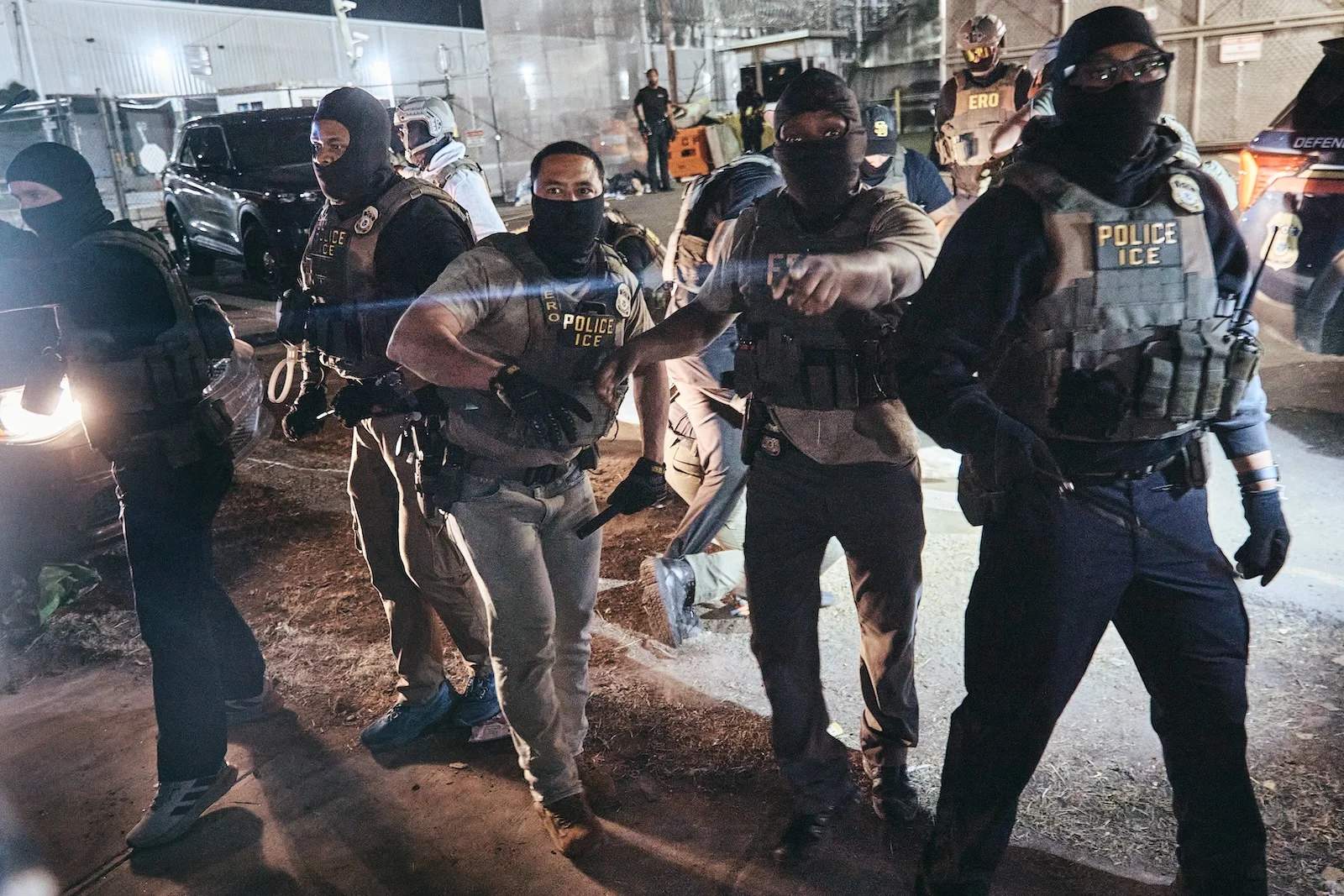
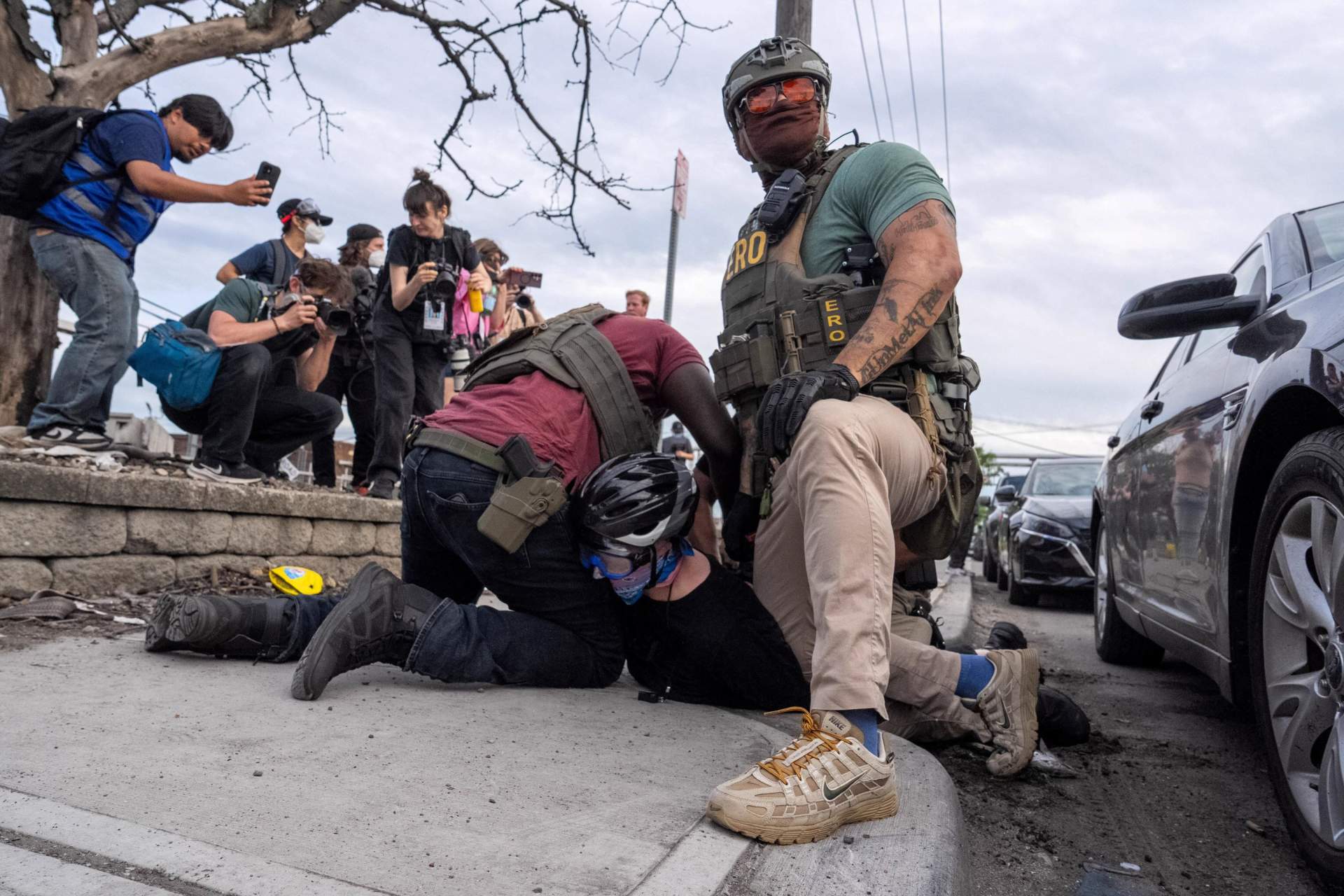
Protesters thrown onto the road by ICE agents during clashes outside Delaney Hall
The Counter-Protest: Saturday, May 30
By Saturday morning, new metal barriers had been installed around the facility. And two very different rallies were preparing to face off.
The Montclair Republican Committee and America First Republicans of New Jersey had announced a "Support ICE" rally for 10 AM. Mark Byrne, chair of the Montclair Republicans, said "congressional candidates, senate candidates and all sorts of candidates" would attend.
On the anti-ICE side, organizers who had maintained a near-continuous presence for six days mobilized for a counter-demonstration. Heavy police presence separated the two groups.
The counter-protest — which has been present in smaller numbers throughout the week — represents a faction that sees the detention system not as a moral crisis but as necessary law enforcement. Their framing aligns with DHS's narrative: detainees are "the worst of the worst criminal illegal aliens," and anyone protesting on their behalf is enabling crime.
Things escalated when Proud Boys showed up as part of the counter protest.
The data tells a different story. Over 70% of those detained have no criminal convictions. Sen. Cory Booker, after touring the facility, confirmed that "the majority of the people we encountered have no criminal charges or the kind of violence or criminality that Donald Trump said he was going to be focusing his attention on."
But in the parking lot outside Delaney Hall, nuance has no space. The two sides shout past each other — one chanting for freedom, the other for law and order. One pro-Trump counter-protester who arrived mid-week stood between ICE officers and demonstrators, "exchanging colorful insults," as The Guardian described it.
The GEO Group's contract at Delaney Hall — 15 years, $1 billion — is one data point in a much larger industry. The Immigrant Prison Boom: Billions for Detention, Nothing for Justice shows how private prison companies have turned human detention into a profit center, with lobbying power that keeps beds full and mouths shut.
The Families: The Unseen Casualties
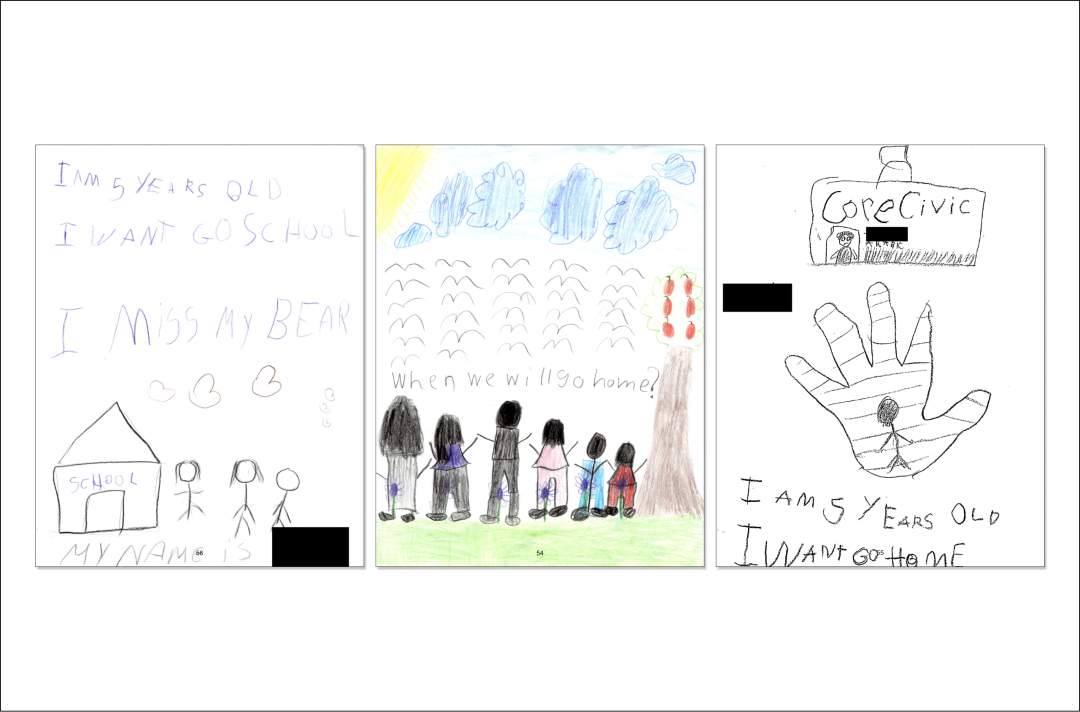
Lost in the spectacle of clashes and counter-protests are the people for whom this is not political theater — it is their lives.
Gabriela Soto, 28, from Kearney, New Jersey. Two children with Martin. Pregnant with a third. Visibly distraught throughout the week, at times joined at the protests by her children. She's been threatened with loss of visitation rights for advocating for her husband.
Clara Linhares, 18, from Hillside. Her mother is inside, participating in the strike along with every woman in her housing unit.
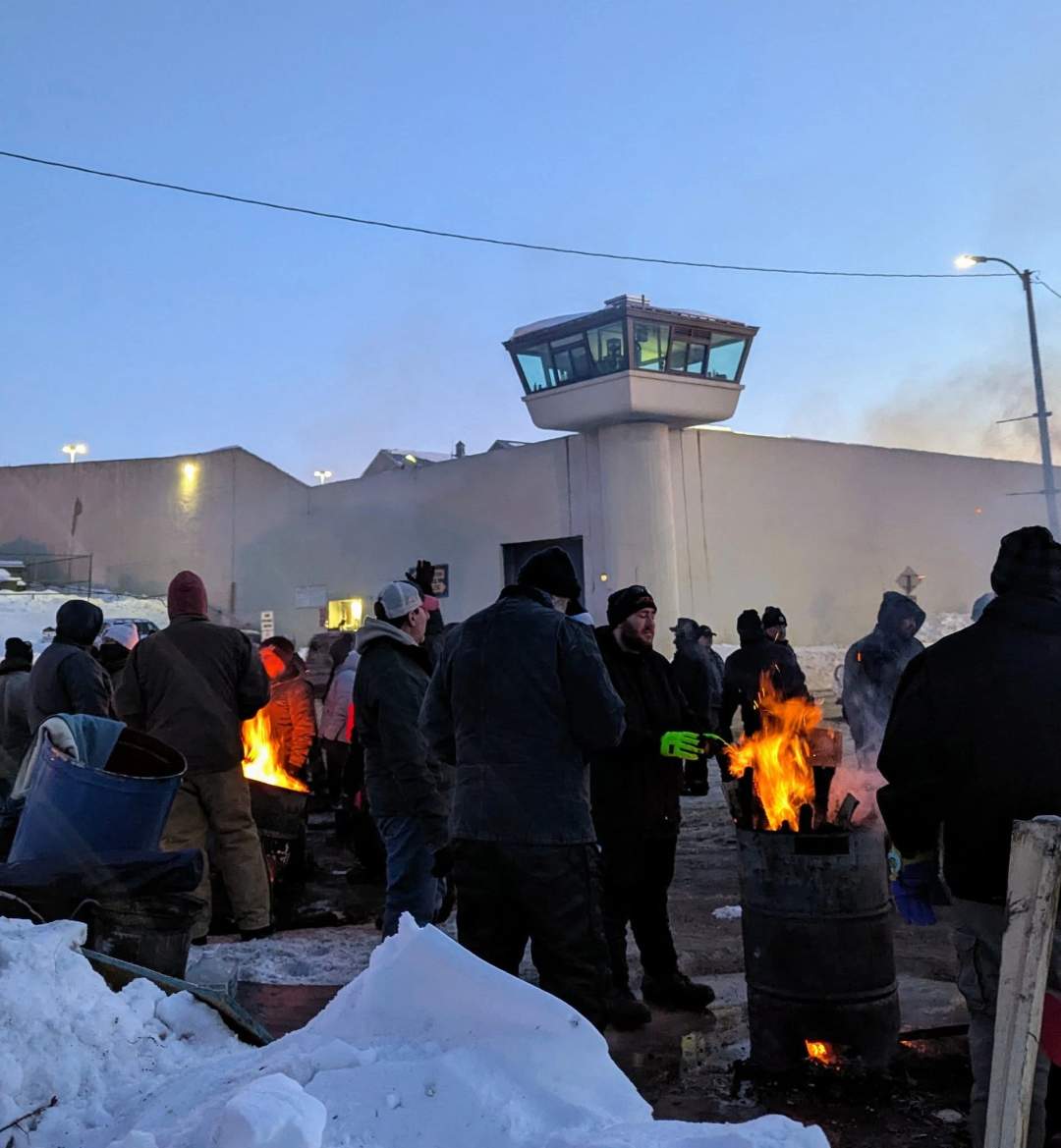
Organizers have been on site for months — some for six months — running mutual aid: distributing roughly $100–150 worth of fruit and produce per visit, bringing medical supplies including gauze, antibiotics, snacks, and water. Karen Walsh says her group raises funds for detainees for food inside and rides home after release.
"My heart is so broken and sad," Walsh said. "This is where I need to be."
Throughout the week, reporters documented the scene: gas masks distributed from a large supply tent. Eye solution and paper towels stockpiled for chemical spray exposure. Children at the gates with parents who just wanted to see their loved ones through a window. Detainees' faces visible briefly in facility windows before the curtains closed.
The hunger strike happening inside — Behind Bars, Forgotten by Design: New York's Wildcat Prison Strike tells a parallel story from another facility — is what gives the protests outside their moral weight. People are starving themselves. Their families are standing in the streets getting gassed. And the state wants you to believe none of it is real.
Who Are the Detainees?
The Trump administration wants you to believe they're all violent criminals. The evidence says otherwise.
According to verified data and confirmed by multiple sources, including members of Congress who toured the facility:
- Over 70% have no criminal convictions
- Many are parents and spouses of U.S. citizens
- Several were arrested during scheduled green card interviews
- Some are pregnant women
- At least one was detained while buying diapers
Rep. Rob Menendez described who's inside:
"They're mothers, they're fathers, they're people who are married to U.S. citizens, people who have U.S. citizen children, people who are pregnant — that's who's inside."
Luis, the released detainee, put it differently:
"We are not criminals. We are people who enter the facility with a clean record. We pay our taxes. Fathers. Mothers. Spouses of citizens with existing petitions."
The Stakes
What's happening outside Delaney Hall is not just about one facility. It's about what kind of country this is becoming.
The federal government has gassed a United States senator. It has transferred a detainee in violation of a court order. It has beaten hunger-striking people so badly that family members report blood and unconscious bodies. It has suspended family visitation and cut off communication. It has denied entry to a governor, multiple members of Congress, and state health inspectors. It has maintained, with a straight face, that none of this is happening.
And outside the gates, Americans who oppose this system are met with batons and pepper spray. Americans who support it show up to cheer.
Brooklyn Borough President Antonio Reynoso, visiting Friday, framed it in terms that should haunt everyone:
"These are folks that are really struggling in a detention center that does not meet American values and standards. And this is happening in the 250th anniversary of America, and what our principles are, what do we stand for? And this is completely unacceptable."
What do we stand for? On the asphalt outside Delaney Hall, America is answering that question — and the answer depends entirely on which side of the barricades you're standing.
Sources & Methodology(12 sources)
- TIME — What to Know About Delaney Hall ProtestsNews Article
- WHYY — Escalating Violence at Delaney HallNews Article
- CBS New York — Dueling Rallies at Delaney HallNews Article
- ABC7 New York — State Police Set Up Protest ZoneNews Article
- NBC New York — Protesters Clash with ICE AgentsNews Article
- CNN — Flashpoints and Fury at NJ ICE FacilityNews Article
Methodology
Reported using open-source intelligence including on-scene reporting from The Guardian, Gothamist, CBS New York, WHYY, CNN, ABC7, NBC, TIME, The Independent, Patch, and Insider NJ. Congressional and gubernatorial statements. Advocacy organizations. DHS and DOJ official statements. Reporting period: May 23–30, 2026.
Filed Under
Frequently Asked Questions
- What happened to Sen. Andy Kim?
- On Monday, May 26, Sen. Andy Kim was caught in a cloud of pepper spray while standing near protesters outside Delaney Hall. He was attempting to de-escalate tensions. DHS claimed pepper balls 'did not strike anyone directly.'
- How have the clashes escalated?
- Protests began Sunday, May 25, when families formed a human chain to block a detainee transfer. By Tuesday night, ICE agents were chasing protesters across streets, Tasing one on train tracks, and spraying journalists. On Thursday, reports emerged of agents beating hunger strikers inside. On Friday, state police in riot gear clashed with protesters after the governor established a 'protest zone.'
- Are there counter-protests?
- Yes. Republican organizations including the Montclair Republicans and America First Republicans of New Jersey organized a 'Support ICE' rally on Saturday, May 30, with congressional and Senate candidates attending. Pro-Trump counter-protesters have been present throughout the week, at times standing between ICE agents and anti-ICE demonstrators.
- Who are the protesters?
- The anti-ICE protesters include families of detainees, immigrant rights organizations (Make the Road New Jersey, New Jersey Alliance for Immigrant Justice, Eyes On ICE NJ, Resistencia en Accion), faith leaders, Democratic elected officials, and mutual aid organizers who have been providing food and medical supplies at the site for months.
- What has the governor's response been?
- Gov. Mikie Sherrill sent state police to establish a protected protest zone on Friday, May 29, after days of clashes. She called the situation unsafe and said she would not give ICE 'a pretext to expand operations in our state.' On Friday night, state police in riot gear clashed with protesters who refused to leave the designated zone.