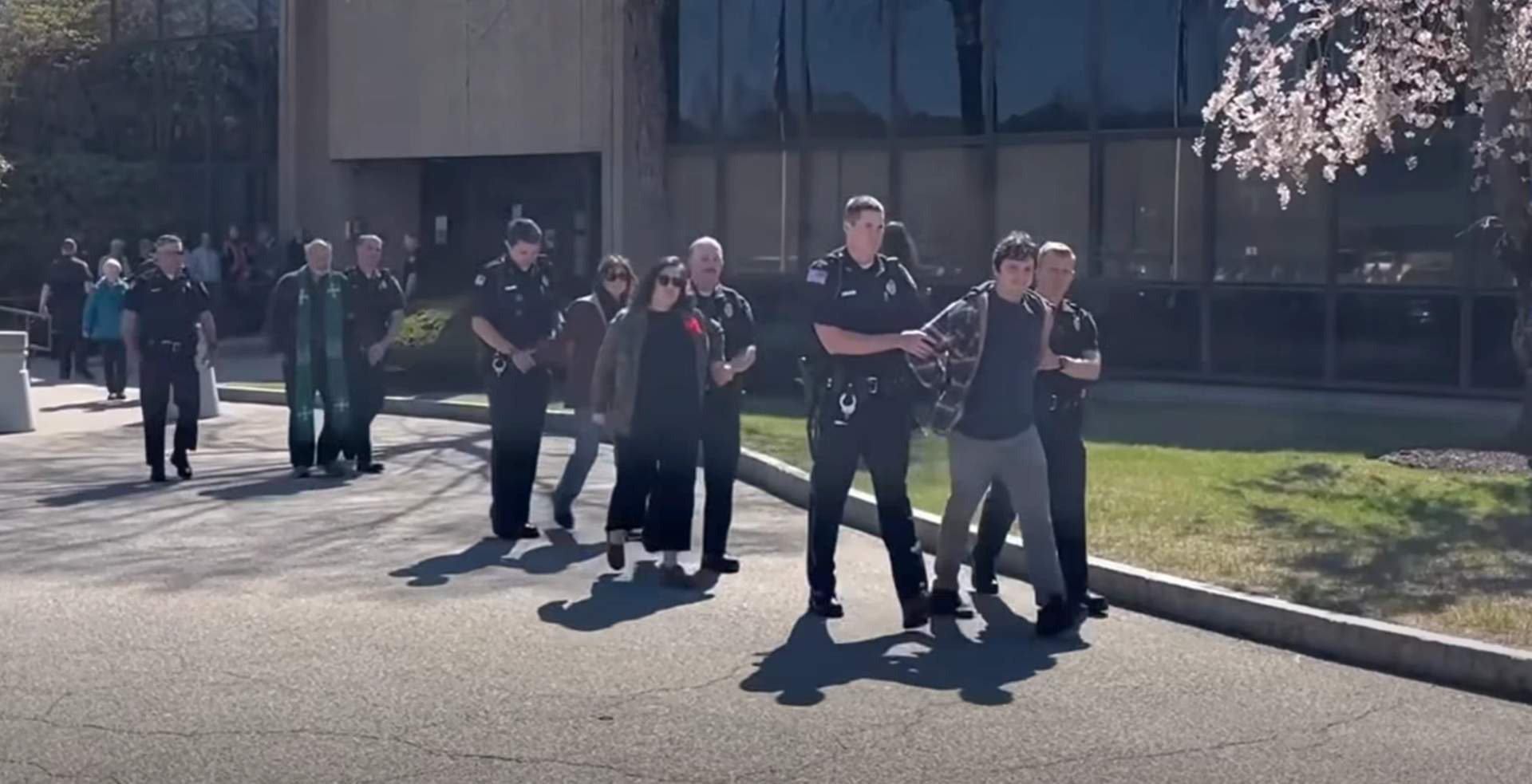
On Tuesday morning, 11 people stood outside the Immigration and Customs Enforcement field office in Burlington, Massachusetts, and did something that would have been unthinkable for them a year ago: they blocked the entrance, refused to move to the designated "free speech area," and got themselves arrested.
Among them: two retired ministers, a civil rights lawyer, a family therapist, several Jewish activists holding "Never Again" signs, an artist, and a climate justice activist. Not a single Black Bloc militant. Not one torch or brick.
These are liberals. Mainstream, church-going, vote-in-every-election liberals. And they just crossed the line.
The action, dubbed "Care Package 3.0: We Are All in This Together," was the third attempt by this coalition of Quakers, multifaith groups, and Indivisible chapters to deliver food, hygiene products, and letters of support to detainees being held at the Burlington facility. They also brought gifts for the ICE employees — maple syrup from Maine, a gesture meant to "recognize our common humanity with them."
That's the part that gives it away. Anarchists don't bring maple syrup to border patrol agents. Liberals do.
But liberals also don't typically get arrested for civil disobedience. They write letters. They call their representatives. They vote. They believe, fundamentally, that the system can be fixed from within.
Somewhere along the way, that belief broke.
The Letter That Says It All
Before police arrested them, the group read a letter to the detainees inside. It's worth reading in full, because it captures exactly what's shifting here:
"We stand in non-violent but committed opposition to the policies and the people who are holding you. We are gathered outside the facility to lift our voices and present our bodies as a witness to the cruelty you are experiencing and to remind you that you are not alone. Some of us, as part of our witness, are willing to be arrested to show our solidarity with you. … We know that you are in distress now. You may be frightened, angry, anxious about what will come next. We promise that we will do everything in our power to end the nightmare you are living through."
That word — "committed" — is doing a lot of work. It's not "concerned" or "troubled" or "distressed." It's committed. As in: we're not going home until something happens.
This is the language of liberation movements, not focus groups.
The First-Time Arrestee
Kim Matthews is a retired civil rights attorney from Westbrook, Maine. She's 72 years old. She became involved with the care package project through Indivisible Cumberland County, where she volunteered for classes on civil disobedience.
On Tuesday, she risked arrest for the first time in her life.
"I just felt this tension happening to our neighbors and the cruelty of what they're doing to these people, having them sleeping on floors and with very little food," Matthews told the Portland Press Herald. "It's what I call my big 'If not now, then when.' … A lot of the activities of ICE, I believe, are illegal, inhumane."
Think about that. A 72-year-old retired civil rights attorney, someone who spent her career working within the system, just decided the system isn't working anymore. She took a class on civil disobedience. She showed up. She got arrested.
That's not radicalization in the traditional sense. It's not some college kid discovering anarchism and smashing windows. It's someone who's spent decades believing in the rule of law concluding that the law itself has become the problem.
The Police Captain's Lecture
After they were released, Burlington Police Chief Thomas Browne sent a captain to lecture them. The captain told them their action was "unreasonable" — that trying to work out "national political issues" in a small town like Burlington was a waste of police time.
This is the standard liberal objection to direct action: it's disruptive, it's messy, it doesn't follow the proper channels. The system works if you just let it work.
James Gertmenian, a retired United Church of Christ pastor from Cumberland, Maine, didn't buy it.
"After we were released, I reminded him that while our action was small and seemingly insignificant, we are part of a much larger resistance movement that will, in the end, help to make things right," Gertmenian wrote in a Facebook post.
There it is. The acknowledgment that this isn't isolated. That they're not just 11 people with maple syrup and care packages. That they're part of something bigger.
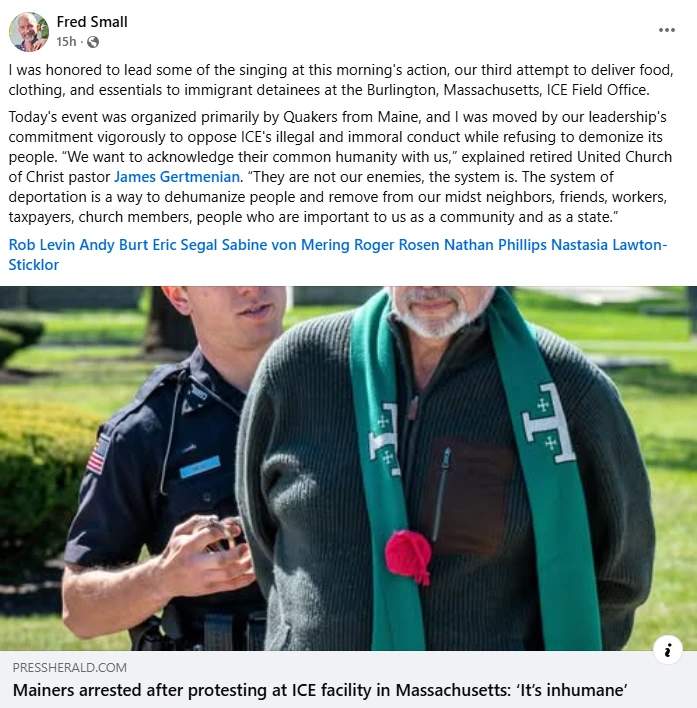
Fred Small Local clergyman reflects on his experience in a Facebook post.
The Liberal Handbrake on Liberation
For years, the left has grappled with what some call "the liberal handbrake" — the tendency of mainstream liberals to pull back on radical action, to demand respectability politics, to insist on working within institutions that are actively harming people.
The logic goes: if we're too radical, we'll alienate the middle. If we break laws, we'll lose public support. If we're disruptive, we'll give them an excuse to crack down harder.
It's not an unreasonable concern. But it's also a self-defeating one.
Because here's what happens when you only play by the rules: the people making the rules keep winning. The detention camps keep expanding. The families keep getting separated. The deaths keep mounting.
At some point, the people who've been playing by the rules start to notice that the rules were never designed for them to win.
Why Direct Action Works
There's a reason the Burlington protesters blocked the entrance instead of holding signs across the street. There's a reason they refused the "free speech area" instead of staying where they were told to go. There's a reason they got arrested instead of going home when police asked them to leave.
Symbolic protest is safe. It's contained. It allows the powerful to pretend to listen while continuing exactly what they were doing before. It's performative dissent — it looks like resistance, but it doesn't actually interrupt the machinery of harm.
Direct action does something different. It says: No more business as usual.
When you block an entrance, you interrupt the flow of people being processed into detention. When you refuse a "free speech area," you reject the premise that dissent can be safely contained. When you accept arrest instead of leaving, you make it clear that your commitment exceeds the cost of compliance.
This isn't about being disruptive for disruption's sake. It's about acknowledging that the systems doing harm have adapted to every form of protest that stays within the lines. They know how to ignore signs. They know how to dismiss petitions. They know how to wait out vigils. They don't know how to function when business as usual stops.
The cost of inaction is invisible until it becomes undeniable. The families separated, the people detained in inhumane conditions, the deaths that could have been prevented — these costs accumulate quietly, outside the frame of "acceptable discourse." The cost of disruption is visible: arrests, headlines, inconvenience. And so people are trained to fear disruption more than they fear the quiet accumulation of harm.
But the people in Burlington have done the math. They've looked at the detention camps, the overcrowding, the deaths, the families torn apart, and they've decided that the cost of staying within the lines is higher than the cost of crossing them.
That's the shift that matters. Not that ministers and lawyers are getting arrested — but that they've concluded that getting arrested is more effective than not getting arrested. That disruption is more ethical than respectability.
Direct action works because it makes the harm visible in a way that symbolic protest cannot. It forces a choice: accommodate the disruption, or escalate the response. Either way, business as usual stops.
If You're On the Fence, Ask Yourself This
Maybe you're reading this and thinking: I can't do that. I have a job. I have a family. I have responsibilities. I can't get arrested.
Kim Matthews is 72 years old. She's a retired civil rights attorney. She spent her career believing in the system. And on Tuesday, she got arrested for the first time in her life.
The people in Burlington aren't different from you. They're not radicals by temperament. They're people who reached a point where the cost of doing nothing felt higher than the cost of doing something. That point is different for everyone — but it's real, and it arrives.
You don't have to start by blocking an entrance. You don't have to start by getting arrested. You start by showing up. You start by standing with people who are already doing the work. You start by letting yourself see what's happening and refusing to look away.
The liberals who crossed the line in Burlington didn't wake up one morning and decide to become revolutionaries. They showed up to a protest. They heard about people being detained in their own communities. They learned about the conditions inside. They took a class on civil disobedience. And somewhere along the way, the line they thought they'd never cross became the line they couldn't not cross.
You're already part of this story. The question is what role you're going to play in it.
What This Means
These 11 arrests in Burlington aren't a revolution. They're not even close. They're care packages and maple syrup and letters written with the best intentions.
But they're also something else: a crack in the liberal consensus that respectability and process will save us.
When ministers start getting arrested for blocking ICE facilities, when civil rights attorneys start taking classes on civil disobedience, when Quakers start refusing to move to "free speech zones," something fundamental is shifting.
The people who used to believe in the system are starting to realize the system believes in cruelty.
And that's when things get dangerous for the powerful.
Not because these protesters are going to burn anything down. They're not. They're going to keep bringing care packages and writing letters and singing "We Shall Not Be Moved."
But they're also going to keep showing up. They're going to keep getting arrested. And they're going to keep telling everyone who'll listen that they're part of "a much larger resistance movement that will, in the end, help to make things right."
That's the threat. Not the maple syrup. Not the arrests. The refusal to go home and pretend everything is fine.
The liberal handbrake is slipping. And the people who've been holding it back are starting to realize they were never the ones driving the car.
Sources & Methodology(5 sources)
April 29, 2026 - Coverage of the Burlington ICE facility protest, including details about care packages, Maine participants, and statements from Rev. Allison Smith and organizer Andy Burt.
April 29, 2026 - Detailed coverage of the civil disobedience action, including Rev. James Gertmenian's statement about maple syrup gifts and his response to police about being part of a larger resistance movement.
April 29, 2026 - Coverage identifying the arrested activists as including two retired ministers, a civil rights lawyer, a family therapist, and Jewish activists with 'Never Again' signs. Quotes from Minga Claggett-Borne about the evil of the deportation system.
- Portland Press Herald - Mainers arrested after protesting at ICE facility: 'It's inhumane'News Article
April 28, 2026 - Comprehensive coverage including the full letter read to detainees, quotes from Kim Matthews about her first arrest at age 72, and details about the Burlington facility's overcrowded conditions and lack of basic amenities.
- The Maine Wire - Protest at Massachusetts ICE Facility Leads to Arrests of Eight MainersNews Article
April 29, 2026 - Coverage identifying the protest as organized primarily by Quakers from Maine, with full list of arrested individuals and context about 'Care Package 3.0' being the third attempt.
Frequently Asked Questions
- Who was arrested at the Burlington ICE facility?
- Eleven people were arrested, including eight from Maine: two retired ministers (Jim Gertmenian and Rev. Mair Honan), a retired civil rights attorney (Kim Matthews), a family therapist (Minga Claggett-Borne), an artist and justice activist (Natasha Mayers), and several Jewish activists holding 'Never Again' signs. Also arrested were activists from Massachusetts including Rebecca Tabasky and Josh Model.
- What were they trying to do?
- They were attempting to deliver care packages containing food, hygiene products, and letters of support to detainees being held at the facility. They also brought gifts of maple syrup for ICE employees as a gesture of 'common humanity.' This was their third attempt, following actions in September and December 2025.
- What charges are they facing?
- All 11 were charged with criminal trespass and disturbing the peace. They were released after about three hours and will be summoned to appear in court at a later date. Federal Protective Services also issued them no-trespass orders.
- Why is this significant?
- The protesters are mainstream liberals — ministers, lawyers, therapists, Quakers — not typical radical activists. Several were first-time arrestees, including 72-year-old retired civil rights attorney Kim Matthews. Their willingness to cross from protest to civil disobedience signals a broader shift in how liberals view the system's ability to address immigration cruelty.
- What is the 'Care Package 3.0' project?
- Care Package 3.0: We Are All in This Together is a coalition effort by Quakers, multifaith groups, and Indivisible chapters to deliver humanitarian aid to ICE detainees. Previous attempts in September and December 2025 also resulted in arrests. The project aims to show solidarity with detainees while humanizing both the detainees and ICE employees through gestures like maple syrup gifts.