

Systemic Torture and the Cover-Up at Alligator Alcatraz
On April 2, 2026, guards at Florida's "Alligator Alcatraz" immigration detention center did something the Trump administration would prefer you forget about.
They cut off the phones.
Not just for a few minutes. For an entire day.
Then, when detainees complained, the guards did what prison guards do when they think no one is watching. They beat them.
---
🩸 The Abuse: What Happened on April 2
The phones went dead at Alligator Alcatraz in the early morning of April 2, 2026.
Detainees had no way to call their families. No way to call their attorneys. No way to tell anyone what was happening to them.
This wasn't an accident. It was retaliation.
Less than a week before, on March 27, 2026, U.S. District Court Judge Sheri Polster Chappell had issued a preliminary injunction ordering the facility to provide detainees with access to timely, free, confidential, unmonitored, and unrecorded outgoing legal calls.
The order was clear. The guards ignored it.
When detainees complained about the phone cutoff, guards retaliated with collective punishment.
Katie Blankenship, an attorney with Sanctuary of the South who represents detainees at the facility, documented the abuse in a sworn declaration to the court:
"The officers beat several people during this incident and broke another detained individual's wrist. The officers then pepper sprayed everyone in the cage."
Everyone in the cage. That's about 32 men, crowded into a chain-link fence enclosure, getting pepper-sprayed together.
"A detained older gentleman passed out, as he could not breathe," Blankenship wrote in the filing.
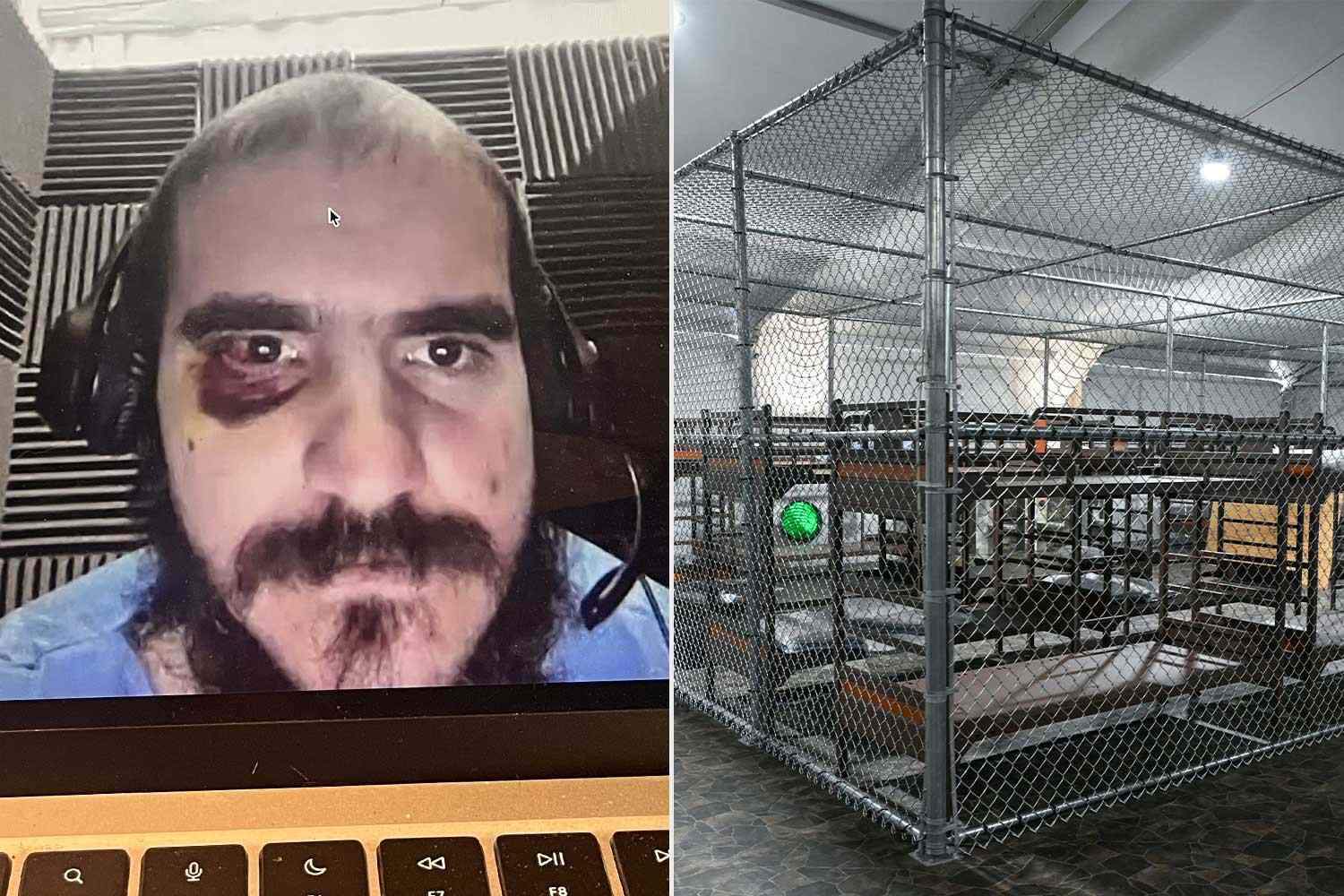
One of Blankenship's clients, identified as Mr. Morffi, suffered a severely bruised right eye. When Blankenship met with him on a video call six days later, on April 8, 2026, she took a picture of her screen and entered it into the court record.
His eye was still a dark shade of purple.
Morffi's arm was also injured. He doesn't know which guards were involved — they don't wear ID badges — but he believes he would recognize them if he saw them again.
Detainees were so afraid guards would come back to beat them some more, they barricaded the door to their cage, eventually allowing staff in only to render medical care to the injured men.
The phones were turned back on the next day, but staff never provided an explanation for why they had been cut off.
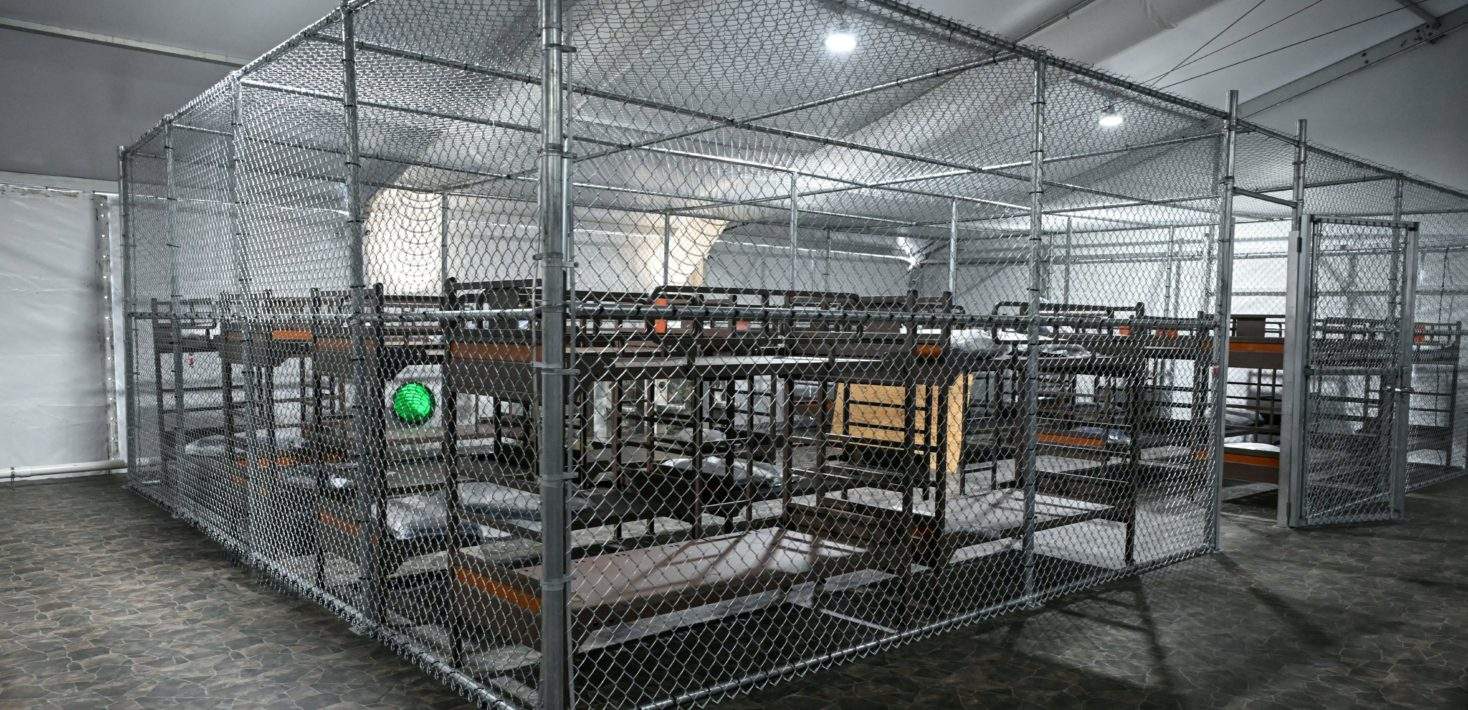
Housing conditions of detainees inside this tent city.
⚖️ The Violation: This Was Direct Contempt of Court
The phone cutoff wasn't just abuse. It was a direct violation of a federal court order.
Judge Chappell's March 27, 2026 injunction ordered detention center officials to:
- Provide detainees access to confidential legal phone calls
- Allow attorneys to make unscheduled visits to their clients
- Post policies allowing attorney visits on both ICE and Florida Division of Emergency Management websites
The day-long phone prohibition on April 2, 2026 — happening less than a week after that order — was blatant contempt.
The violence that followed was retaliation for detainees asserting their rights.
---
💰 The Contractor Network: Who Runs This Torture Chamber?
Alligator Alcatraz isn't run directly by ICE. It's run by a network of private contractors hired by the state of Florida, creating layers of deniability and obfuscation.
Critical Response Strategies — Jacksonville-based consulting firm with a $78.5 million contract to run the facility. Their responsibilities include hiring a warden, camp managers, corrections officers, and IT personnel.
Nakamoto Group — Maryland company subcontracted by Critical Response Strategies to provide legal access. They're responsible for ensuring detainees can contact their attorneys.
But there's a problem: Nakamoto Group has a history of rubber-stamping inspections.
A 2018 Department of Homeland Security Office of Inspector General report found that even ICE's own staff considered Nakamoto's inspections "useless" and "very, very, very difficult to fail."
Nakamoto used to have the main federal contract to inspect ICE jails but lost its decades-long deal after it was accused of rubber-stamping its findings. Yet Florida's DeSantis administration entrusted them with providing legal access at Alligator Alcatraz.
Mark Saunders, Nakamoto's vice president and a former prison warden who helped re-open Iraqi prisons after the war there, testified in January 2026 that policies at the facility were "written rather quickly" and that "the policies lag behind the practices."
That's the company responsible for ensuring detainees can access their lawyers.

President Trump tours "Alligator Alcatraz" with Gov. Ron DeSantis and Secretary of Homeland Security Kristi Noem.
🏛️ The Facility: Built on Emergency Funds, Fueled by DeSantis
Alligator Alcatraz opened July 3, 2025, at the Dade-Collier Training and Transition Airport in Ochopee, Florida — the eastern edge of Collier County, deep in the Everglades.
It's a tent-based detention center built by the state of Florida to house people detained by federal authorities. The facility has capacity for thousands of people and held roughly 1,500 detainees in late January 2026.
The cost is staggering: $1.2 million per day to run, with a "daily burn" rate of $3 million per day during its earliest weeks.
As of March 2026, Florida had spent $264.2 million on the facility over 259 days.
The single largest state contract: $78.5 million to Critical Response Strategies.
DeSantis's government is spending taxpayers' money on this facility at an unprecedented rate — $1.2 million per day to run a tent prison in the Everglades.
The federal government promised to reimburse the state, but recent reporting suggests the reimbursement may never come through. DeSantis announced in October 2025 that DHS had awarded Florida a $608 million reimbursement, but federal lawyers later claimed that was simply a "letter from FEMA approving FDEM's eligibility" for the grant — not actual funding.
DOJ has refused to pay for construction costs, injecting uncertainty into whether any of that $608 million will ever materialize.
Florida taxpayers may be stuck with the bill for DeSantis's immigration crusade.
---
🚽 The Conditions: Amnesty International Calls It Torture
In December 2025, Amnesty International released a report titled "Torture and Enforced Disappearances in the Sunshine State: Human Rights Violations at 'Alligator Alcatraz' and Krome in Florida."
The report found that people arbitrarily detained at Alligator Alcatraz are being held in inhuman and unsanitary conditions:
- Overflowing toilets with fecal matter seeping into where people are sleeping
- Limited access to showers
- Exposure to insects without protective measures
- Lights on 24 hours a day
- Poor quality food and water
- Lack of privacy, including cameras above toilets
That's not just bad conditions. Amnesty International calls it torture.
The report also documented delays in intake procedures, overcrowding in temporary processing areas, inadequate and inaccessible medical care, and alarming disciplinary practices including the use of prolonged solitary confinement.
---
🕵️ The Cover-Up: Layers of Deniability
The abuse at Alligator Alcatraz is happening behind multiple layers of obfuscation:
1. Contractor Layers
- Florida runs the facility, not ICE directly
- Critical Response Strategies operates it
- Nakamoto Group handles legal access
- Corrections officers don't wear ID badges
When guards beat detainees, detainees can't identify who did it. No ID badges, no names, no accountability.
2. Document Obstruction
The Florida Division of Emergency Management (FDEM) refused for months to hand over documents under the state's public records law. The documents were only released after a judge's order.
Florida's public records law was once considered a national model for open government. Under the DeSantis administration, it's routinely undermined by state agencies.
3. Funding Confusion
DeSantis announced a $608 million FEMA reimbursement, but DOJ has refused to pay for construction costs. The reality of federal reimbursement is uncertain, but the political optics of the announcement were clear: DeSantis wanted voters to think the federal government was paying for his immigration crackdown.
4. Facility Isolation
Alligator Alcatraz is located deep in the Everglades, remote and difficult to access. Attorneys drive out there only to be turned away at the gate by armed guards. The location itself is part of the strategy: make it hard for anyone to see what's happening inside.

Drone shot of Alligator Alcatraz
📜 The Legal Context: Constitutional Rights Don't End at the Border
Any immigrant facing deportation has the right to a private meeting with their lawyer, even in detention.
That's not a suggestion. That's a constitutional right.
Yet at Alligator Alcatraz, that right is routinely denied.
Before the court order, officials required attorneys to schedule in-person legal visits three days in advance. But before the visits could happen, detained immigrants were transferred to another facility "immediately."
One man detained inside Alligator Alcatraz wasn't able to contact his attorneys. When he asked for help, officers told him to contact his family instead "because there was nothing that they could do."
Another detainee, J.E., testified via Zoom from Haiti that ICE had given him papers to sign while he was at Alligator Alcatraz. One said "deportation." Another said "Mexico."
Confused when ICE told him that "the president had canceled" his legal options, J.E. asked to speak to a lawyer he had already hired. Guards told him "there was nothing that they could do."
On a call with his family, J.E. got his attorney's phone number — but he had no pen or paper to write it down. So he wrote it on the walls with soap.
Florida law permits state prisoners to have four pens in their personal possession, but officials said security concerns prompted them to ban pens and paper at Alligator Alcatraz — even though deportation officers have pens at the ready when they want people to sign deportation orders.
J.E. tried to call his lawyer but only heard a "tuk, tuk, tuk" sound. After multiple failed attempts, he agreed to sign the papers for his self-deportation.
"Anytime you're in a place like that," he testified, "if you don't comply with what they're doing, they punish you."
He was eventually sent to Haiti, the country he had fled two years earlier to escape a humanitarian disaster.
"I believe that if I had an attorney on my case, the possibility for me to be released would have been higher," J.E. said.
---
🔮 The Future: ICE's National Expansion
What's happening at Alligator Alcatraz isn't an isolated incident. It's a model for what ICE plans to do nationwide.
The ACLU's Haddy Gassama said she is "alarmed at the scale and pace" of how ICE is proceeding with little transparency or oversight for billions already spent.
ICE plans to buy warehouses nationwide to convert into eight mass detention sites, with 16 more feeder sites, to add 92,000 additional beds by November 2026.
Floor plans to convert a warehouse in Social Circle, Georgia, show no location for people to meet with their lawyers.
The case against Alligator Alcatraz could shape legal access at these future ICE jails.
Judge Chappell is not the first judge to rule that people held in ICE facilities still have fundamental rights:
- 26 Federal Plaza in New York
- Broadview near Chicago
- San Francisco
- Minneapolis
Federal courts across the country have been saying repeatedly that people held in detention — even temporarily — have constitutional rights to basic conditions of confinement and access to counsel.
The Trump administration is ignoring them.
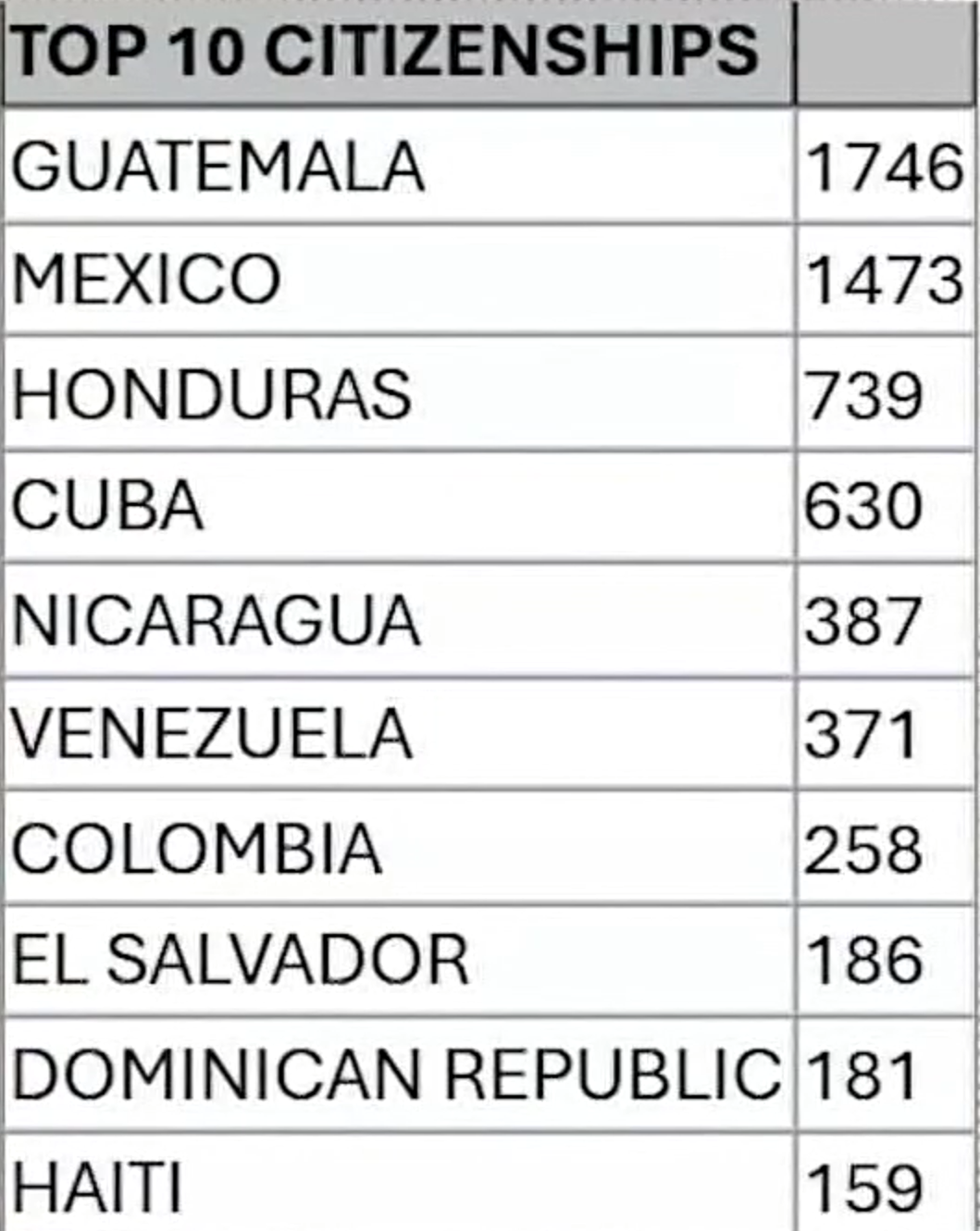
Top 10 nationalities being held at Alligator Alcatraz
💀 The Pattern: This Is Systemic Torture
What happened on April 2, 2026, at Alligator Alcatraz is not an isolated incident.
It's the logical outcome of a system designed to:
- Deny legal access — Three-day scheduling requirements, phone cutoffs, transfers before visits
- Create isolation — Remote location, armed guards at the gate, turned-away attorneys
- Obstruct oversight — No ID badges, rubber-stamping contractors, document refusals
- Punish resistance — Collective pepper spray, broken wrists, retaliation for complaints
- Dehumanize — Overflowing toilets, lights on 24 hours a day, cameras over toilets
This is what systemic torture looks like.
Amnesty International calls it torture. The conditions at Alligator Alcatraz — inhuman and unsanitary, including overflowing toilets with fecal matter seeping into sleeping areas — amount to torture under international law.
And it's happening in America, funded by Florida taxpayers, run by private contractors with histories of incompetence, authorized by a governor who sees human beings as political props.
---
✊ The Resistance: They Haven't Given Up
Immigrant and human rights activists continue to hold weekly vigils at the gates of Alligator Alcatraz. They've organized against potential new ICE warehouse sales in Orlando and Palm Beach.
"I think our communities are rightfully scared about what's happening," said Yareliz Mendez-Zamora, the American Friends Service Committee-Florida policy coordinator. "But that doesn't mean that we give up or stay silent … there are ways for us to organize and uplift the fact that this is evil."
They're not wrong. This is evil.
Abuse, torture, enforced disappearances — that's what's happening at Alligator Alcatraz. And it's happening with the full knowledge and authorization of Ron DeSantis, Donald Trump, and the private contractors who are making millions off human misery.
The cover-up is extensive. The contractor network is opaque. The funding is confusing. The facility is remote.
But the truth is coming out.
The phones were cut off on April 2, 2026. Then the beatings began.
This is what systemic torture looks like.
And we're not looking away.
Oh Yeah Fuck ICE
Sources & Methodology(6 sources)
April 16, 2026 - Details the April 2, 2026 incident where guards beat detainees, broke a wrist, pepper sprayed everyone in the cage, and an elderly man passed out after phones were cut off in violation of court order.
April 13, 2026 - Katie Blankenship's sworn declaration about the April 2 incident: officers broke a detainee's wrist, pepper sprayed everyone in the cage, an elderly man passed out. Phone cutoff was direct violation of March 27 court order.
- Truthout — Judge's Order for 'Alligator Alcatraz' May Shape Legal Access at Other ICE JailsNews Article
April 13, 2026 - Details on Nakamoto Group's history of rubber-stamping ICE inspections (called 'useless' by ICE staff in 2018 DHS OIG report). Mark Saunders testimony that policies were 'written rather quickly' and 'lag behind practices.'
December 4, 2025 - Comprehensive report documenting torture at Alligator Alcatraz: overflowing toilets with fecal matter seeping into sleeping areas, limited showers, 24-hour lights, cameras above toilets, poor food and water.
- CBS 12 — New Records Show Florida Officials Spent Over $1.2 Million Daily on 'Alligator Alcatraz'News Article
March 2, 2026 - $264.2 million spent in 259 days ($1.2 million daily). $78.5 million contract to Critical Response Strategies. DeSantis announced $608 million FEMA reimbursement, but DOJ blocking funding. $1.49 billion grant requested.
- WUSF — Lawyer Says Guards Beat and Pepper-Sprayed Detainees at Florida's 'Alligator Alcatraz'News Article
April 15, 2026 - Phone service was restored the next day without any explanation for why it was cut off. Blankenship's declaration was included in a court filing accusing state and federal officials of failing to comply with federal judge's preliminary injunction.
Filed Under
Frequently Asked Questions
- What is Alligator Alcatraz and where is it located?
- Alligator Alcatraz is a tent-based immigration detention center built by the state of Florida to house people detained by federal authorities. It opened July 3, 2025, at the Dade-Collier Training and Transition Airport in Ochopee, Florida — the eastern edge of Collier County, deep in the Everglades. The facility has capacity for thousands of people and held roughly 1,500 detainees in late January 2026.
- What happened on April 2, 2026 at the facility?
- On April 2, 2026, guards cut off detainee phones for an entire day, denying them access to their families and attorneys. This was in direct violation of a federal court order issued just six days earlier on March 27, 2026. When detainees complained about the phone cutoff, guards retaliated with collective punishment: beating detainees, breaking one detainee's wrist, pepper-spraying all 32 men in the cage, and causing an elderly man to pass out from inability to breathe. Detainees barricaded their door out of fear that guards would return to beat them again.
- What did the federal court order require?
- U.S. District Court Judge Sheri Polster Chappell issued a preliminary injunction on March 27, 2026, ordering detention center officials to provide detainees with access to timely, free, confidential, unmonitored, and unrecorded outgoing legal calls. The order also required attorneys to be allowed to make unscheduled visits to see their clients, bypassing the facility's pre-scheduling requirement. The phone cutoff on April 2 was a direct violation of this court order.
- Who runs Alligator Alcatraz and how much does it cost?
- The facility is run by a network of private contractors hired by the state of Florida. Critical Response Strategies, a Jacksonville-based consulting firm, has a $78.5 million contract to run the facility. The Nakamoto Group is subcontracted to provide legal access. The facility costs $1.2 million per day to operate, with a daily burn rate of $3 million during its earliest weeks. As of March 2026, Florida had spent $264.2 million on the facility over 259 days.
- What did Amnesty International find?
- In a December 2025 report titled 'Torture and Enforced Disappearances in the Sunshine State,' Amnesty International documented inhuman and unsanitary conditions at Alligator Alcatraz, including overflowing toilets with fecal matter seeping into where people are sleeping, limited access to showers, exposure to insects without protective measures, lights on 24 hours a day, poor quality food and water, and lack of privacy including cameras installed above toilets. The organization concluded these conditions amount to torture.
- Why is the Nakamoto Group controversial?
- The Nakamoto Group, subcontracted to provide legal access at Alligator Alcatraz, has a history of rubber-stamping ICE facility inspections. A 2018 Department of Homeland Security Office of Inspector General report found that even ICE's own staff considered Nakamoto's inspections 'useless' and 'very, very, very difficult to fail.' Nakamoto lost its decades-long federal contract to inspect ICE jails after these findings. Yet Florida's DeSantis administration entrusted them with ensuring detainees can contact their attorneys.
- What are ICE's plans for future detention facilities?
- ICE plans to buy warehouses nationwide to convert into eight mass detention sites, with 16 more feeder sites, to add 92,000 additional beds by November 2026. Floor plans to convert a warehouse in Social Circle, Georgia, show no location for people to meet with their lawyers. The ACLU has warned it is 'alarmed at the scale and pace' of this expansion with little transparency or oversight.