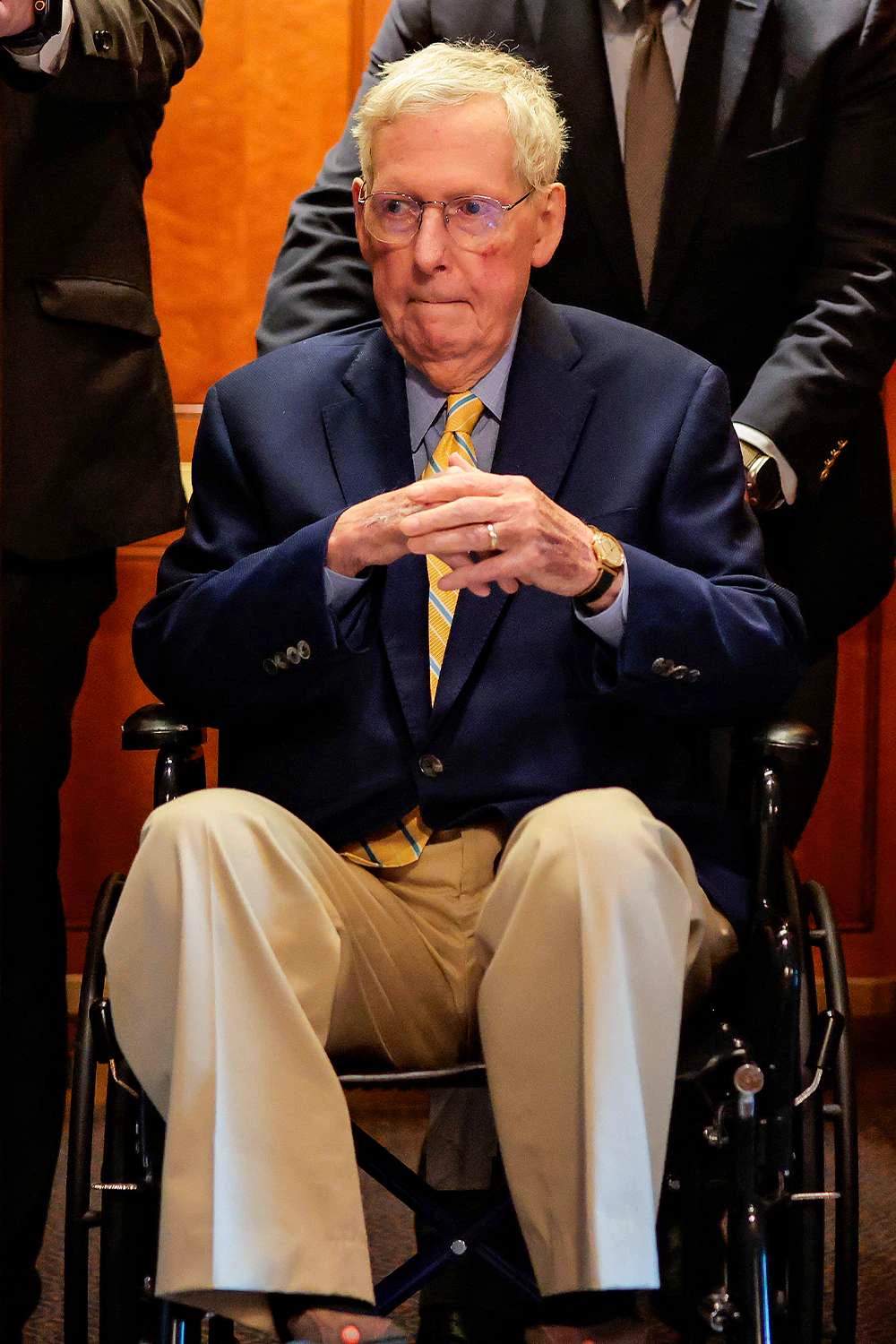
On the morning of June 14, 2026, at 8:36 a.m., emergency dispatchers in Washington, D.C. received a call that would change the balance of power in the United States Senate. An Advanced Life Support ambulance was dispatched to a Capitol Hill townhouse — the home of Senator Mitch McConnell. The caller reported an unconscious person. A paramedic on scene reported CPR in progress. The suspected cause: cardiac arrest.
Three weeks later, the 84-year-old Republican senator has not been seen. He has not voted. He has not appeared in public. His office has released statements claiming he is "improving" and "working closely with staff," but has refused to answer basic questions: Is he conscious? Who is running his office? Will he return to the Senate?
The silence speaks volumes — and the political machinery behind that silence tells you everything you need to know about how power works in Washington.
The cover-up unfolds
The dispatch audio, obtained and published by journalist Desirée Townsend, was the first crack in a wall of official obfuscation that McConnell's office has maintained since June 14. On that day, a spokesperson said only that McConnell was "receiving excellent care." No diagnosis. No prognosis. No explanation.
On June 22, eight days after cardiac arrest and CPR, his office released another statement: McConnell was "working closely with staff on Senate business and Kentucky matters as he continues his recovery."
Working closely with staff. After CPR. After cardiac arrest. After losing consciousness at home alone.
Dr. Jeremy Faust, an emergency physician at Brigham and Women's Hospital and assistant professor at Harvard Medical School, offered a grim medical reality check. "If it does work and we can restart their heart and their heart is beating spontaneously, that begins a long road to recovery, even for the healthiest of patients," Faust said on CNN. "So when you have a person who is elderly and who has other underlying medical conditions, it's really concerning."
He noted that most patients who survive CPR after a heart attack are not able to "take care of their bodily needs" in the immediate aftermath. This is not a man firing off policy memos between physical therapy sessions.
The collapse is not entirely without precedent. As we reported when McConnell experienced his second speaking freeze in public, his health has been deteriorating in plain view for over two years. Those unsettling frozen moments — a senator unable to speak, unable to move, staring blankly at cameras while aides guided him away — were warnings that McConnell's physical decline was accelerating. This is the culmination of that decline: a man who could not finish a sentence on camera is now reportedly unable to finish a thought at all.
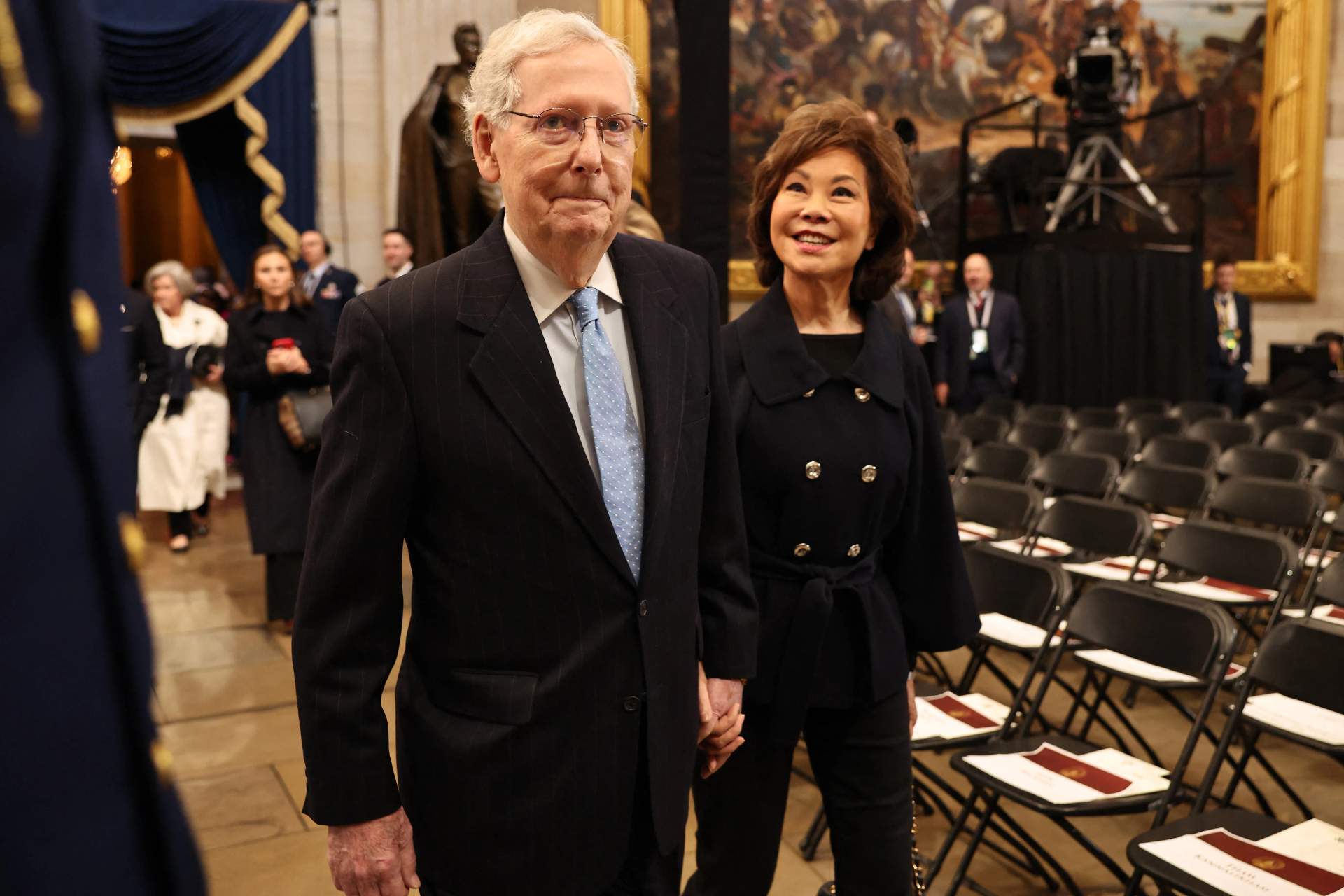
Mitch McConnell walking with his wife Elaine Chao, both dressed formally, at a public event
Where is Elaine Chao?
Perhaps the most revealing detail in this entire saga has nothing to do with McConnell himself. It's about his wife.
Elaine Chao — former Transportation Secretary under Trump, married to McConnell since 1993 — was in China. On June 17, just three days after her husband suffered cardiac arrest and received CPR, photographs emerged showing Chao meeting with Chinese Vice President Han Zheng in Beijing, discussing efforts to strengthen China-U.S. relations.
Chao held no official government position at the time. She was not representing the United States. She was, by all appearances, conducting personal diplomacy while her husband lay in a hospital bed, potentially unconscious, with no family member publicly at his side.
Chao's staff told Newsweek she "had been there for days" before McConnell's collapse — that her travel was pre-planned. But the optics are devastating: the person closest to McConnell, the one who would presumably be making medical decisions if he were incapacitated, was on another continent.
This is not normal. When a public figure of McConnell's stature suffers a medical emergency, the spouse is typically at the hospital within hours. Not on a plane to Beijing.
For anyone who has followed the Chao-McConnell marriage, the Beijing trip fits an established pattern. As our deep investigation into McConnell's forty years of corruption documented, the Chao family's ties to the Chinese Communist Party — Elaine's father James Chao's close relationship with former Chinese dictator Jiang Zemin, the shipping empire, the conflicts of interest that ran through Elaine's cabinet tenure — have been a persistent shadow over McConnell's career. Now that same shadow is hanging over his deathbed.
The "brain dead" rumors and the proof-of-life problem
By early July, the information vacuum had created a monster. Conservative activist Laura Loomer, citing what she described as a "high-level source close to the White House," claimed McConnell was in a "vegetative state" or "brain dead" and would "not be coming back" to the Senate.
Townsend, the journalist who broke the dispatch audio, confirmed she had "heard the same thing from my sources for days." She even posted that she was "at the hospital for when they eventually decide to cut him off of life support."
The Hill, a major Washington outlet, accidentally published an obituary-style retrospective on McConnell's career — then swiftly deleted it.
McConnell's allies scrambled to contain the damage. GOP strategist Scott Jennings, a former McConnell advisor, posted on X that he had spoken with the senator for "just shy of 20 minutes" about Iran, Ukraine, and Maine politics. Senate Majority Leader John Thune described a "lengthy and substantive" phone call. Whip John Barrasso said the same.
But nobody has produced a photo. Nobody has released a video. Nobody has arranged even a brief appearance — not even a window shot of McConnell waving from a hospital bed. When CNN pressed Jennings about why McConnell couldn't simply release a proof-of-life video, he declined to answer directly.
The daughter angle adds another layer of strangeness. Porter McConnell, 48, McConnell's eldest daughter and an outspoken progressive critic of her father's politics, deleted her X account entirely amid the swirling speculation.
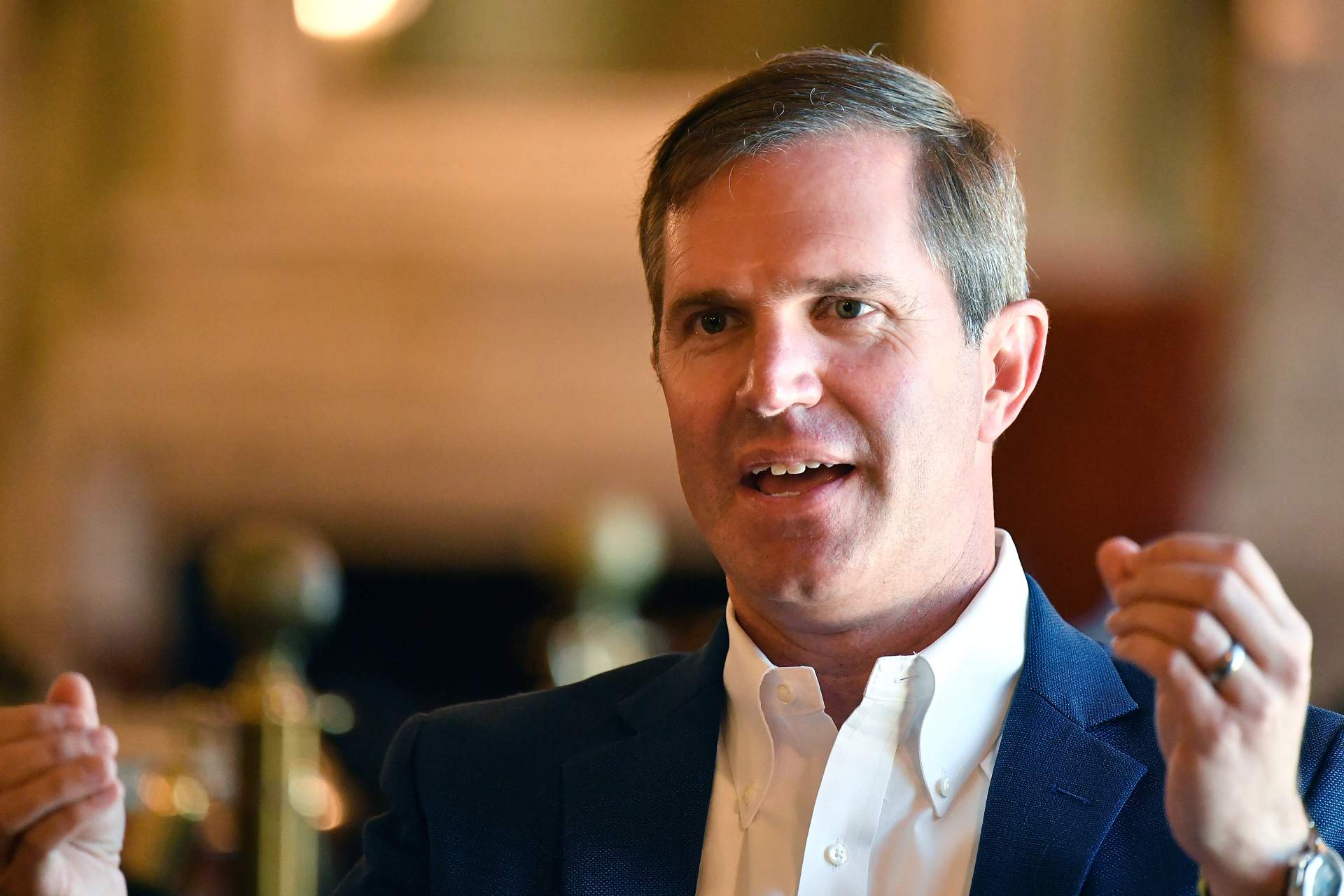
Kentucky Governor Andy Beshear standing at a podium speaking at a press conference
The August 3 deadline: why the GOP is panicking
Here is what nobody in McConnell's orbit wants to say out loud: there is a deadline.
Kentucky law, changed in 2024 by a Republican-controlled legislature specifically to strip power from the state's Democratic Governor Andy Beshear, requires that if a U.S. Senate seat becomes vacant, the governor must call a special election. If McConnell resigns, dies, or is declared unable to perform his duties before a certain cutoff — sources point to early August, with August 3 being the critical date — that special election would be triggered.
And that special election would be catastrophic for the GOP.
Why? Because of Thomas Massie.
The libertarian-leaning congressman from Kentucky's 4th District has been a thorn in the Republican establishment's side for years. He's an anti-interventionist, a fiscal hawk, and — critically — someone the GOP leadership cannot control. In a special election, Massie would almost certainly enter the race, and in Kentucky's current political climate, he could win.
The GOP's razor-thin Senate majority — already fragile with McConnell absent — would not survive a Massie candidacy splintering the Republican vote, especially in a special election where turnout dynamics favor energized bases over party machines.
McConnell has already announced he will not seek re-election in 2026. His current term ends in January 2027. If his seat becomes vacant after the August cutoff, the governor would appoint a replacement to serve out the remainder — giving Democrats a potential path to flipping the seat without an election.
But if McConnell holds on — even as a vegetable, even as a name on a door while his staff runs his office — the GOP avoids a special election entirely. His seat stays Republican. His vote, whatever that means, stays in the caucus.
This is the calculus. This is why the staff won't answer questions. This is why vague statements about "improvement" are the only communication the public receives. A man's body is being used as a political placeholder.
It is a grotesque symmetry: the same man who spent four decades treating American democracy as a personal possession — stealing a Supreme Court seat, architecting the dark money system that poisoned elections, selling out national security for a Russian oligarch's empty promises — is now having his own body possessed by the machine he built. McConnell always treated institutions as instruments. Now the institution is treating him the same way.
The real-world consequences of a phantom senator
The impact of McConnell's absence is already being felt. On June 23, his failure to vote allowed Democrats to pass a resolution limiting Trump's war powers in Iran — a measure that would have failed if McConnell and Senator David McCormick had been present. The resolution passed because the GOP's margin was that thin.
Looking ahead, McConnell's absence threatens the Republican agenda on defense spending, budget reconciliation, and judicial nominations. Thune needs every vote he can get, and several GOP senators — Collins, Murkowski, Tillis, Cassidy — have histories of breaking with leadership.
Meanwhile, Utah Senator Mike Lee admitted what many of his colleagues have been thinking: "Many of us aren't speaking about Mitch McConnell's condition because we know nothing about his condition."
The people's business is not being conducted. A seat that represents millions of Kentuckians is effectively empty. And the only people who know the truth are the ones with every incentive to hide it.
What McConnell's health crisis reveals about American power
This is not just a story about one elderly senator's medical emergency. It is a story about a system that treats human beings as political instruments.
Mitch McConnell, for all his flaws, is a person. A person who may be lying in a hospital bed, unconscious, unable to communicate, while his party calculates the electoral implications of his heartbeat. His wife was in Beijing. His staff issues press releases. His allies make phone calls they won't prove happened. And the machinery of government grinds on without him, pretending that everything is fine.
The American gerontocracy has been a bipartisan problem for years. Feinstein. McConnell. Fetterman. A system that rewards incumbency above all else inevitably produces senators who cling to power long past the point of competence. But McConnell's case is different — because this time, the system isn't just enabling decline. It's actively concealing it.
Kentuckians deserve to know the condition of their senator. Americans deserve to know whether one of the most powerful positions in the legislative branch is being held by a man who cannot perform its duties. And if McConnell is, as multiple sources suggest, in a vegetative state — then the people have a right to know that they are being represented by a ghost.
The cover-up is the scandal. The seat-holding is the corruption. And the silence from McConnell's office is the sound of a political system that has lost any remaining pretense of serving the public. For a deeper look at the career that brought us to this moment — the tobacco money, the dark money, the stolen courts, the abandoned miners — read our full investigation into the dark career of Mitch McConnell.
Sources & Methodology(6 sources)
Dispatch audio obtained by journalist Desiree Townsend reveals paramedics responded to cardiac arrest at McConnell home on June 14, 2026.
Elaine Chao was photographed meeting Chinese Vice President Han Zheng in Beijing three days after McConnell cardiac arrest.
NBC News confirmed paramedics responded to McConnell home for a reported unconscious person with CPR in progress.
Conservative activist Laura Loomer claimed McConnell was in a vegetative state, claims later echoed by other sources.
The Hill reported on political implications of McConnell health crisis including special election scenarios in Kentucky.
- Axios - Inside the McConnell Health Rumor MillNews Article
Axios reported on the information vacuum surrounding McConnell condition and the political calculations driving the secrecy.
Methodology
Reported using dispatch audio obtained by journalist Desiree Townsend, official statements from McConnell's office, medical expert analysis from Dr. Jeremy Faust of Harvard Medical School, and political reporting from multiple outlets including Axios, The Hill, NBC News, and the Daily Beast.
Filed Under
Frequently Asked Questions
- What happened to Mitch McConnell on June 14, 2026?
- Emergency dispatchers received a call reporting an unconscious person at McConnell's Capitol Hill townhouse. Paramedics reported CPR in progress with a suspected cardiac arrest. McConnell has not been seen publicly since.
- Why is the GOP covering up McConnell's condition?
- If McConnell resigns or is declared unable to serve before an early August deadline, Kentucky's Democratic Governor Andy Beshear would be required to call a special election, potentially costing Republicans their slim Senate majority. Holding the seat through January 2027 avoids that risk.
- What is the August 3 deadline?
- Kentucky law, changed by Republicans in 2024, sets a cutoff in early August. If a Senate seat becomes vacant after that date, the governor can appoint a replacement without a special election. Before the cutoff, a special election must be held.
- Was Elaine Chao really in China during McConnell's medical emergency?
- Yes. Three days after McConnell's cardiac arrest, Chao was photographed meeting with Chinese Vice President Han Zheng in Beijing. Her staff claimed the trip was pre-planned.
- What evidence supports claims that McConnell is in a vegetative state?
- Multiple sources, including journalist Desiree Townsend who broke the dispatch audio, have reported hearing that McConnell is in a vegetative state. No proof-of-life photo, video, or public appearance has been provided by his office.