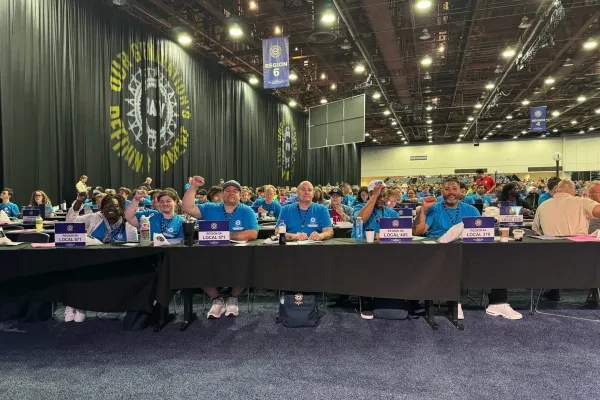
On July 28, 2026, two of North America's largest construction unions — the Laborers' International Union of North America (LIUNA), with roughly 540,000 members, and the International Union of Painters and Allied Trades (IUPAT), with 140,000 members — signed a Memorandum of Understanding that amounts to something the American labor movement has not seen in decades: a binding, industry-wide collaboration between two major international unions that explicitly rejects the old model of isolated, craft-by-craft bargaining.
The joint statement did not mince words. "The construction industry has adopted a model to exploit workers and divide unions. The old playbook isn't working anymore, so we must build a new one: a fighting movement of workers united by 21st century solidarity."
That is not boilerplate. That is a diagnosis — and a threat to every contractor, every right-to-work legislature, and every corporate lobby that has spent the last half-century methodically disassembling working-class power in North America. It is also, whether the signatories intended it or not, a step toward something far more radical than a strategic alliance: the re-emergence of an idea that capital has spent a century trying to bury — that workers themselves, organized by industry and trade in councils of their own making, are capable of running the production they sustain.
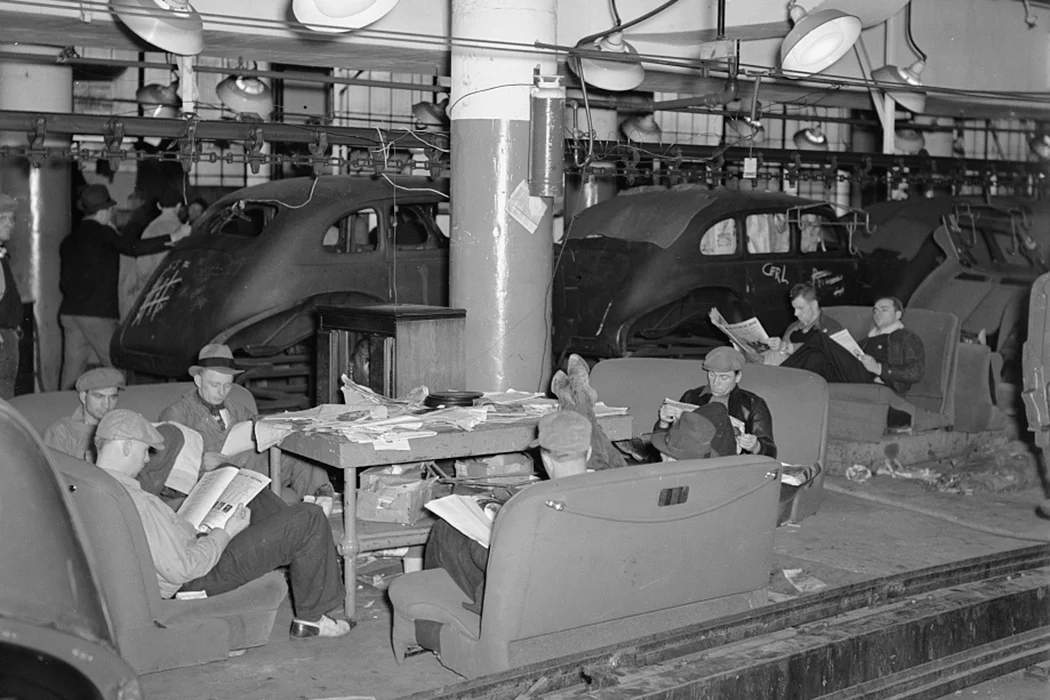
Men sitting on the factory floor inside an automobile manufacturing plant during the 1936-1937 Flint sit-down strike, with machinery and windows visible in the background
What the MOU Actually Commits To
The agreement between LIUNA and IUPAT is not a vague pledge of friendship. It is a seven-point operational framework that, if executed, fundamentally alters how two of the building trades' most powerful unions operate:
- Joint organizing campaigns targeting non-union workers across their shared industry sectors
- Unified communications infrastructure to counter anti-union propaganda and reach broader audiences
- Membership recruitment directed at reflecting the racial and geographic composition of their communities
- Aligned contract expiration dates and bargaining priorities — a tactical weapon that multiplies leverage at the negotiating table
- Pension fund investment reform — explicitly refusing to invest members' retirement money in enterprises that work against unions
- Coordinated political lobbying and pooled resources for Political Action Committees
- Workforce quality standards recognizing that trained, safe, union labor is a competitive advantage
Point four — aligned contract expirations — is the sleeper provision. In the building trades, contract dates are staggered by craft. Employers use this to isolate unions during negotiations, breaking strikes one trade at a time. When multiple trades with aligned expirations walk out together, the entire job shuts down. That is not a strike. That is a shutdown — and it is the single most effective weapon construction workers have ever wielded.
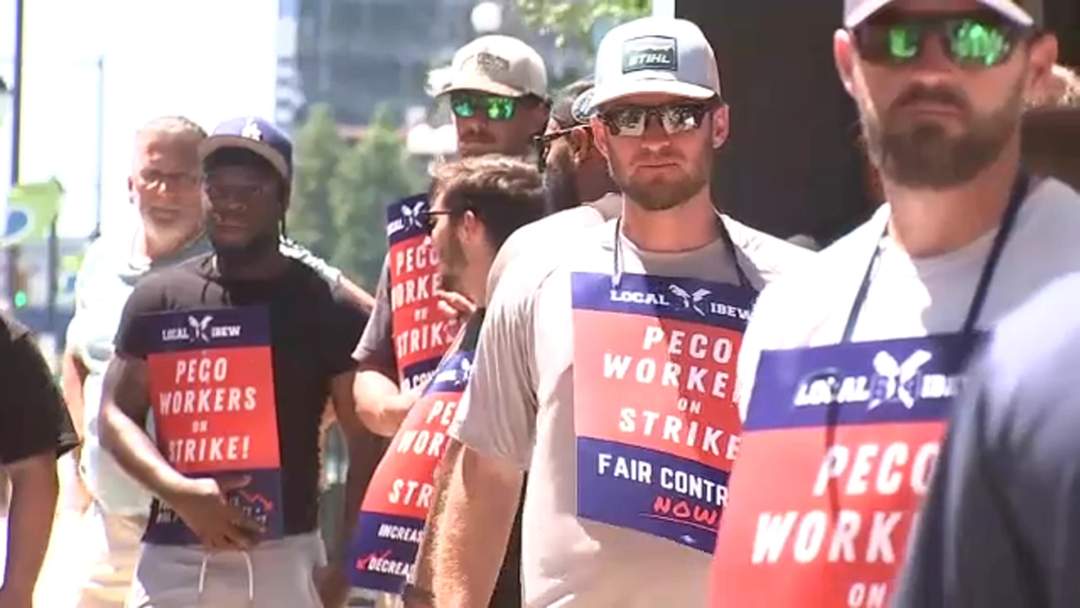
But look at what that weapon actually represents in practice. When laborers and painters walk off the same job site at the same time, they are not just withholding their labor from a single employer. They are demonstrating, in microcosm, the principle that anarcho-syndicalists have argued for over a century: that workers organized by industry — not by craft, not by employer, but by the work they do together — possess the power to halt production entirely. The sit-down strikers in Flint understood this intuitively. They did not ask General Motors for a seat at the table. They took the table. For forty-four days, the workers ran the plant. The strike wave that has swept across America in recent years has carried the same lesson: when workers move together, the system shakes.
The Divide-and-Conquer Machine
To understand why this MOU matters, you have to understand what it is pushing back against.
The American construction industry has spent decades perfecting a labor relations model built on segmentation. Different trades — laborers, electricians, plumbers, ironworkers, painters, operating engineers — are kept in separate silos. Each has its own contract, its own expiration date, its own bargaining unit. This is not an accident. It is the legacy of craft unionism, a model that the American Federation of Labor (AFL) enshrined as orthodoxy in the late 19th and early 20th centuries.
Under the AFL model, skilled trades organized by craft. Carpenters with carpenters. Electricians with electricians. This made sense in 1890 when a carpenter's work bore little resemblance to a mason's. But in 2026, on a commercial construction site, the boundaries between trades blur constantly. And employers have learned to exploit every crack.
When right-to-work laws spread to 26 states — laws that allow workers in unionized workplaces to opt out of paying dues while still receiving the benefits of collective bargaining — the effects were devastating. A 2022 study published by the National Bureau of Economic Research found that in construction-dense states that adopted right-to-work, wages dropped by more than 4% within five years. Union membership fell. Pension funds hemorrhaged. And non-union contractors — paying poverty wages with no benefits — underbid union shops on public projects funded by the very tax dollars of union members.
This is the architecture of exploitation: isolate workers by trade, starve their organizations of resources, then pit them against each other for scraps. The state enforces this architecture through legislation. Capital enforces it through subcontracting and labor brokers. The result is a workforce that builds everything and owns nothing — and is told, at every turn, that it has no choice but to accept the terms dictated by someone else.
The Ghost of Industrial Unionism
The division that LIUNA and IUPAT are now trying to overcome has deep roots in American labor history — and the solution they are reaching toward has roots just as deep.
In 1905, a coalition of socialists, anarchists, and militant trade unionists gathered in Chicago to form the Industrial Workers of the World (IWW). Their founding principle was radical in its simplicity: one big union for all workers. The IWW rejected the AFL's craft-by-craft approach as fundamentally divisive. They argued — correctly, as history would bear out — that capitalism organizes production by industry, and labor must organize the same way.
The IWW organized across ethnic lines at a time when the AFL treated immigrant workers with open contempt. They organized unskilled laborers — the people the craft unions refused to admit. They organized miners, lumberjacks, textile workers, dockworkers, and migrant farm labor. Their model was industrial unionism: all workers in a given industry in one union, striking together, bargaining together.
But the IWW went further than industrial unionism. Their ultimate vision — articulated by figures like Rudolf Rocker and the Spanish Confederación Nacional del Trabajo (CNT) — was anarcho-syndicalism: the belief that the unions themselves, organized by industry into federated councils, could become the skeleton of a new society. Not just bargaining agents negotiating the terms of their own exploitation, but organs of workers' self-management — bodies that could seize and run production directly, without the state and without the boss. The union was not a service provider. It was the embryo of the future.
The IWW was crushed — by a combination of government repression, vigilante violence, and the AFL's own hostility. But their ideas did not die. In 1935, John L. Lewis and others split from the AFL to form the CIO, explicitly on an industrial unionist platform. Within five years, the CIO had organized millions of workers in steel, auto, rubber, and electrical manufacturing. The sit-down strikes in Flint. The Memorial Day Massacre in Chicago. The organizing drives that built the American middle class.
The CIO and AFL eventually merged in 1955, but the merger came at a cost. The industrial unionist impulse was absorbed into a bureaucratic structure that grew increasingly conservative over the following decades. Collective bargaining became contract maintenance. Organizing became member services. The fighting movement that built the CIO became an institution primarily interested in preserving its existing membership base — and, increasingly, its relationship with the Democratic Party, a relationship that has delivered steadily diminishing returns for workers while delivering reliable votes for politicians who abandon them the moment the polls close. What LIUNA and IUPAT are describing in their MOU is, whether they use the word or not, a return to the principles of industrial unionism — adapted for the 21st century. Joint organizing. Aligned expirations. Unified political action. One fight, not twenty-seven separate negotiations. But the anarcho-syndicalist critique asks a further question: what happens when the contract expires and the workers do not go back? What happens when the bargaining unit becomes something more — a workers' council that does not negotiate with the employer but replaces the employer? The MOU does not ask this question. But it builds the infrastructure from which that question becomes unavoidable.
The 2026 Labor Moment
This MOU does not exist in a vacuum. It arrives at a moment when the American labor movement is experiencing its most significant resurgence in generations — and when the limits of traditional unionism are becoming visible to anyone paying attention.
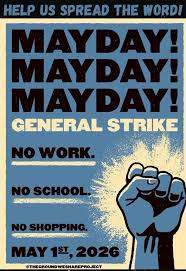
On May Day 2026, workers in over 80 countries took to the streets in what organizers called a global economic blackout. In the United States, the day saw coordinated actions from Amazon warehouse workers, graduate student employees, nurses, and construction trades — all acting in loose but unmistakable solidarity with one another. The global uprising on May Day 2026 was not a single event. It was a signal that workers across industries and borders are beginning to understand their struggles as connected.
The UAW's decision to divest from Israel bonds earlier this year marked another turning point. For the first time, a major American union explicitly connected international anti-imperialism to domestic labor strategy. Shawn Fain framed the divestment as a matter of working-class solidarity — the same principle that underpins the LIUNA-IUPAT agreement. The UAW's break from the silence on Palestine showed that unions can take positions far beyond wage negotiations without collapsing.
And the ongoing strike wave across American workplaces — from warehouse workers to educators to World Cup construction laborers fighting both ICE and their employers simultaneously — has demonstrated that the appetite for collective action is not abstract. It is material, immediate, and growing.
The LIUNA-IUPAT MOU sits squarely within this current. It is a recognition that the old model — isolated unions, isolated contracts, isolated fights — cannot withstand the coordinated power of capital. Corporations do not negotiate one division at a time. Their lobbyists do not lobby one issue at a time. Their political action committees do not fund one candidate at a time. They operate as a system. And to fight a system, you need a system of your own.
The anarcho-syndicalist tradition has a name for that system: workers' councils — federated bodies organized by industry and trade, coordinated through delegates recallable at any moment, making decisions through direct democracy rather than representative bureaucracy. The CNT built them in Spain in 1936. Workers' councils ran the factories, the farms, the transportation networks, the utilities — not perfectly, not without conflict, but functionally, for months, while simultaneously fighting a fascist war. The proof of concept exists. What has been missing is the infrastructure to scale it.
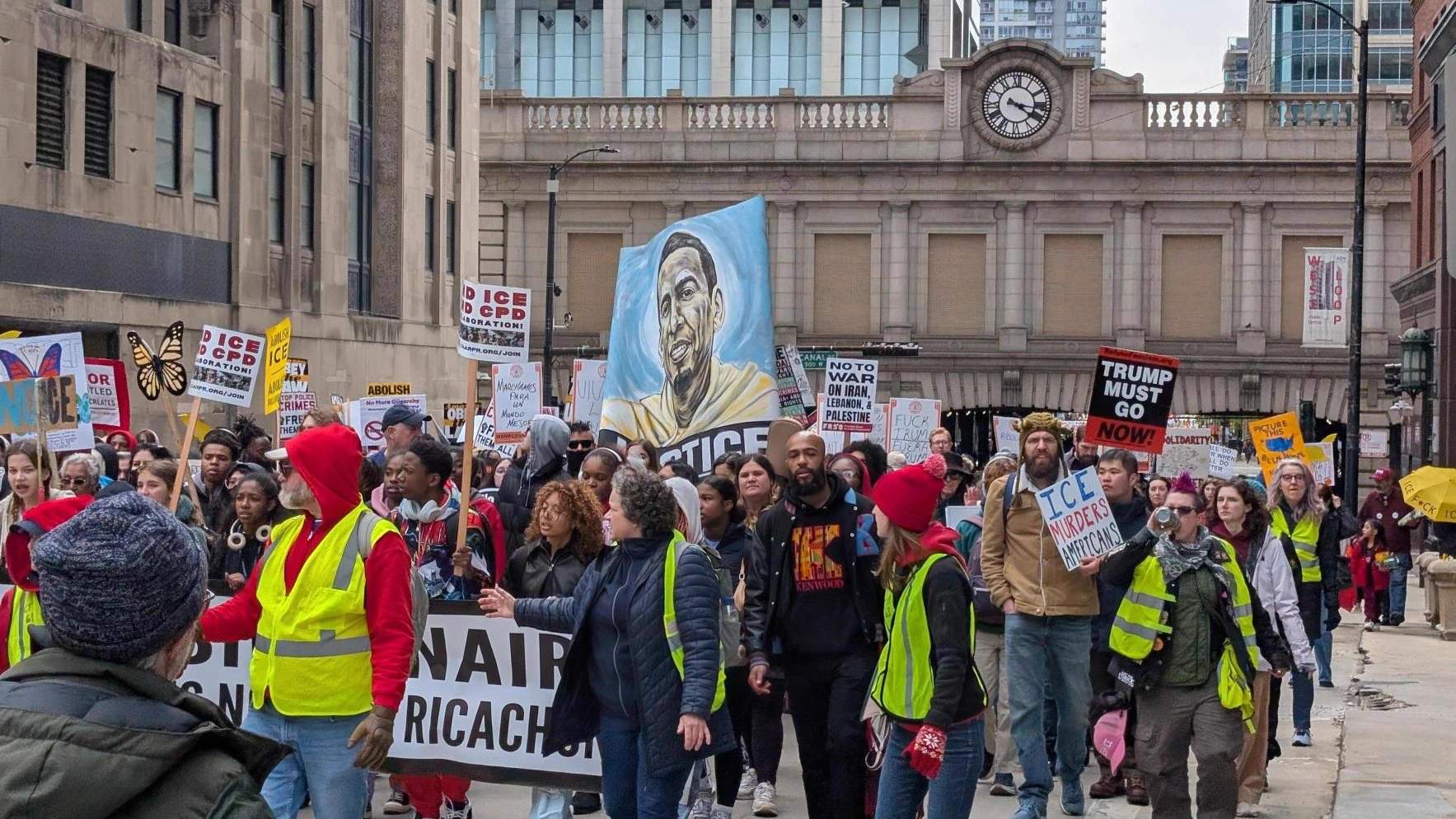
Large crowd of demonstrators marching down a city street carrying signs and banners during a May Day labor rally in Chicago, with buildings visible on both sides
Pension Funds as Political Weapons
Perhaps the most under-discussed commitment in the MOU is the one about pension fund investments. LIUNA and IUPAT have pledged to direct their members' pension fund investments "in the interest of our members and refusing to place members' pension funds in investments that work against unions."
Union pension funds in North America control hundreds of billions of dollars in assets. When a union pension fund divests from a company that uses non-union labor, that is not just a symbolic gesture. It is a material withdrawal of capital. When multiple union funds coordinate those decisions — as LIUNA and IUPAT are now committing to do — it becomes a leverage point that no corporation can easily ignore.
This is where the MOU brushes against something more radical than its signatories may intend. Capital flows where capital is directed. If workers' pension funds — collectively, across trades and industries — redirected investment toward worker cooperatives, community land trusts, and union-built housing, they would not merely be pressuring existing corporations. They would be building the economic infrastructure of a different society. The divestment campaigns of the 1980s targeted South Africa. The next logical target is the system itself.
The Council as Horizon
Here is where the LIUNA-IUPAT agreement becomes something larger than a construction industry story.
The American left has spent decades in fragmentation. Marxist reading groups. Anarchist collectives. Democratic Socialist electoral campaigns. Tenant unions. Mutual aid networks. Each one doing vital work. Each one operating largely in isolation from the others.
The result is a left that is rich in analysis and poor in power. We can identify the systems of oppression with precision. We can name the mechanisms of exploitation. But we lack the coordinated institutional force to dismantle them. The anarcho-syndicalist answer has always been the same: build the alternative within the shell of the old. Organize workers by industry. Federate those organizations into councils. Use direct action — strikes, boycotts, occupations, sabotage — not as pressure tactics to extract concessions from power, but as the means by which workers develop the capacity to exercise power directly.
The LIUNA-IUPAT MOU is a crack in the wall. Joint organizing across two unions. Aligned contract dates. Coordinated capital deployment. These are not revolutionary acts on their own. But they are the structural preconditions for something the left has talked about for a century and rarely built: interlocking councils of industry and trade, federated from below, answerable to no party and no state, capable of coordinating production and withholding it at will.
The question is not whether LIUNA and IUPAT are anarcho-syndicalists. They are not. The question is whether the left — the actual left, the one that exists in basements and group chats and mutual aid warehouses — will recognize what the MOU makes possible, and organize within and around these institutions to push them past the limits of collective bargaining toward workers' self-management.
Every joint organizing campaign is a seed. Every aligned expiration is a rehearsal for a general strike. Every coordinated pension investment is practice for collective ownership of the means of production. The MOU does not say these things. But it builds the scaffolding from which they become thinkable.
One Fight, One Movement, One Council
The LIUNA-IUPAT statement ends with a declaration: "A fighting movement of workers united by 21st century solidarity."
The fighting movement exists. It is building. From the picket lines at Amazon warehouses to the encampments on university campuses, from the streets of May Day to the strike lines where workers are fighting the carceral state, from the warehouse floor where workers demanded their worth and the system refused, the pieces are on the board.
What the LIUNA-IUPAT MOU represents is the understanding that those pieces must be connected. That the construction worker in Ohio and the warehouse worker in Illinois and the worker who burned it down because they were not paid enough are not separate stories. They are the same story. They are the story of a class that produces everything and owns nothing, that is told its struggles are individual when they are systemic, that is offered incremental concessions when what it needs is transformative power — power exercised directly, through its own institutions, accountable to no one but itself.
The councils are not a fantasy. They are a historical fact — built in Spain, built in Hungary in 1956, built in Chile before the coup, built every time workers occupy a workplace and discover that they do not need the boss to keep the lights on. What they have never had in North America is the scale. The LIUNA-IUPAT MOU, combined with the resurgence of strike activity, the growing critique of electoral politics among young workers, and the material desperation of a working class that has nothing left to lose, may be providing it.
Solidarity is not a sentiment. It is a strategy of institution-building. And the institutions it builds are not lobbying groups or PACs or electoral machines. They are councils — of industry, of trade, of neighborhood — federated, democratic, and directly controlled by the workers who constitute them.
Our struggles are connected. We must be just as connected — if not more so. One fight. One movement. Built on solidarity, organized in councils, answerable to no one but ourselves.
That is not a slogan. That is a program. And the time to execute it is now.
Sources & Methodology(6 sources)
Methodology
Analysis based on the official LIUNA-IUPAT joint statement, reporting from WNY Labor Today and The Labor Tribune, NBER research on right-to-work wage effects, and historical labor scholarship on the IWW, CIO, and Flint sit-down strike. Published August 27, 2026.
Frequently Asked Questions
- What exactly is the LIUNA-IUPAT Memorandum of Understanding?
- A seven-point binding agreement signed July 28, 2026, between LIUNA (540,000 members) and IUPAT (140,000 members) committing to joint organizing, unified communications, aligned contract expiration dates, pension fund investment reform, coordinated political lobbying, and workforce quality standards.
- Why is aligned contract expiration dates significant?
- When multiple unions' contracts expire at the same time, they can strike together and shut down entire construction projects. This multiplies leverage dramatically compared to isolated single-craft negotiations.
- How does this connect to historical labor movements?
- The MOU's principles — joint organizing, industrial solidarity, unified political action — mirror the industrial unionism of the IWW (1905) and CIO (1935), which organized across craft lines to fight employer segmentation.
- What are right-to-work laws and how do they affect unions?
- Laws in 26 states allowing workers in unionized workplaces to opt out of paying dues while receiving union benefits. NBER research shows they've reduced construction wages by 4% or more in affected states.
- What does the pension fund commitment mean?
- Both unions pledged to direct members' pension investments in workers' interests and refuse to invest in enterprises that work against unions — using hundreds of billions in capital as leverage.