
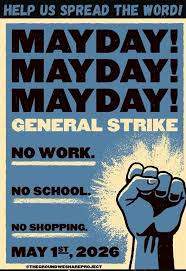

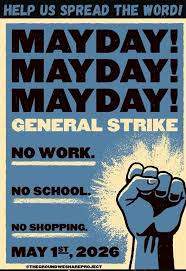
CHICAGO — On May 1, 2026, Chicago public schools will be closed. Not because of snow. Not because of a holiday. But because the city declared May 1 a "day of civic action" — and the teachers union is asking every student, parent, and worker to stay home.
It's called an economic blackout. "No work, no school, no shopping." And Chicago isn't alone.
Across the United States and around the world, May Day 2026 is shaping up to be the largest coordinated day of labor action in generations. More than 3,000 events are planned in every U.S. state and Washington D.C. — up from 1,300 last year. More than 500 labor unions and community organizations have signed on. Schools in North Carolina are closing. Businesses in Los Angeles are preparing to shut down. And in Paris, trade unions are mobilizing under banners of "peace" and "freedom."
This isn't a protest. It's a practice run for a general strike.
The Numbers Tell the Story
The scale is unprecedented in modern American labor history:
3,000+ actions across all 50 states (more than doubled from 2025)
500+ unions and organizations participating, including the Chicago Teachers Union, SEIU, National Education Association, American Federation of Teachers, American Postal Workers Union, and United Auto Workers
Every state and D.C. has scheduled events
Los Angeles: 101+ endorsing organizations, up from 85 last year, aiming to 'shut down the city' like the mega-marches of 2006
Chicago: City-wide economic blackout, May 1 declared a 'day of civic action'
North Carolina: More than a dozen school districts closed for 'Kids Over Corporations' protests
Western Massachusetts alone: At least 16 separate events across the region
The organizing has been happening in plain sight. Since 2024, the May Day Strong coalition has hosted Solidarity School trainings, shared toolkits, and helped people set up their own events. The NEA posted a May Day planning guide on its website. The UAW is publicly calling for a general strike in 2028 — and lining up unions to align their contract expirations for May 1, 2028, so they can all strike legally at the same time.
This is what movement building looks like.
From Minnesota to the Nation
The blueprint for this came from Minnesota.
On January 23, 2026, after ICE agents swept through the state and shot Renee Nicole Good, Minnesotans didn't just hold signs. They shut the state down. More than 100,000 people marched. Hundreds of businesses closed. The economy went dark for a day.
They called it the 'Day of Truth and Freedom.' And it worked.
The May Day Strong coalition is amplifying that call nationwide. The logic is simple: When workers stop working, when students stop going to school, when shoppers stop buying, the machinery of capitalism grinds to a halt. The people who make this country run have the power to stop it running.
That's not a threat. That's a fact.
Diversity of Tactics: From Marches to Festivals
What makes May Day 2026 remarkable isn't just the scale — it's the diversity of tactics being deployed. This isn't one-size-fits-all organizing. It's adapted to every community, every context, every level of risk tolerance.
The Economic Blackout: The core tactic is the economic blackout: 'No work, no school, no shopping.' Stay home. Don't buy anything. Don't participate in the economy. It's a general strike by another name, without the legal complications of an official strike.
Walkouts and Standouts: From school walkouts to highway overpass standouts, workers and students are refusing business as usual in visible, disruptive ways. In Western Massachusetts alone, there are standouts planned in Greenfield, Gill/Montague, Hatfield, Northampton, Orange, Pelham, Shelburne, South Deerfield, and Worthington.
Teach-Ins and Political Education: At UMass Amherst, organizers are running a full-day 'May Day Fest' with live music, art-making, and tabling — but also serious political education. The 'Power Hour' will feature speakers from Students for Justice in Palestine, Sunrise, campus unions, and fair transition activists. They're teaching people how to fight, not just that they should fight.
Festivals and Community Building: The UMass event also includes bands, dance groups, comedy acts, meditation, student co-op food, and more. The message: This is a celebration of collective power, not just a protest against injustice. Resistance can be joyful.
Targeted Actions: In Northampton, Massachusetts, activists are targeting Citizens Bank for financing private ICE prisons. In Raleigh, North Carolina, the 'Kids Over Corporations' protest is specifically demanding higher pay and more funding for public schools. The tactics are matched to the targets.
Unity Without Uniformity
What binds all these tactics together isn't rigid ideology — it's three simple demands:
Tax the rich: Our families, not their fortunes, come first.
No ICE. No war. No private army: End federal power serving billionaires, not people.
Expand democracy, not corporate power: Hands off our vote.
These demands unite labor unions, student groups, immigrant rights organizations, racial justice groups, climate activists, anti-war coalitions, reproductive justice advocates, and pro-democracy organizations. This is intersectionality in practice.
International Solidarity
May Day has always been global. International Workers' Day was born in the United States — in Chicago, in 1886, when anarchist labor organizers Lucy and Albert Parsons led 300,000 striking workers on the first American May Day parade. The Haymarket affair that followed made May Day a symbol of workers' struggle worldwide.
Today, May Day is an official holiday in 66 countries. In the United States, it was erased — replaced with 'Loyalty Day' on May 1 and Labor Day in September. The erasure was deliberate. The memory was dangerous.
Now the memory is returning.
In Paris, trade unions are marching under banners of 'peace' and 'freedom.' Around the world, workers are marching in the streets, shutting down economies, and demanding their share.
The message is the same: There are more of us than there are of them. We just have to organize ourselves together.
The Path to 2028
May Day 2026 isn't the endgame. It's the buildup.
The United Auto Workers, under President Shawn Fain, have called for a nationwide general strike on May 1, 2028. The legal obstacles are formidable — the 1946 Taft-Hartley Act effectively outlawed general strikes and limited solidarity strikes. But Fain and other union leaders found a loophole: If multiple unions' contracts expire on the same day, the no-strike clauses expire too. If millions of workers happen to find themselves without contracts on May 1, 2028, and they all decide to strike on the same day, well — there's not much the law can do to stop them.
The NEA, AFT, American Postal Workers Union, and CTU have already pledged to join them. May Day Strong is giving non-union organizations a way to prepare their members.
This is what long-haul organizing looks like. You don't build a general strike in a month. You build it over years — through trainings, toolkits, smaller actions, building trust, testing tactics, expanding coalitions. May Day 2026 is the dress rehearsal.
How to Participate
Find an event near you: Go to maydaystrong.org and use the interactive map. There are more than 3,000 events across the country. One of them is near you.
Take the pledge: Sign the 'No Work. No School. No Shopping.' pledge. Get connected, get updates, know what's happening.
Join the economic blackout: On May 1, stay home if you can. Don't shop. Don't go to work. Don't go to school. Even one day of economic withdrawal sends a message.
If you can't stay home, show up: Join a march. Attend a rally. Stand on an overpass with a sign. Bring a friend.
Organize in your community: If there's no event in your area, host one. The May Day Strong coalition has toolkits, trainings, and resources. You don't need to be an expert — you just need to be willing.
Build for the long haul: This isn't about one day. It's about building a movement that can win. Join a union. Organize your workplace. Connect with local groups. The power on May 1 comes from the organizing done the other 364 days of the year.
See You in the Streets
We're at a turning point. The billionaire class has declared war on working people, on democracy, on the planet itself. They think they've won. They think there's no resistance left that can stop them.
They're wrong.
On May 1, 2026, workers, students, and families across the United States and around the world will show what happens when the people who make this country run decide to stop running it for free.
This is about solidarity. This is about unity. This is about diversity of tactics. This is about reclaiming power that was never meant to be taken from us.
May 1 is our day. Not the billionaires'. Not the politicians'. Ours.
No work. No school. No shopping.
Workers over billionaires.
See you in the streets.
Frequently Asked Questions
- What is May Day 2026?
- May Day 2026 is a nationwide economic blackout and day of labor action on International Workers' Day (May 1). Organizers are calling for 'No Work, No School, No Shopping' to protest Trump administration policies and economic inequality that prioritizes billionaires over workers. More than 3,000 events are planned across all 50 U.S. states.
- How can I participate in May Day?
- Visit maydaystrong.org to find events in your area using the interactive map. Take the economic blackout pledge by staying home from work and school and not shopping on May 1. Text 58910 for updates.
- What are the demands of May Day Strong?
- Three core demands: (1) Tax the rich so families, not fortunes, come first. (2) No ICE, no war, no private army. (3) Expand democracy, not corporate power. Hands off our vote.
- Is May Day 2026 a general strike?
- Not yet. May Day 2026 is a nationwide day of economic disruption and practice run for a general strike. The United Auto Workers has called for an actual general strike on May 1, 2028.
- Which cities are planning major May Day actions?
- Major actions include city-wide economic blackouts in Chicago and Los Angeles, 'Kids Over Corporations' protests in North Carolina with 12+ school districts closed, and events in every U.S. state.