The Crime Was a Facebook Post. The Water Was Actually Poisoned.
Trinidad, Texas is not the kind of town that makes national news. Population 860. Situated in Henderson County, about an hour southeast of Dallas, near the Trinity River that gave it its name. One stoplight, maybe. A water tower. A police department with a chief who, until recently, most residents probably couldn't have named on a bet.
That changed in May 2026, when Trinidad became the cautionary tale of the year — a case study in what happens when a small-town government decides that the most dangerous thing in its jurisdiction is not contaminated drinking water, but a woman with a Facebook page.
Here is what happened. And here is what the town is still trying to bury.
Image
The Water
The problems started before anyone outside Trinidad had ever heard the name.
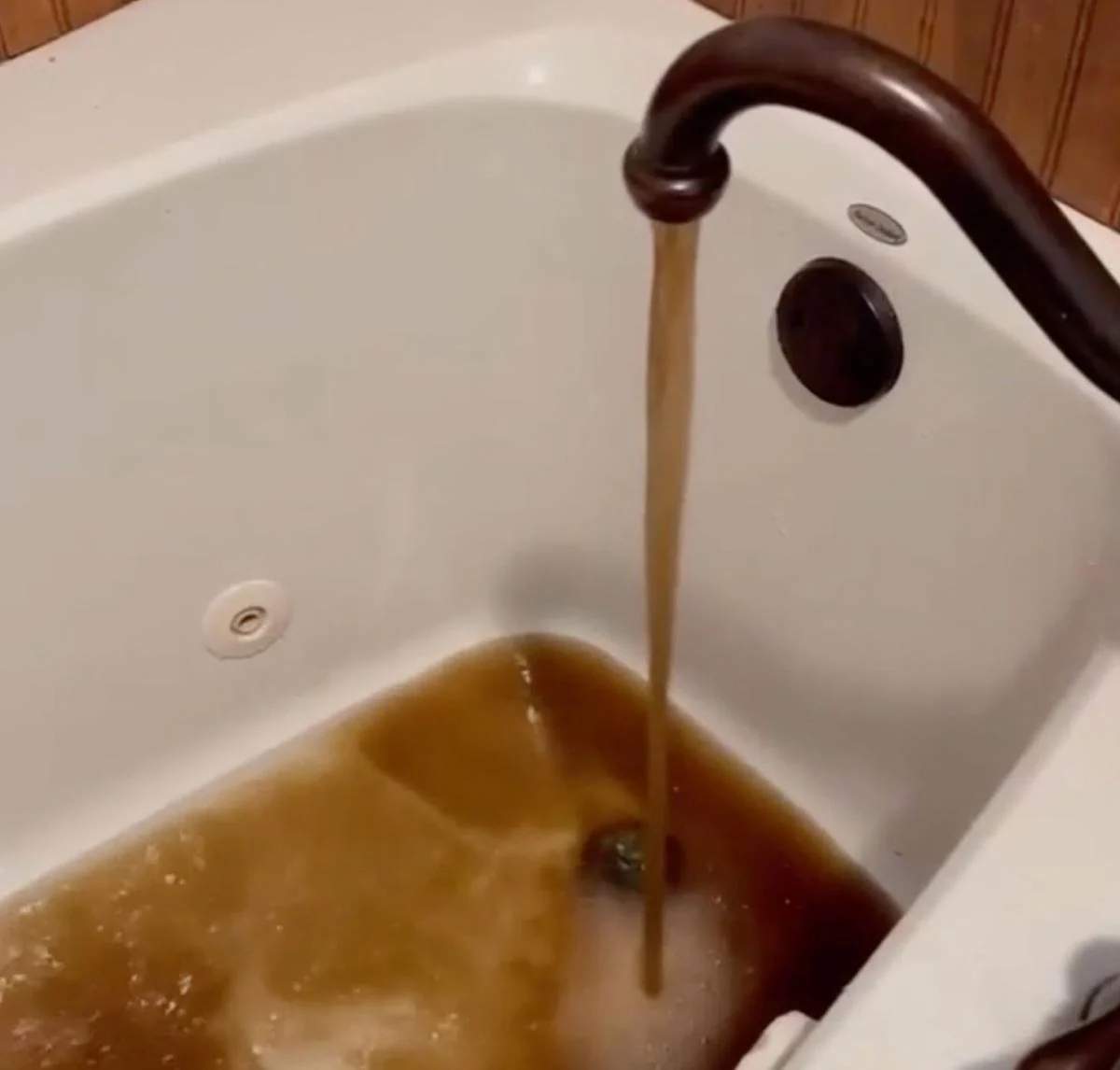
In early April 2026, residents began posting in a local Facebook group called "The New Age Trinidad Texas" about something happening every time they turned on their taps. The water was brown. Murky. Chunky in places. It left dark residue in sinks, bathtubs, and washing machines. It smelled wrong. Some people said they'd been getting sick — stomach issues, skin reactions, symptoms they couldn't explain but that started around the same time the water changed.
On April 2, a Trinidad resident named Emmily Emerine Stearman posted a detailed, technical breakdown of what she believed was happening. She cited EPA guidance about distribution system deterioration. She named the symptoms of pipe failure — discoloration, particulate matter, intermittent worsening after flushing. She provided residents with three regulatory paths to file complaints: the Texas Commission on Environmental Quality (TCEQ), the EPA, and the City of Trinidad itself. She even included copy-paste complaint language so people wouldn't have to figure out how to say it themselves.
The post drew over a hundred comments. And the comments themselves told the story of a town that had been living with this problem for far longer than a few weeks.
Jan Dover, identifying herself as a 35-year resident, wrote that she planned to sell her home and attributed cancer in the community to the water. Allison McCormick Cox wrote that TCEQ "has been involved so many times over the years." Linda Maxwell wrote simply: "It's the old cast iron pipes." Flor Hernandez Gaspar said the city had given her a written warning three years earlier about cancer and chemical concerns from drinking the water. Serena Feagin wrote that Trinidad's budgets were "fabricated" and that she had previously been arrested "for things I never did" while raising the same concerns about misuse of public funds.
This was not a new crisis. This was a crisis that had been simmering for years — maybe decades — in a town that didn't have the money, the political will, or the institutional courage to fix it.
Jennifer Combs, a resident of nearby Kerens who ran a community Facebook page called Southern Belle Watch, saw the posts and did what any person with a functioning conscience would do. She started asking questions.
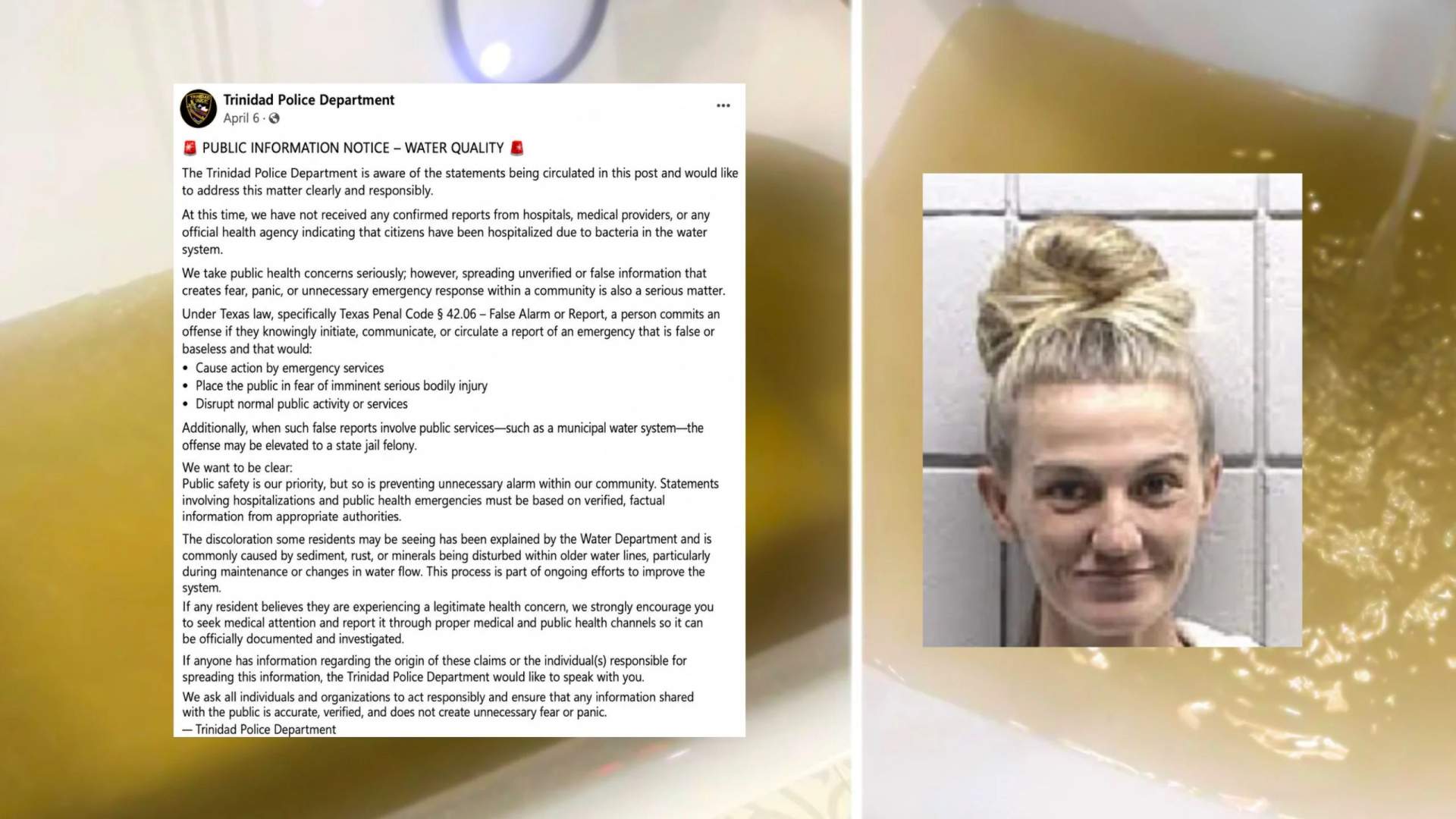
Facebook post paired with Combs mug shot over images of the filthy water.
The Post
Combs posted on her Southern Belle Watch page in early April. The core of the message was straightforward:
"We have received reports that some citizens have been hospitalized due to bacteria in the water. This is a serious public health concern that deserves immediate attention. If your water looks discolored, contains sediment, has a strong odor, or you have experienced related health issues, please send us a message. We are gathering information and reporting findings to the state."
She included photographs that residents had sent her. Brown water. Dark, opaque, river-like liquid pouring from kitchen faucets and bathtub spouts. The kind of images that make your stomach tighten when you realize people were drinking this.
She was not making things up. She was aggregating what residents had already been publicly posting — complaints about the water, claims of illness, questions about why nothing was being done. She was acting as a citizen journalist, which is precisely what she described herself as. She had previously served on the Kerens Community Development Committee and had run for Kerens City Council. She was not a random troll. She was a community member doing the work that local media wasn't doing and local government refused to do.
The response from the City of Trinidad was swift. And it was not to fix the water.
The Threat
On April 6 — four days after Stearman's detailed technical post and shortly after Combs began amplifying the concerns — the Trinidad Police Department posted a "PUBLIC INFORMATION NOTICE: WATER QUALITY" on its official Facebook page.
The notice did not address the water. It addressed the people talking about the water.
The department cited Texas Penal Code §42.06, the False Alarm or Report statute, which makes it a crime to knowingly make a false report involving an emergency. The notice specifically highlighted that when such a report involves a public water supply, the offense "may be elevated to a state jail felony."
The post included a screenshot of Combs' Southern Belle Watch page. It did not name her directly, but the message was unmistakable: stop talking about the water, or we will arrest you.
This was not a correction. It was not a reassurance. It was a threat delivered from a police department's official social media account, weaponizing a criminal statute against a woman who was quoting residents' own complaints.
Think about that for a moment. A police department — an institution theoretically tasked with protecting public safety — used its official platform to threaten felony charges against a citizen for raising concerns about public safety.
The Boil Notice
Fifteen days later, on April 21, the City of Trinidad issued a formal Boil Water Notice on its official Facebook page.
The notice told residents to boil water before drinking, cooking, washing dishes, or using it on cuts. The Trinidad Police Department — the same department that had threatened felony charges for talking about water contamination — shared that boil water notice on its own official page.
The same agency that, fifteen days earlier, had cited a felony statute to silence discussion of contaminated water was now publicly confirming that the water was, in fact, not safe.
The irony was not subtle. The contradiction was not ambiguous. The Trinidad Police Department had warned the public that claiming the water was dangerous was a crime. Then the city confirmed the water was dangerous. Then the police department shared that confirmation. Then, two and a half weeks after that, they arrested the woman who had been right all along.
Chief Gregory would later claim the boil water notice was merely a "precautionary measure" due to "low chlorine residual levels" in parts of the water system. But a precautionary measure is still an admission that the system is compromised. You don't tell people to boil their water if the water is fine. And you don't arrest someone for warning people about a problem that your own city subsequently confirmed exists.
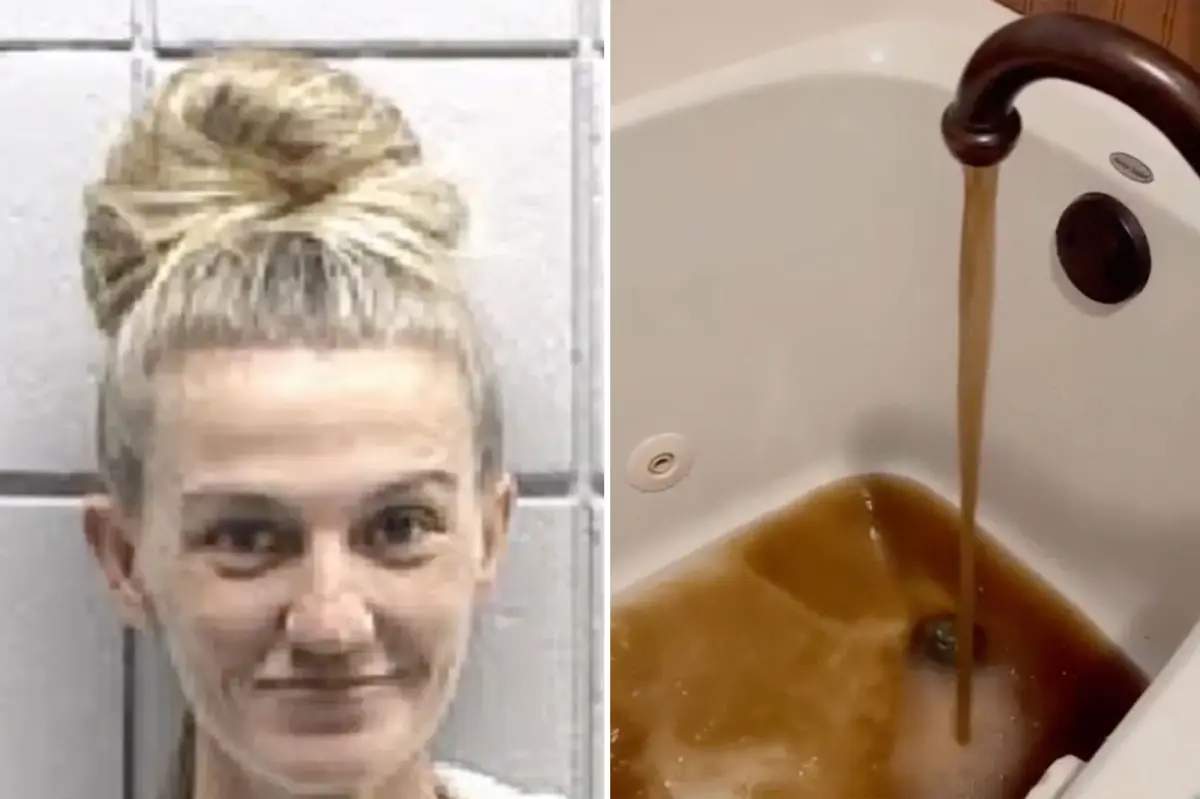
Jennifer Combs mugshot paired with photo of her home bathtub water.
The Arrest
On May 8, 2026, at 5:36 PM, Jennifer Combs was booked into the Navarro County Justice Center. The charge: FALSE ALARM OR REPORT. The charging agency: Trinidad Police Department. The level: state jail felony.
She had never received so much as a speeding ticket.
A confidential source with direct knowledge of the investigation later confirmed two critical facts to Watchtower CI, a local outlet that has been tracking the case: the arrest was based specifically on the social media post, and the charge was escalated to a state jail felony explicitly because the speech concerned a public water supply. Texas law allows that escalation. Trinidad chose to use it. For a Facebook post.
Combs spent 23 hours in jail. In her interview with Fox 4 Dallas reporter David Sentendrey, she described the experience as "probably one of the most humiliating things I've ever gone through in my entire life. It was very, very bad."
Two days after the arrest, Chief Charles Gregory posted on the department's Facebook page calling the case "cut and dry." He stated that Combs' claims about hospitalizations "are simply false and have only caused unnecessary fear and confusion in our community."
But Combs maintains that multiple citizens had posted to Trinidad PD's own Facebook page stating they were hospitalized or otherwise affected by the water. The mayor himself told reporters he had at least seen social media posts making the same claims. And the city's own contracted water system operator, Jeremy Crocker, confirmed on a public Facebook thread on May 10 that Trinidad's pipes are old cast iron with built-up scale breaking off into residents' lines, and that the city was performing an active chemical conversion to clean the pipes.
"Once this stuff breaks off the inner walls of the pipes it has to be flushed out," Crocker wrote. "There is so much of it that it is getting in people's lines as well."
This is not a man describing a system that's working. This is a man describing an infrastructure failure in real time.
The Second Arrest
The story didn't end with Combs.
Winston Noles, a citizen journalist who goes by Otto the Watchdog and has approximately 80,000 YouTube subscribers, traveled to Trinidad to protest Combs' arrest. He held up a sign outside the Trinidad Police Department. Eighteen minutes into his livestream, he was arrested and charged with misdemeanor disorderly conduct for the sign.
The sequence was almost farcical: a woman arrested for a Facebook post about water quality, then a man arrested for protesting the woman's arrest for a Facebook post about water quality. The city was not solving the water problem. It was solving the talking-about-the-water-problem problem.
A municipal judge dismissed Noles' case on May 21. The same day, a Henderson County grand jury no-billed Combs' case — meaning it was dismissed due to a lack of evidence. The criminal case collapsed almost as quickly as it was brought, which itself tells you everything you need to know about the strength of the original charges.
The Cover-Up Unravels
In the days following the arrests and dismissals, a disturbing picture of the city's internal dynamics began to emerge.
Combs filed a 43-page federal civil rights lawsuit in the Eastern District of Texas on May 19. The case — Combs v. Gregory, No. 6:26-cv-00235 — names the City of Trinidad, Police Chief Charles Gregory, another police officer, and a sitting Trinidad City Council member, Marie Bannister, as defendants.
Her attorney, CJ Grisham, delivered a statement that painted the situation in stark terms:
"The City of Trinidad has become a cautionary tale of what happens when unchecked ego masquerades as governance. At the center of this ongoing constitutional crisis is the case of Jennifer Combs, whose unlawful treatment by city officials exposed a pattern of corruption, retaliation, and abuse of power that has infected the entire municipal apparatus. Rather than course-correct, city leadership has chosen to double down on its misconduct by engaging in an escalating campaign of retaliatory firings, punishing employees whose only offense was bearing witness to the truth or refusing to participate in the cover-up."
Retaliatory firings. Employees punished for "bearing witness to the truth." Refusals to "participate in the cover-up."
These are not the words of a routine civil dispute. These are the words of a town eating itself to protect a secret.
Grisham, notably, is a conservative civil rights attorney and the founder of Open Carry Texas — not exactly the profile of a left-wing activist looking for a cause. The fact that he's willing to go on the record with language this strong suggests the underlying facts are worse than what's public.
Then Trinidad City Hall abruptly closed. For unknown reasons. Until at least the following Tuesday. Carol Countryman, a veteran East Texas reporter who drove to Trinidad to cover the story, found a sign on the city office door announcing the closure. She described a town "visibly afraid of speaking." At one gas station, employees told her they had been instructed not to discuss the water situation with reporters. One resident admitted she feared being arrested for speaking publicly.
This is Trinidad, Texas in 2026: a town of 860 people where you can't talk about the water, you can't protest the people who won't let you talk about the water, and city employees are allegedly being fired for knowing too much about the water.
The Infrastructure
Let's talk about what's actually in the ground.
Mayor Dennis Haws confirmed to Fox 4 that portions of Trinidad's water infrastructure date back to the 1950s. The city was incorporated in 1955. That means pipes that were laid when Dwight Eisenhower was president — before the Civil Rights Act, before the Clean Water Act, before virtually every modern water safety standard existed — are still carrying the drinking water for 860 people in 2026.
Haws acknowledged the city is "struggling, without question" with its water supply and that replacing the infrastructure would be "very expensive." He would not confirm whether anyone had gotten sick from the water.
But the historical record tells its own story. TCEQ logged a complaint from a Trinidad resident in 2009 about yellow water and an unpleasant taste and odor. The city achieved compliance later that year. Seventeen years ago. And here we are again, with the same pipes, the same problems, and now a woman in a jail cell for pointing it out.
The Environmental Working Group's tap water database lists contaminants of concern for Trinidad's water system. The contracted operator, Jeremy Crocker, has confirmed on the record that the city is running an "active chemical conversion" to clean decades of scale buildup from the cast iron pipes — a process that itself can temporarily worsen water quality as the buildup breaks loose and enters the supply.
TCEQ has confirmed it received a complaint about Trinidad's water quality and that an investigation is ongoing. The agency has not released findings.
The Precedent
There is a pattern in American life, and it goes like this: ordinary people notice something wrong with the systems that are supposed to protect them. They speak up. The institutions responsible for those systems attack them. The institutions are later proven wrong. The people who spoke up are never made whole.
Flint, Michigan is the canonical example. Residents spent months complaining that their water smelled foul, looked discolored, and was making children sick after the city switched water sources in 2014. Officials at every level — local, state, federal — repeatedly assured the public that the water was safe. It took more than a year before the state acknowledged dangerous lead contamination. By then, thousands of children had been exposed. The people of Flint knew something was wrong before anyone in power was willing to admit it.
Trinidad is not Flint. The scale is different, the contaminants may be different, the bureaucracy is different. But the architecture of the cover-up is identical. The people who live with the problem are the first to identify it. The institutions that should fix it are the first to deny it. And the people who speak up are the first to be punished.
Dale Carpenter, a constitutional law professor at SMU, reviewed Combs' case and questioned whether any crime had occurred at all. "People sometimes make false statements on matters of great public interest," he told Fox 4, "and they're allowed to do so." The First Amendment, he noted, provides broad protection for speech about public concerns — even if some of that speech turns out to be inaccurate.
But that's the thing. Combs' speech wasn't inaccurate. The water was brown. The boil water notice was real. The pipes were from the 1950s. The TCEQ investigation is ongoing. The only thing that was false was the police department's claim that there was nothing to worry about.
What Happens Next
As of this writing, the criminal charges against both Combs and Noles have been dismissed. The federal civil rights lawsuit is proceeding. TCEQ's investigation into Trinidad's water quality is ongoing. Trinidad City Hall reopened after its unexplained closure. The water, by all available evidence, is still a problem.
The city has not released the arrest affidavit, the criminal complaint, or the magistrate's order. Watchtower CI has filed public information requests for those documents. The city has not responded.
Multiple residents have reported that they are afraid to speak publicly. One told a reporter directly that she feared being arrested for talking about the water. Gas station employees were instructed not to discuss it. A former city council member, Paul Kern, was seen on Facebook asking about Combs' "known associates" after her arrest — the language of a police investigation, not a small-town council meeting.
Jennifer Combs has said she created her Facebook page "after seeing citizens publicly share concerns about their water and their community." She asked questions. She gathered information. She refused to ignore people who felt like nobody was listening.
For that, the City of Trinidad put her in a jail cell for 23 hours and charged her with a felony.
The water is still brown. The pipes are still from the 1950s. The investigation is still open. And the people who tried to sound the alarm are the ones who got treated like criminals.
That's not governance. That's a cover-up wearing a badge.
Trinidad, Texas. Population 860. Where the water is brown, the Facebook posts are felonies, and the people in charge would rather arrest a mother than fix a pipe.
Sources & Methodology(7 sources)
Filed Under
Frequently Asked Questions
- Who is Jennifer Combs?
- Jennifer Combs is a resident of Kerens, Texas who runs the Facebook page Southern Belle Watch. She was arrested on May 8, 2026 on a felony charge of false alarm or report after posting about contaminated water in Trinidad, Texas. She had no prior criminal record, not even a speeding ticket.
- Why was Jennifer Combs arrested?
- Combs was arrested under Texas Penal Code Section 42.06 for posting on her Facebook page that Trinidad residents had been hospitalized due to bacteria in the water supply. The Trinidad Police Department escalated the charge to a state jail felony because the post involved a public water system. The charges were later dismissed by a Henderson County grand jury.
- Was the water in Trinidad, Texas actually contaminated?
- Yes. The City of Trinidad issued a boil water notice on April 21, 2026 telling residents to boil water before drinking, cooking, or bathing. The Texas Commission on Environmental Quality confirmed it received complaints and has an ongoing investigation. Mayor Dennis Haws acknowledged the city's water pipes date back to the 1950s.
- What happened after the arrest?
- A Henderson County grand jury declined to indict Combs in a no-bill decision. A second arrestee, citizen journalist Winston Noles known as Otto the Watchdog, also had his charges dismissed by a municipal judge. Combs filed a 43-page federal civil rights lawsuit against the City of Trinidad, Police Chief Charles Gregory, another officer, and a city council member.
- What is the current status of the case?
- As of May 2026, the TCEQ investigation into Trinidad's water quality is ongoing. The federal civil rights lawsuit Combs v. Gregory, No. 6:26-cv-00235, is proceeding in the Eastern District of Texas. Trinidad City Hall briefly closed for unexplained reasons after the arrests drew national media attention.
- What is Texas Penal Code Section 42.06?
- Texas Penal Code Section 42.06 makes it a crime to knowingly make a false report involving an emergency. The offense is elevated to a state jail felony when the report involves a public water, gas, or power supply. Trinidad police used this felony enhancement provision against Combs for her Facebook post about water quality.