

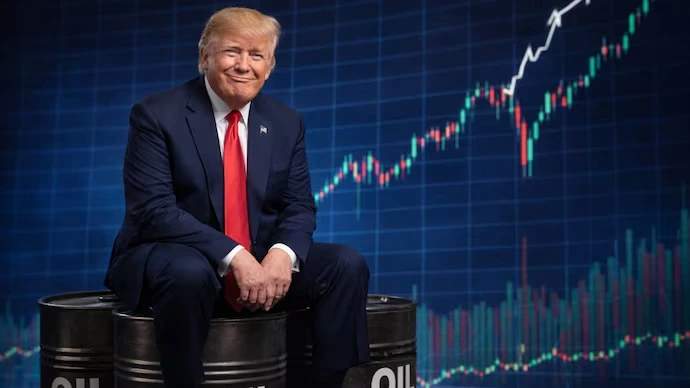
The trades arrived in a blur of algorithms and milliseconds, timed with the precision of a bomb timer.
At 12:24 GMT on April 17, 2026, investors slammed roughly 7,990 lots of Brent and WTI oil futures into the market — a bet worth about $760 million that oil prices would fall. Twenty minutes later, Iran's foreign minister posted on X that the Strait of Hormuz was "completely open for the remaining period of ceasefire," part of the fragile Lebanon truce. Oil prices immediately plunged by as much as 11%.
The shorts minted money. The timing was perfect.
This wasn't a lucky guess. It was the third suspiciously well-timed wager in less than a month — part of a pattern stretching back to Trump's first term that represents potentially the largest instance of insider trading in American history.
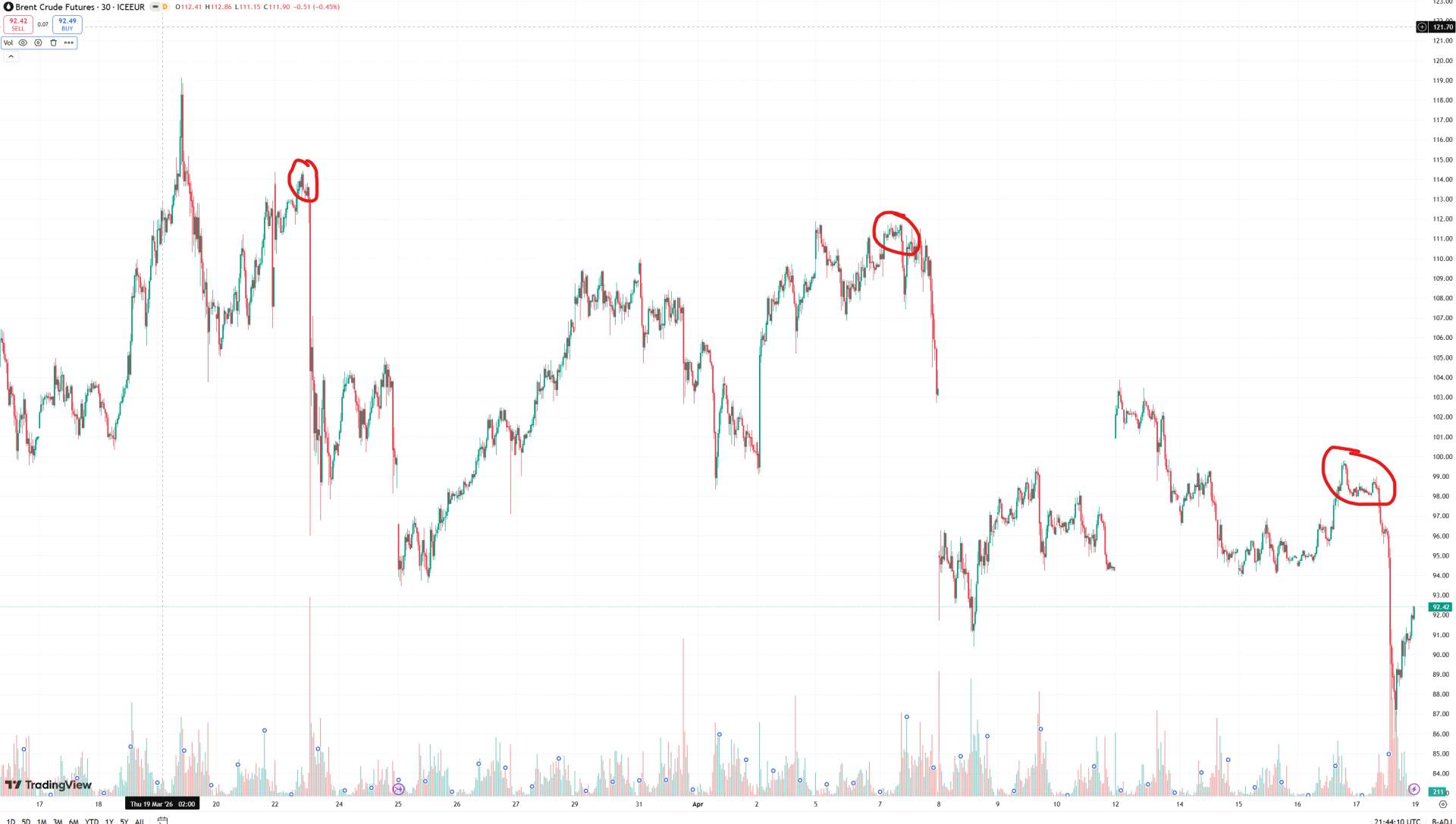
30 day Brent Crude Oil Futures chart highlighting the timing of the trades.
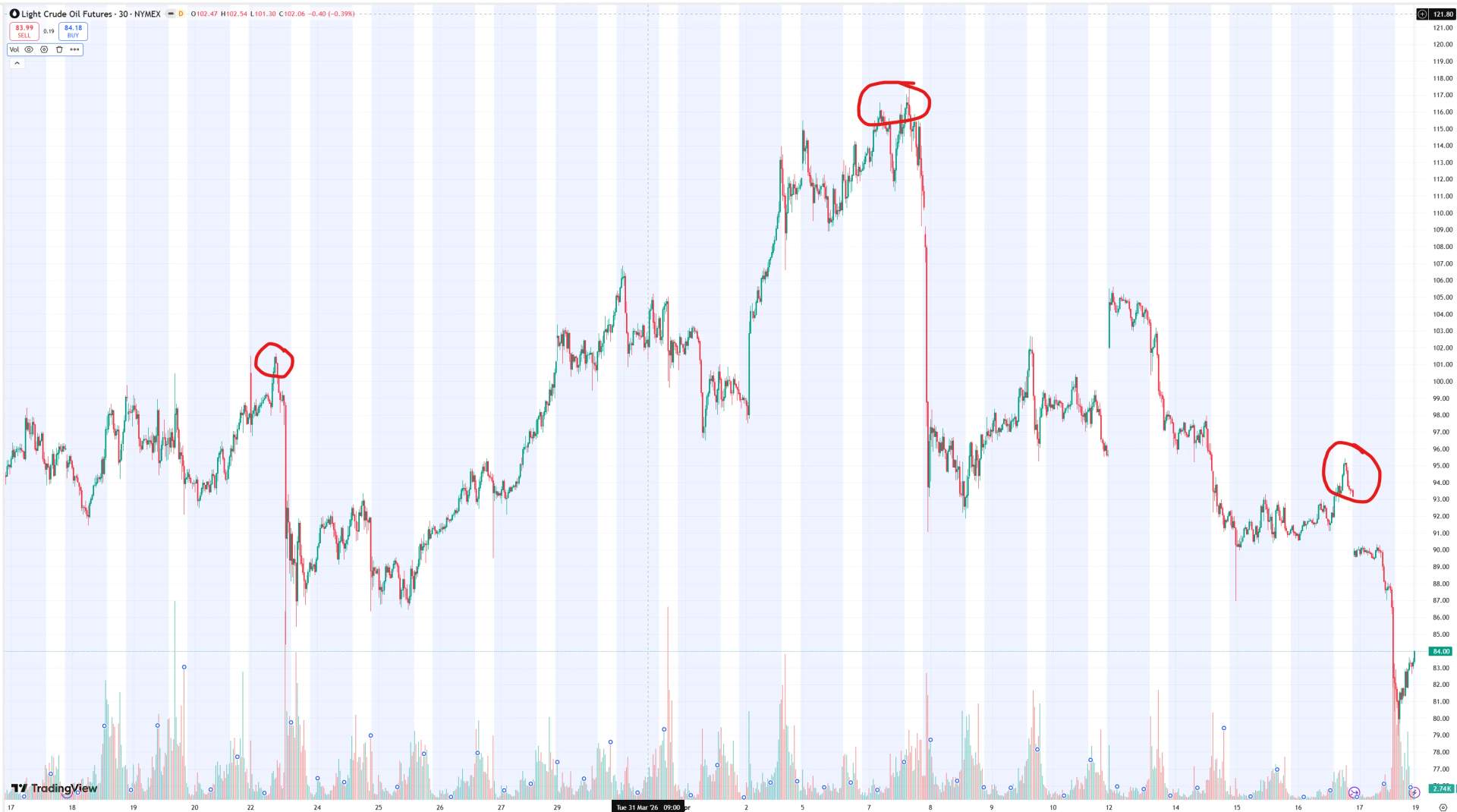
30 day WTI Crude Oil Futures chart highlighting the timing of the trades.
The $2.2 Billion Pattern
The April 17 trade was the latest in a series of bets that have defied statistical probability.
April 7, 2026: Investors sold a combined 8,600 lots of Brent and U.S. crude futures at 19:45 GMT — approximately $950 million betting on falling oil prices. Just hours later, at 22:30 GMT, Trump announced a two-week ceasefire with Iran, stepping back from threatening the destruction of "a whole civilization." Crude futures crashed 15% to below $100 a barrel.
March 23, 2026: At 6:49 AM Eastern Standard Time, roughly 6,000 oil-trading contracts, worth more than half a billion dollars, changed hands. Simultaneously, there was a surge in contracts tied to the S&P 500 stock index. According to data analyzed by Bloomberg, the trading volume was approximately nine times the average level for that time of day. Shortly after 7 AM, Trump announced that he was postponing attacks on Iran's energy infrastructure for five days. Crude plunged more than 10%. Stock futures jumped about 2.5%.
The trades weren't random. Someone was selling oil futures and buying stock futures — a precise bet on de-escalation before the world knew it was coming.
Mike Khouw, a veteran futures trader and portfolio manager who used to run a derivatives desk at Cantor Fitzgerald, told The New Yorker that the timing "kind of smells like something was off." These were large positions requiring tens of millions in margin reserves, placed by sophisticated traders or institutions. "You are not dealing with a rube," Khouw said. "You are not dealing with someone whose other occupation is working at Starbucks."
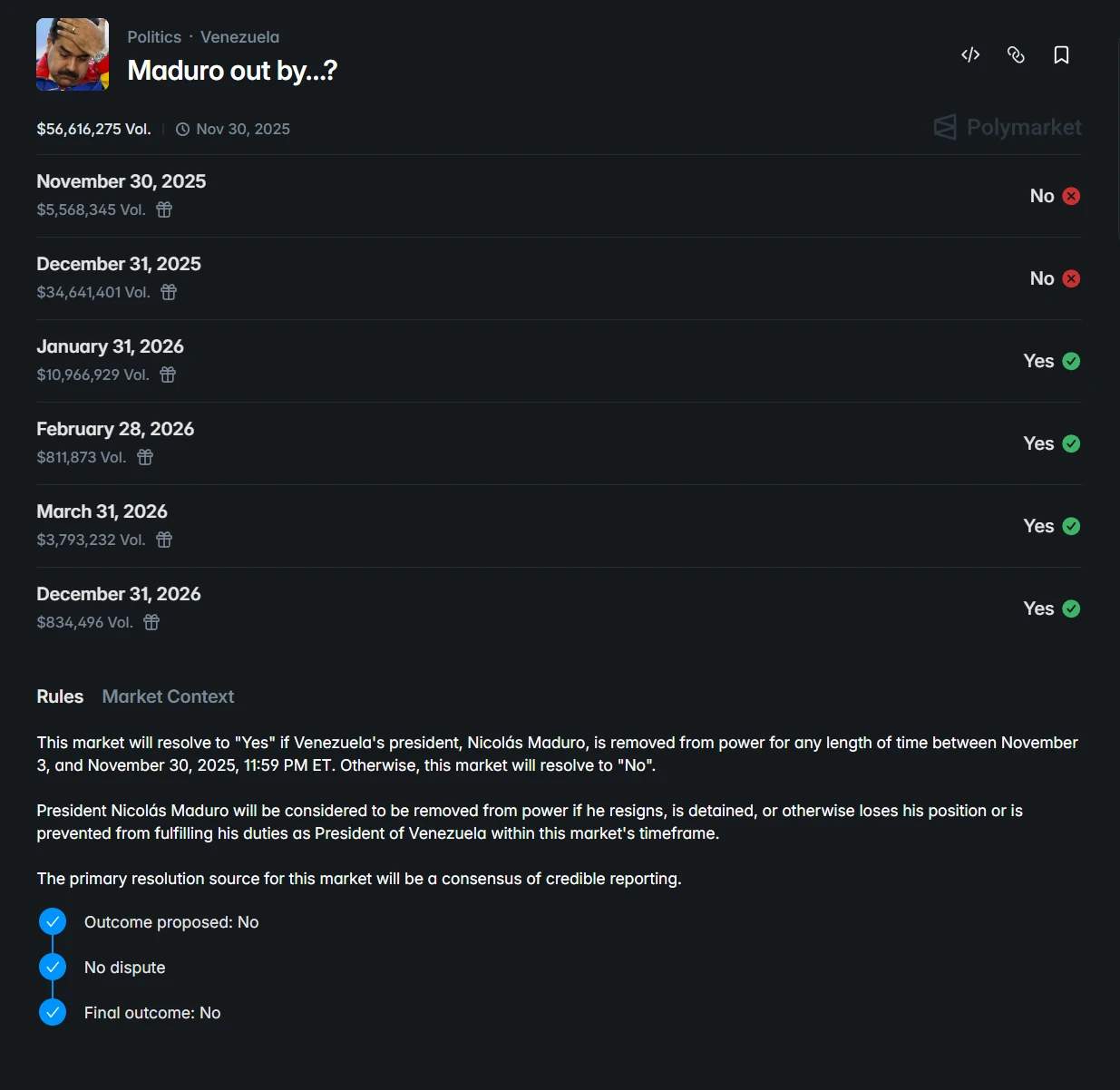
The Polymarket prediction for the capture of Nicolás Maduro.
It's Not Just Iran
The pattern extends beyond the Iran war.
January 3, 2026: A mysterious new user on the prediction market Polymarket bet $35,000 on Venezuelan President Nicolás Maduro being forced out of power by January 31, when the market estimated the probability at only 6 percent. Hours later, Trump announced that the United States had bombed Venezuela and abducted Maduro and his wife. The account made over $400,000 in less than a day. The account had been created on December 27 and had only bet on two things: the U.S. invading Venezuela, and Maduro being ousted.
April 9, 2025: At 9:30 AM, Trump posted on his social media platform Truth Social: "THIS IS A GREAT TIME TO BUY!!! DJT." Less than four hours later, he shocked investors by announcing a 90-day pause on additional trade tariffs on most countries except China. The S&P 500 closed up more than 9%, the Nasdaq more than 12%. Trump Media & Technology Group (ticker: DJT) stock shot up 22%. Republican Rep. Marjorie Taylor Greene disclosed that she had purchased shares in Amazon and Apple on April 3 and 4 — days when markets fell after Trump detailed his "Liberation Day" tariffs.
The Democratic senator Adam Schiff called it "a tsunami of corruption that is sweeping through Washington." The Democratic senator Chris Murphy was more direct: "Insider trading scandal is brewing. Who knew ahead of time and how much money did they make?"
The Watchdogs Have Been Muzzled
If there were ever an investigation that demanded aggressive regulatory action, this is it. But the agencies tasked with policing such conduct have been systematically weakened under the Trump administration.
The U.S. Commodity Futures Trading Commission (CFTC), which has primary responsibility for enforcing laws in the futures markets, is investigating the March 23 and April 7 trades, according to a source familiar with the matter. But the agency's leadership doesn't inspire confidence.
CFTC Chairman Michael Selig is a 36-year-old lawyer and crypto booster. Last week, Selig announced the creation of an "innovation task force" centered on three industries — crypto, prediction markets, and AI — in which the Trump family now has business interests. "The CFTC seems to be more focussed on promoting crypto, prediction markets, and A.I. than its core function: investigating and preventing manipulation in the futures markets," Ben Schiffrin, a former SEC attorney now with the public-interest group Better Markets, told The New Yorker.
The Securities and Exchange Commission (SEC), which often cooperates with the CFTC on insider-trading investigations, has been similarly compromised. Its chair, Paul Atkins, is a Trump appointee with strong links to the crypto industry. Earlier this month, Margaret Ryan, the director of the SEC's enforcement division, resigned after just six months in the job. According to Reuters, Ryan wanted to be more aggressive in pursuing charges for fraud and other misconduct — including cases that touched the president's circle — but faced resistance from Atkins and other top Republican appointees.
Under Atkins, the SEC has filed 300 enforcement cases, compared with 2,700 under his predecessor, Gary Gensler, who was a Biden appointee.
But the most devastating blow to accountability came at the Justice Department.
From 36 Lawyers to Two
When Donald Trump took office eight months ago, the Department of Justice had 36 experienced attorneys assigned full-time to investigate corrupt politicians and police officers in the Public Integrity Section. Today it has two.
All the other lawyers have either quit under pressure, resigned in protest, or been detailed to other matters across the nation, according to multiple sources. The section has also lost all but one of more than a dozen paralegals.
"To me, it just screams that public corruption cases are no longer a priority of DOJ," Andrew Tessman, a prosecutor who left the Justice Department this month, told NOTUS. "I cannot understand why we would want to restrict that section."
The Public Integrity Section, created in 1976 in the aftermath of Watergate, was designed to prosecute corrupt officials regardless of party. It was the unit that would have handled any criminal case arising from these suspicious trades.
Now it's effectively dead.
The Trump administration has also torn down the communication wall between the Justice Department and the White House, effectively shut down the Merit Systems Protection Board used by employees to challenge their firings, and disbanded the DOJ task force that cracks down on unregistered foreign agents engaged in political activities.
When there are only two lawyers left to advise the 94 U.S. attorneys' offices on how to build cases against crooked government officials, the consultation requirements become meaningless. "In reality, the advising function becomes a box-checking exercise," Michael Romano, a former prosecutor on the team, told NOTUS.
The Money Trail
So who made these trades? The answer matters.
The CFTC has requested Tag 50 identifications from the exchanges — the data field that reveals the entities behind trades. These identifications will show whether the trades came from hedge funds, institutional investors, or offshore accounts tied to Trump insiders.
But here's what we know already:
These were not retail investors making lucky bets. The March 23 trades required tens of millions in margin reserves. The April 7 trades — 8,600 lots representing roughly 1% of the day's total volume — were executed in a single block after settlement, which is unusual because large positions are typically spread across exchanges and executed algorithmically over hours to avoid price impact.
Someone with advance knowledge of Trump's decisions — or someone with access to someone who had that knowledge — placed these bets.
The circle of people who knew Trump would delay attacks on Iran's energy infrastructure, or that a ceasefire was imminent, or that Maduro would be captured, was relatively small. The trades occurred on regulated exchanges, where identities can be traced.
There is no technical barrier to finding out who placed these bets. The only barrier is political.
The Cost to the Public
This isn't just about a few traders getting rich on inside information. It's about the integrity of markets that ordinary Americans rely on for their savings, their retirement, their economic security.
When insider trading of this magnitude goes uninvestigated, it tells the public that the game is rigged. It tells them that the rules apply to everyone except the people with connections to power.
The April 17 trade alone — $760 million in shorts placed 20 minutes before a market-moving announcement — suggests that someone made a fortune by betting on de-escalation while the rest of the world was still bracing for escalation. The profits from these trades likely ran into the hundreds of millions.
That money came from somewhere. It came from the ordinary investors on the other side of these trades — pension funds, mutual funds, individual traders who didn't have the luxury of advance knowledge.
What Happens Next
Rep. Ritchie Torres (D-NY) has called on the SEC and CFTC to open a formal investigation, obtain comprehensive trading records including beneficial ownership information, and provide a timely public update. Torres described the trading activity as "potentially the largest instance of insider trading in history."
Sen. Elizabeth Warren (D-MA), the ranking minority member of the Senate Banking Committee, has warned that "a tsunami of corruption is sweeping through Washington — a tsunami whipped up by the President of the United States."
But with the CFTC focused on crypto "innovation," the SEC's enforcement director forced out for pursuing cases too aggressively, and the Justice Department's anti-corruption unit gutted from 36 lawyers to two, the question is whether anyone will actually do anything about it.
The trades are documented. The pattern is clear. The regulatory capture is undeniable.
The only thing missing is accountability.
The Information War
In geopolitics-fueled oil markets, information is the ultimate weapon. When billion-dollar bets land perfectly before presidential announcements reshape energy flows and wars, we should ask harder questions about fairness, leaks, and market integrity.
Transparency isn't optional when lives and trillions ride on it.
Coincidence? The odds are astronomical.
Or maybe, just maybe, the "prophets" don't have divine gifts. Maybe they just have friends in high places who are willing to sell information for a cut of the profits.
And maybe, just maybe, the regulatory agencies that should be investigating this have been systematically dismantled to ensure that no one ever finds out who they are.
This is how corruption works in the second Trump administration. It's not hidden. It's not subtle. It's right there in the trading data — $2.2 billion in bets placed with impossible timing, while the agencies that should be investigating are being dismantled piece by piece.
The working class burns warehouses while the connected class burns the markets. The justice system has two lawyers left to fight corruption while the insiders cash in.
The question isn't whether this is happening. The question is whether anyone will stop it.
Sources & Methodology(8 sources)
April 17, 2026 - Investors placed a bet worth about $760 million on a falling oil price around 20 minutes before Iran's foreign minister announced that the Strait of Hormuz was open. Oil prices fell up to 11% following the announcement.
- Reuters - Traders place large $950 million bet on oil price falling hours ahead of ceasefireNews Article
April 8, 2026 - Investors placed an approximately $950 million bet on oil prices falling just hours before the U.S. and Iran announced a ceasefire. Oil prices plunged 15% following the announcement.
April 15, 2026 - The CFTC is examining a series of trades in oil futures placed shortly before major shifts in Trump's Iran war policy, focusing on trading on CME Group and ICE platforms.
March 2026 - Investigation into the March 23, 2026 trading surge where $500+ million in oil futures were sold 15 minutes before Trump announced delayed strikes. Trading volume was 9 times the average for that time of day.
- NOTUS - The Justice Department Had 36 Lawyers Fighting Corruption Full-Time. Under Trump, It's Down to Two.News Article
September 22, 2025 - Investigation into how the DOJ's Public Integrity Section was gutted from 36 lawyers to 2 under the Trump administration, effectively ending its ability to investigate corrupt officials.
- Rep. Ritchie Torres - Letter Demanding SEC and CFTC Investigate Suspicious Oil Futures TradeDocument
April 2026 - Congressional letter calling for formal investigation into the March 22 oil futures trades, describing the activity as 'potentially the largest instance of insider trading in history.'
April 10, 2025 - Trump posted 'GREAT TIME TO BUY!!! DJT' just hours before announcing a 90-day pause on tariffs. S&P 500 rose 9%, Nasdaq 12%, Trump Media stock jumped 22%.
- The New Republic - Was Someone Insider Trading Right Before Trump's Attack on Venezuela?News Article
January 3, 2026 - A mysterious new user on Polymarket turned $35,000 into $400,000 betting on Maduro's capture hours before Trump announced it. Account was created December 27 and only bet on Venezuela intervention.
Frequently Asked Questions
- What were the three major suspicious oil futures trades?
- On April 17, 2026, traders placed $760 million in oil shorts 20 minutes before Iran announced the Strait of Hormuz was open. On April 7, $950 million in bets were placed hours before a ceasefire announcement. On March 23, $500+ million in shorts were placed 15 minutes before Trump announced delayed strikes on Iran's energy infrastructure.
- Is this pattern limited to the Iran war?
- No. Similar suspicious trading occurred before Trump's January 2026 announcement of the Venezuelan president's capture (a $35,000 bet turned into $400,000 on Polymarket) and before his April 2025 tariff pause announcement (Trump posted 'GREAT TIME TO BUY!!! DJT' 4 hours before announcing the pause).
- What agencies are supposed to investigate this and what's their status?
- The CFTC oversees futures markets and is reportedly investigating, but Chairman Michael Selig is a 36-year-old crypto booster focused on 'innovation task forces' for industries Trump has business interests in. The SEC's enforcement director resigned after 6 months for wanting to pursue cases too aggressively. The Justice Department's Public Integrity Section has been gutted from 36 lawyers to 2.
- How much money was made from these trades?
- The exact profits aren't publicly known, but given the timing and magnitude, the profits likely ran into the hundreds of millions. The April 7 trade alone — $950 million bet on falling oil prices before a 15% price drop — would have generated approximately $142.5 million in profit if fully realized.
- What is Tag 50 and why does it matter?
- Tag 50 is the data field in trading records that identifies the entities behind trades. The CFTC has requested Tag 50 identifications from exchanges, which will reveal whether these trades came from hedge funds, institutional investors, or offshore accounts tied to Trump insiders. This is the key to finding out who placed the bets.