

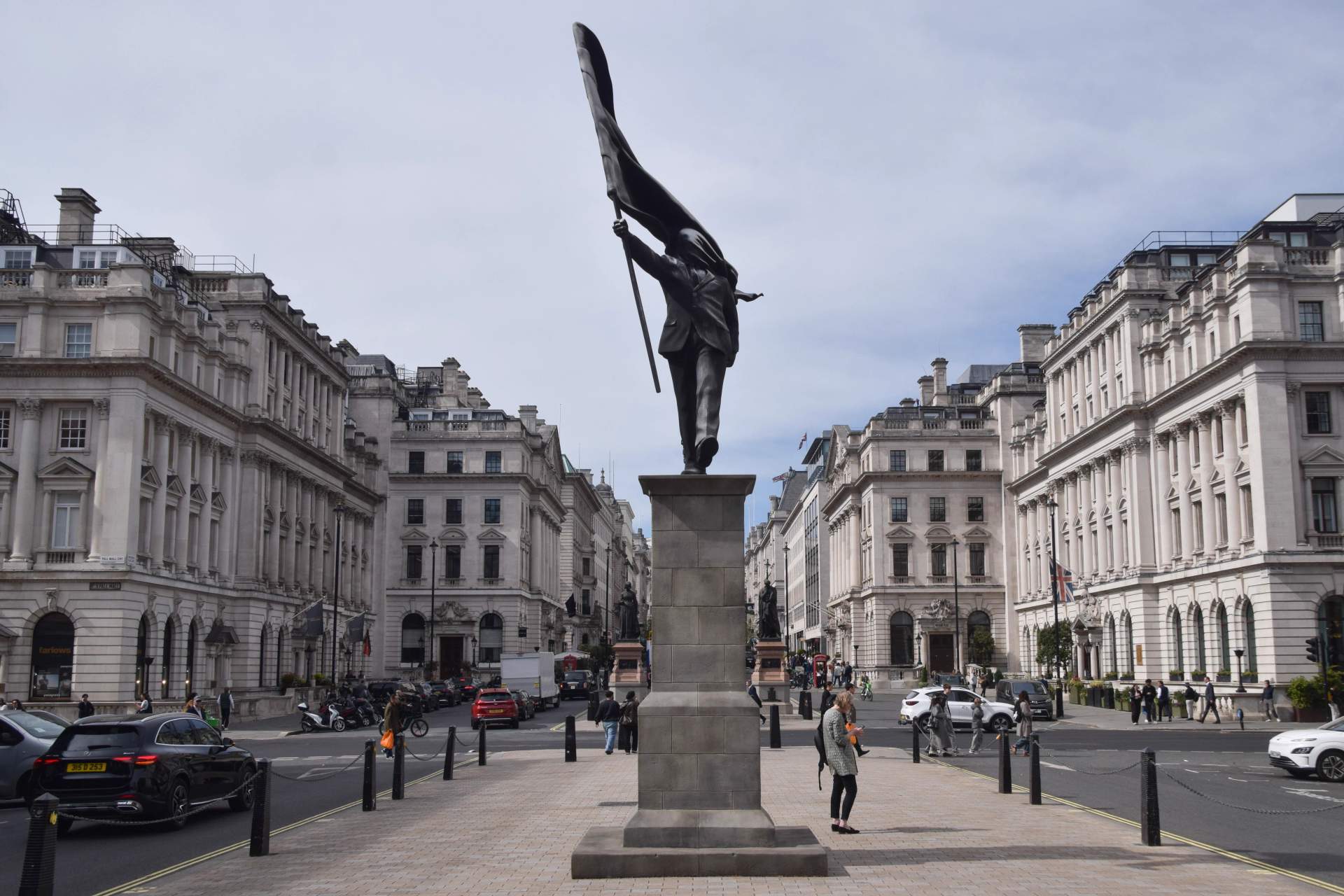
LONDON — In the predawn hours of Wednesday, April 30, 2026, a low-loader truck pulled into Waterloo Place in central London. Workers unloaded a large statue and hoisted it onto an empty plinth. By sunrise, a suited figure stood there — arms outstretched, flag in hand, walking forward with one foot already over the edge.
The flag is billowing into his face. He can't see where he's going. He's about to walk off the plinth.
By Thursday, Banksy had claimed it. By Friday, barriers were up to protect it. And the crowds had already begun to gather, smartphones raised, trying to capture what might be Banksy's most perfectly framed work yet.
The statue is deceptively simple: a man in a suit, blinded by his own flag, stepping off the edge. But nothing about this placement is accidental.
The Location: Imperialism's Ceremonial Heart
Waterloo Place, St James's — this is not just any spot in London. This is the ceremonial heart of the British empire, an area designed in the 1800s to celebrate imperialism and military dominance.
The statue sits among monuments to: King Edward VII, mounted on horseback in imperial splendor; Florence Nightingale, the Crimean War hero; Sidney Herbert, the statesman who oversaw British military expansion; and the Crimean War Memorial, honoring Britain's 19th-century conquests.
It stands in front of the gilded statue of Athena on the façade of the Athenaeum Club — a private gentlemen's club founded in 1824 for men of "accomplishments in science, literature, and the arts," which historically served as a gathering place for the British elite who ran the empire.
Banksy knew exactly where he was putting it. When asked about the location, he offered a typically understated explanation: "There was a bit of a gap."
The gap was in the imperial narrative. The gap was in the unquestioning celebration of British power. The gap was in the monuments that glorify empire without acknowledging the cost.
Banksy filled it.
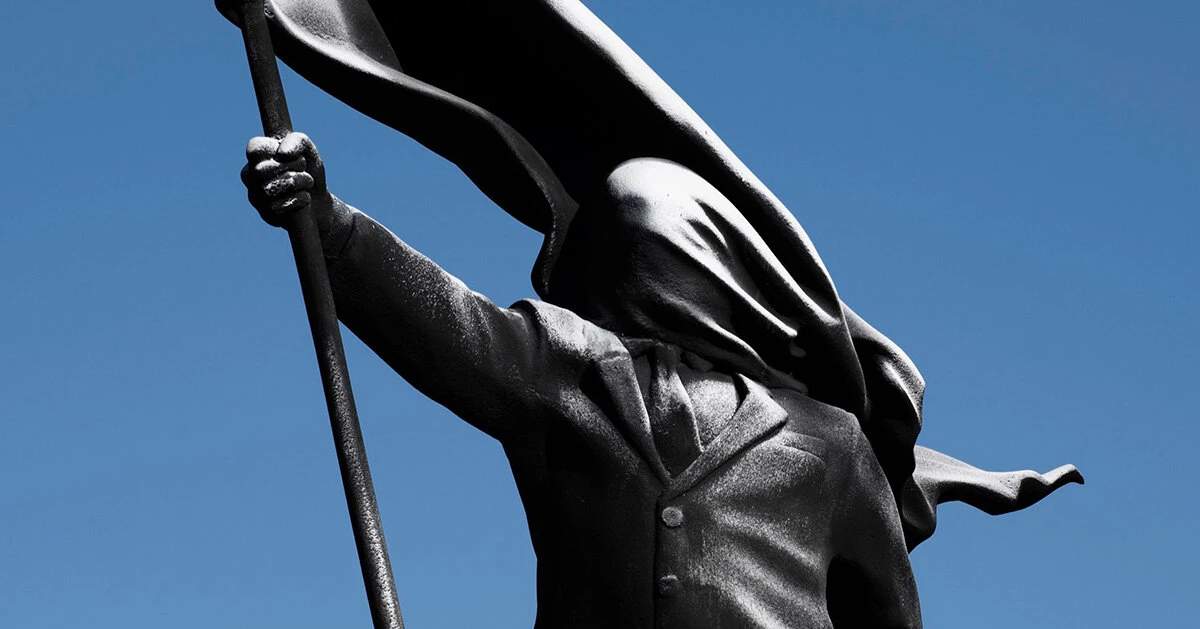
Flag drapes the face of the suited figure close up.
The Visual: Blind Patriotism, Literally
The statue depicts a suited man — a politician, a bureaucrat, a figure of authority — marching forward with purpose. His arms are outstretched, holding a flag that has blown completely into his face.
He is blind.
He is also about to fall. One foot is already off the plinth, suspended in mid-air. He is stepping forward without seeing where he's going.
This is not subtle. This is not ambiguous. This is blind patriotism, rendered in three dimensions.
The flag itself is crucial: it bears no markings. No Union Jack. No national identity. No allegiance to a specific country. It is just a form, a universal symbol of patriotic blindness. As one commentator on Instagram noted: "The flag carries no identity — no country, no allegiance — just a form, making the figure universal… and somehow still unmistakably directed."
That's the point. This isn't about Britain specifically. This isn't about one nation's particular brand of nationalism. This is about the phenomenon of blind patriotism itself — the way that waving a flag can obscure reality, the way that national pride can become a blinding force, the way that marching in step can mean marching off a cliff.
James Peak, creator of the BBC podcast series The Banksy Story, captured it perfectly: "Here, you've got a brilliant comment on a bumptious, chest puffed out man in power with the flag completely obscuring his vision, which is why he is about to fall off the plinth."
The Moment: Nationalism Resurgent
Ollie Isaac, a 23-year-old student who came to see the statue, said he thought it was a response to "the resurgence of nationalism in the world and this country."
He's right.
Across Europe, far-right parties are gaining ground. In the United States, nationalism has become the dominant political force. In Britain, Brexit and the culture wars have normalized a strain of patriotism that is less about celebrating diversity and more about reclaiming a mythical past.
Waterloo Place, surrounded by monuments to imperial conquest, is the perfect place to comment on this resurgence. The statues around it were erected at the height of British imperialism, when the flag was something to be proud of — a symbol of global dominance, of civilizing missions, of the sun that never set on the empire.
Banksy is asking: What happens when that same flag obscures your vision? What happens when you can't see where you're marching because you're too busy waving? What happens when the symbols of power become the source of your blindness?
The answer is in the statue's posture: one foot off the edge. You fall.
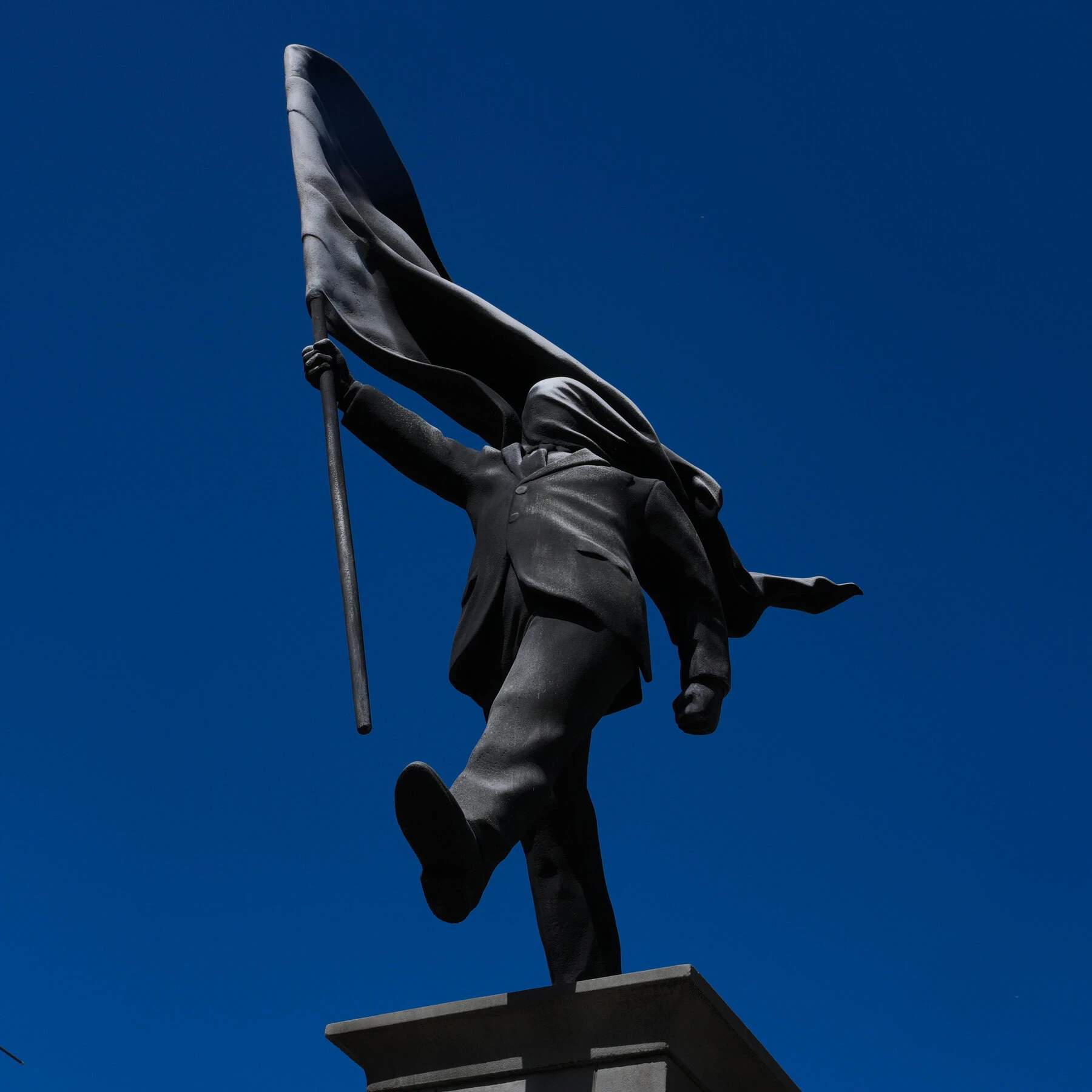
Suited figure blindly marching off his pedestal
The Subversion: Monuments Against Monuments
What makes this piece so devastating is that it's a monument criticizing monuments.
Waterloo Place is filled with statues designed to glorify — generals on horseback, statesmen in heroic poses, figures of authority rendered in stone and bronze for all time. These monuments were created to tell a story: that Britain's power was just, that its empire was noble, that its leaders were visionaries who saw clearly where they were going.
Banksy's statue disrupts that narrative. It uses the same language — a figure on a plinth, monumental scale, bronze or resin in a public space — to tell a different story. It looks like the monuments around it, but it's saying the opposite thing.
The monuments say: Look at our leaders. They saw clearly. They marched forward. They built an empire.
Banksy says: They were blind. They didn't see where they were going. They marched off the edge.
The genius of the placement is that it forces the viewer to look at the surrounding monuments differently. You can't see Edward VII on horseback in the same way once you've seen the Banksy statue. You start to wonder: What was he looking at? Where was he marching? What flag was in his hand?
The monuments become vulnerable to the same critique. The narrative becomes harder to maintain.
The Execution: How Do You Do That in London?
James Peak put it well: "I don't know how he's managed to do it. How has he got a low-loader to there with all the security and put up a massive resin statue?"
That's part of the point. Waterloo Place is in the heart of the British establishment, surrounded by royal palaces and gentlemen's clubs, in one of the most surveilled and secured areas of London. The fact that Banksy could install a large statue there overnight without being caught is itself a commentary on power.
It says: The people who think they control everything — the government, the security forces, the institutions — can be outmaneuvered. A truck and some workers can get through their defenses. A piece of art can appear in the most protected space and force a conversation they didn't want to have.
This is what Banksy does. He finds the spaces where power thinks it's untouchable and shows that it's not.
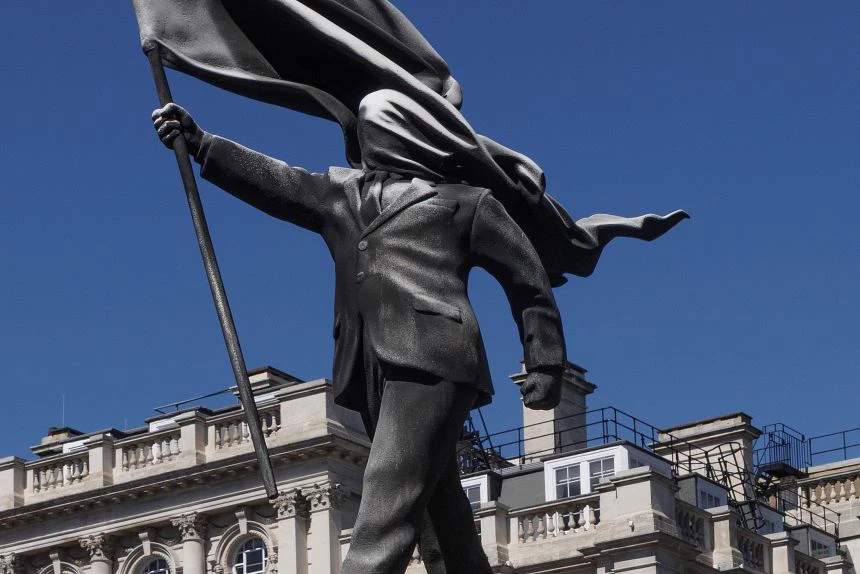
Close up shot of the statue
The Broader Context: Every Piece Is A Campaign
Peak said it: "Every (Banksy) piece is a campaign."
This statue isn't just art. It's part of a broader political project. Banksy has spent three decades using public spaces to critique power, to challenge assumptions, to force people to see what they'd rather ignore.
In 2004, he installed "The Drinker" in London — a subversive take on Rodin's "The Thinker," featuring a bronze figure wearing a traffic cone as a hat. It was stolen soon after, but the point was made: the icons of Western art history are not sacred. They can be mocked, recontextualized, turned against themselves.
In 2024, he created an animal trail around London — a goat, elephants, a gorilla, monkeys, piranhas, a rhino, pelicans — appearing across the city overnight. The pieces were installed on both private and public property, removed soon after they appeared. But again, the point was made: the city is not a monolith. It can be populated with different stories, different creatures, different ways of seeing.
This statue in Waterloo Place is the next step in that project. It's more permanent, more monumental, more directly confrontational. It's not just asking people to see differently — it's forcing them to confront a narrative they've been ignoring.
The Reception: Who's Blind Now?
Westminster City Council's response was telling: "We're excited to see Banksy's latest sculpture in Westminster, which makes a striking addition to the city's vibrant public art scene. While we have taken initial steps to protect the statue, at this time it will remain accessible for the public to view and enjoy."
They didn't say what it means. They didn't acknowledge the critique. They called it "vibrant public art" and moved on.
Which is exactly the point.
The institutions that Banksy is critiquing — government, the establishment, the defenders of the imperial narrative — are often blind to the critique itself. They see the art, they see the crowds, they see the media attention. But they don't see the message.
They're like the figure in the statue: carrying the flag, walking forward, unable to see where they're going.
What It Really Speaks To
This statue speaks to several things at once:
Blind Patriotism. The most obvious reading, and the one most commentators have seized on. When patriotism becomes uncritical, when national pride becomes a blinding force, when waving a flag means you can't see what's happening around you — that's when societies walk off cliffs.
The Failure of Leadership. The suit, the authoritative posture, the lack of vision — this is a critique of leaders who are more invested in maintaining appearances than in seeing reality. They march forward because that's what leaders do. They wave the flag because that's what leaders do. They don't see where they're going.
The Fragility of Imperial Narrative. By placing the statue among monuments to empire, Banksy is exposing the fragility of the stories societies tell themselves about their history. The monuments are designed to be permanent, to make certain narratives feel inevitable. But once you introduce an element of critique, once you show the blind man walking off the edge, the whole narrative becomes harder to sustain.
The Power of Subversion. The fact that this statue could be installed in the heart of the British establishment is itself a statement about power. Power is not monolithic. It can be challenged. It can be mocked. It can be forced to see what it would rather ignore.
The Urgency of the Moment. This statue appeared at a time when nationalism is resurgent globally, when democracies are backsliding into authoritarianism, when flags are being used to justify violence and exclusion. Banksy is saying: We need to see what we're doing. We need to pull the flag away from our eyes. We need to look at where we're marching.
The Inevitability of Removal
Every commentator who has spoken about this statue has noted the same thing: "With Banksy, it's a limited time event because it's public art — you don't know how long it's going to be up."
The statue will likely be removed eventually. It might be vandalized. It might be taken by the authorities. It might be stolen, like "The Drinker" was in 2004.
But that's also part of the point.
Monuments to empire are designed to last forever. They're made of stone and bronze because they're supposed to endure, to keep telling the same story for generations.
Banksy's statue is made of resin or fiberglass. It's designed to be temporary. It's designed to make a point in the moment, to disrupt the narrative, to force a conversation — and then to be removed, leaving behind the memory of the disruption.
The question is: What remains after the statue is gone?
The monuments to Edward VII and Florence Nightingale and Sidney Herbert will still be there, telling their stories. But now, anyone who sees them will also remember the blind man with the flag, stepping off the edge. The narrative has been contaminated. The critique has been introduced. The gap has been filled, if only temporarily.
That's what Banksy does. He doesn't just make art. He changes the way you see.
There was a bit of a gap in Waterloo Place. Banksy filled it with a blind man walking off a cliff.
The question now is whether the people looking at it can see what they're being shown.
Sources & Methodology(3 sources)
May 1, 2026 - Detailed coverage of Banksy's new statue in Waterloo Place, including description of the suited figure with flag obscuring face, the Instagram video confirmation, Westminster Council's response to protect the work, and context about Banksy's identity being revealed by Reuters in March 2026.
April 30, 2026 - Coverage of the statue installation near The Mall in London's ceremonial heart, details about the figure's posture (one foot in mid-air), the resin/fiberglass construction, Westminster City Council's welcome of the work, and the location near monuments to Edward VII, Florence Nightingale, and Sidney Herbert.
May 1, 2026 - Extensive coverage including Banksy's quote 'There was a bit of a gap,' location context (Waterloo Place designed to celebrate imperialism in the 1800s), interviews with visitors including student Ollie Isaac's interpretation about 'resurgence of nationalism,' and James Peak's analysis of the statue as a 'brilliant comment on a bumptious, chest puffed out man in power.'
Frequently Asked Questions
- What is Banksy's new London statue?
- A large statue depicting a suited man holding a flag that has blown completely into his face, obscuring his vision. The figure is shown walking forward off a plinth with one foot already in mid-air, suggesting he's about to fall. It was installed overnight in Waterloo Place, central London, on April 30, 2026.
- Where is the Banksy statue located?
- Waterloo Place, St James's, central London — an area designed in the 1800s to celebrate imperialism and military dominance. It stands among monuments to King Edward VII, Florence Nightingale, Sidney Herbert, and the Crimean War Memorial, and is positioned in front of the gilded statue of Athena on the Athenaeum Club.
- What does the Banksy statue mean?
- The statue is widely interpreted as a critique of 'blind patriotism' — the idea that uncritical national pride can obscure reality and lead societies to walk off cliffs. The flag bears no national markings, making it a universal symbol of how patriotic fervor can blind leaders and nations to the consequences of their actions.
- When did Banksy confirm the statue?
- Banksy confirmed the work on Thursday, May 1, 2026, by posting a video to his Instagram account showing workers erecting the statue under cover of night. The statue itself appeared in the early hours of Wednesday morning, April 30, and was spotted by passersby later that day.
- Will the Banksy statue remain in place?
- Westminster City Council has said they welcome the statue and have no plans to remove it, calling it 'a striking addition to the city's vibrant public art scene.' However, like all Banksy public works, its future is uncertain — it could be vandalized, removed by authorities, or stolen, similar to his 2004 work 'The Drinker.'