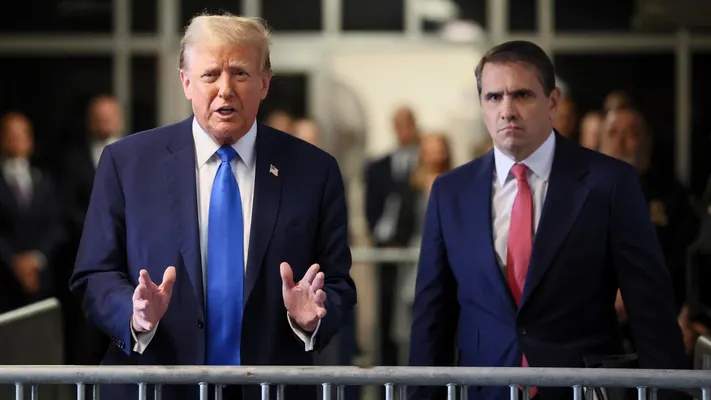
Markwayne Mullin has no legal authority to run elections in the United States. He has no statutory power to mandate how states manage their voter rolls. He has no constitutional basis to imprison state officials for conducting the election administration that the Constitution explicitly delegates to the states.
That did not stop him from threatening to do all three.
On July 17, 2026, standing at a podium in the Eisenhower Executive Office Building, the Homeland Security Secretary declared that state election officials who refuse to funnel their voter registration data through a federally controlled database face fines, penalties, and prison time. The threat was delivered to officials in all 50 states and Washington, D.C. — not as a suggestion, but as what Mullin called a mandatory requirement.
This is not a policy disagreement. This is a federal official threatening to criminalize state governance. It is, in the language of political science rather than polite journalism, an authoritarian power grab — the kind that gets described in retrospective histories of democratic collapse, always with the qualifier that no one believed it could happen here.
It is happening here.
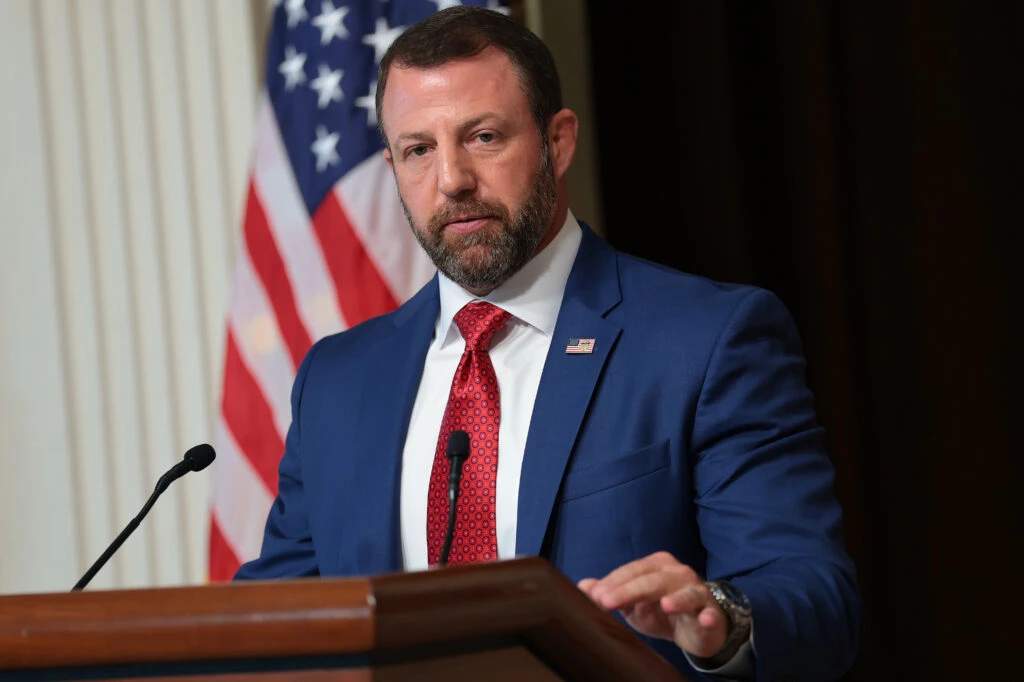
Markwayne Mullin speaking at a podium in front of DHS seal and American flags
The SAVE Database: A Weapon Dressed as a Tool
At the center of Mullin's threat is the Systematic Alien Verification for Entitlements (SAVE) database — a system originally designed for a mundane purpose: helping states verify the citizenship status of people applying for government benefits like Medicaid and food stamps.
Under the Trump administration, SAVE has been retrofitted into something far more dangerous: a mass citizenship screening tool for voter registration lists. The transformation began under former DHS Secretary Kristi Noem and has accelerated under Mullin, who has demanded that states use the system to check every voter on their rolls — and implied that officials who refuse will face criminal prosecution.
The problem is that the system doesn't work. It has repeatedly and falsely identified eligible citizens as noncitizens. The Brennan Center for Justice has documented extensive errors. The Texas Tribune found the system produces widespread confusion and false flags. The Associated Press reported that the administration is promoting a program that critics fear will fuel a midterm voter purge.
Wendy Weiser, a vice president at the Brennan Center, cut through the noise:
*"Pay attention to what Mullin did not provide: any evidence to back up his wild numbers or even an explanation as to where those numbers came from. They are almost certainly false or wildly overstated. This administration has a poor track record with false allegations of election improprieties."
David Becker, executive director of the Center for Election Innovation & Research, attended a White House briefing the day before Mullin's speech where an official admitted the "250,000 noncitizens" figure was based on comparisons with commercial data — the kind of opaque, error-prone datasets that marketing companies use to target ads, not the kind you use to strip people of their constitutional rights.
*"That 250,000 number is an irresponsible number to share given the opaque methodology that they claimed here."
The Numbers: Manufactured Crisis, Real Consequences
Mullin's claim that SAVE identified over 250,000 noncitizens registered to vote in California, New Jersey, Nevada, and Pennsylvania is the kind of statistic designed to generate headlines, not to inform policy. Note what he did not say:
- He did not claim any of these individuals actually voted
- He did not explain how DHS obtained the data (though many states sell public voter files)
- He did not acknowledge the database's documented error rate
- He did not provide methodology, sources, or verification
This is the manufactured crisis model that has become the trademark of Trump-era authoritarianism: invent or inflate a threat, demand extraordinary powers to address it, and criminalize anyone who questions the premise. It is the same playbook that brought us the Muslim ban, the family separation policy, and the January 6th narrative inversion.
The Legal Reality: Mullin Has No Authority Here
Federal courts have repeatedly ruled that the executive branch has very limited authority to demand access to or changes in state voter rolls. The Constitution gives states primary authority over election administration. The Tenth Amendment reserves powers not delegated to the federal government to the states. The National Voter Registration Act establishes specific procedures for maintaining voter rolls — procedures that do not include federal mandates from DHS.
Mullin is not ignorant of these constraints. He is simply choosing to ignore them, betting that the threat of criminal prosecution will intimidate officials into compliance regardless of whether the underlying authority exists.
This is how authoritarian creep works in liberal democracies. It does not arrive with tanks in the streets. It arrives with a letter from a cabinet secretary, threatening prison time for exercising lawful state authority, wrapped in the language of "election security."
The Pushback: "Try Us"
The responses were swift and pointed. California Governor Gavin Newsom posted two words on social media: "Try us."
*"California has free, fair, and secure elections and we will fight for them."
Senate Minority Leader Chuck Schumer vowed to fight the administration's efforts. Idaho's Republican officials fired back against the DOJ's parallel threats. The backlash was bipartisan — which is remarkable only because bipartisanship in defense of democratic norms has become so rare that it warrants remark.
The breadth of the pushback reveals something important: this is not a partisan issue dressed as one. Election officials across the political spectrum understand that allowing a federal agency to criminalize state-level decisions about voter eligibility is not a win for any party. It is a loss for federalism, for the Constitution, and for the principle that elections are administered by the people, not by the executive branch.
The SAVE Act: The Legislative Hammer
Mullin's threats did not emerge from thin air. They are the enforcement arm of the so-called SAVE Act — legislation that would require documentary proof of citizenship to register to vote in federal elections. Trump resurrected debunked claims of fraud in the 2020 election during a primetime address the same day Mullin made his threats, using the same speech to demand the SAVE Act's passage.
The combination is instructive: a president pushes debunked conspiracy theories about election fraud while his cabinet secretary threatens to imprison officials who refuse to comply with a database that generates debunked data. The propaganda and the enforcement are synchronized.
This is the Gramscian concept of hegemony in real time: control the narrative, then use the narrative to justify control of the machinery. If you can convince enough people that the system is rigged, you can justify dismantling the safeguards that make it function — and replacing them with mechanisms that you control.
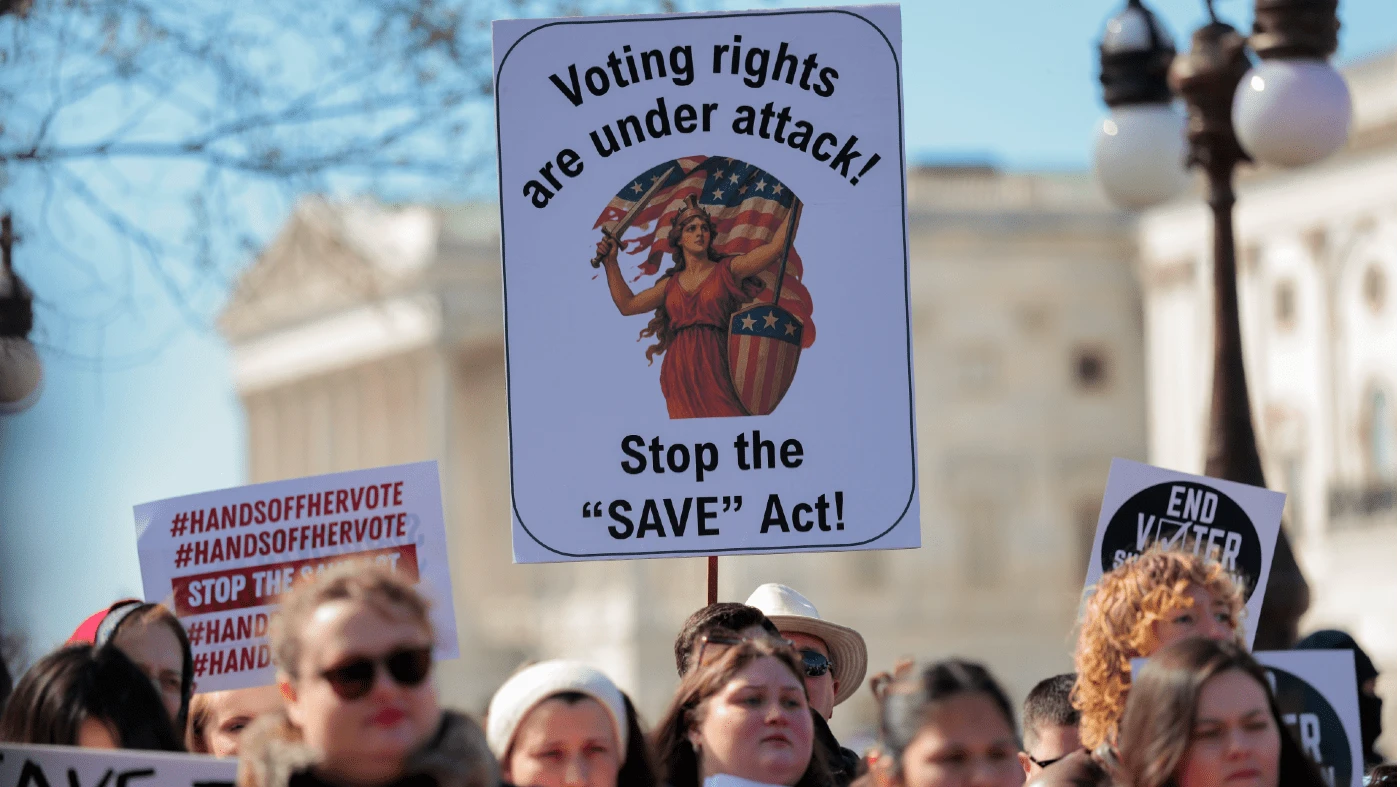
Protesters holding signs reading 'Protect Voting Rights' outside the Capitol
Historical Pattern: From Jim Crow to SAVE
What Mullin is attempting is not without American precedent. It is, in fact, deeply American.
The history of voter suppression in the United States is a history of exactly this kind of weaponized bureaucracy:
- Literacy tests — administered by white officials who could pass or fail Black voters at will
- Poll taxes — designed to price the poor out of the franchise
- Grandfather clauses — exempting white voters from restrictions imposed on Black ones
- Purge lists — like the one Florida used under Governor Jeb Bush to strip thousands of eligible voters, disproportionately Black, from the rolls before the 2000 election
- Crosscheck programs — the interstate voter comparison system that generated millions of false "duplicate" matches, again disproportionately affecting minority voters
SAVE is the digital iteration of this tradition. The technology has changed. The target population — poor people, immigrants, people of color — has not. The mechanism is the same: create an ostensibly neutral administrative system, stock it with flawed data, and use the resulting errors to purge voters who are unlikely to vote for the party in power.
The addition of criminal penalties for officials who refuse to participate is a new escalation, but it follows the same logic. If the data won't produce the desired result voluntarily, threaten the people who control the data until it does.
The DHS Power Grab: Who Benefits?
Mullin's department — Homeland Security — was created in the aftermath of 9/11 as a domestic security apparatus. It has no historical mandate over elections. Its absorption of election administration functions represents an expansion of the national security state into the last domain of genuinely democratic governance: the act of voting itself.
As we have documented extensively, Trump's second term has been defined by the systematic dismantling of institutional constraints on executive power. Pam Bondi's weaponized Justice Department has targeted political opponents. Kash Patel's FBI has been transformed from a law enforcement agency into a political intelligence service. Now DHS is staking a claim on elections.
The pattern is not random. It is systematic. And it points toward a vision of governance in which every lever of state power — military, intelligence, law enforcement, and now election administration — serves the political interests of a single man.
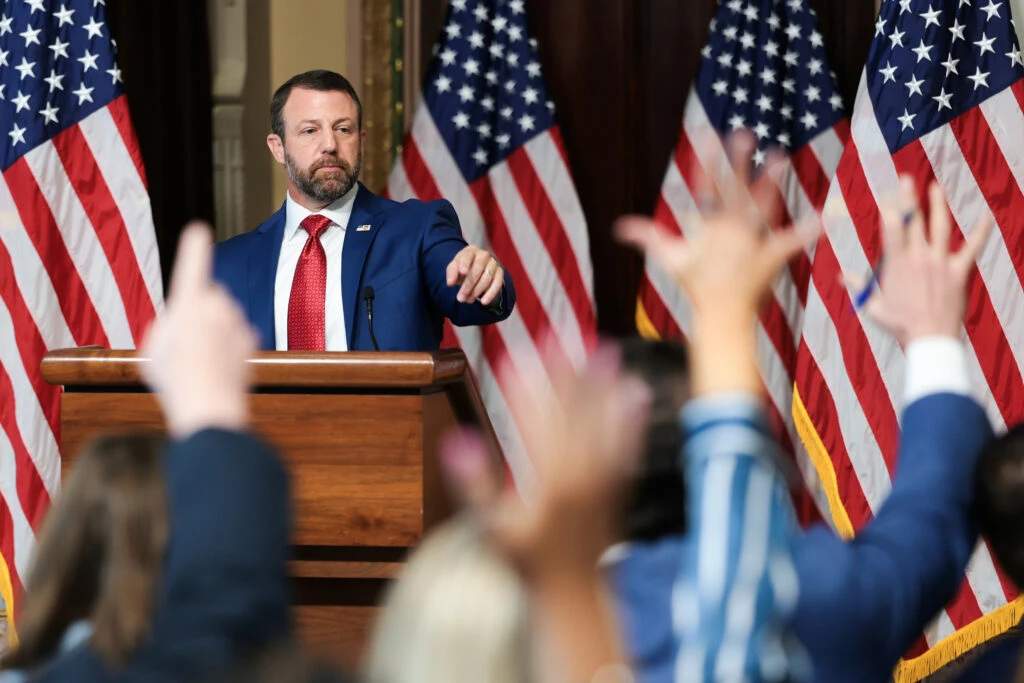
Markwayne Mullin at a press conference podium with microphones, flanked by officials
What This Means for the Midterms
The timing is not coincidental. Mullin's threats came ahead of the 2026 midterm elections, when control of Congress is at stake. The SAVE database, with its documented errors, would disproportionately flag naturalized citizens — a population that skews Democratic in its voting patterns. The threatened purges would, in effect, constitute a targeted disenfranchisement program disguised as election security.
States face a choice: comply with a federal mandate that has no legal basis and use a system that generates false results, or resist and face the threat of criminal prosecution. The administration is counting on fear of prosecution to override respect for the law.
Some states will comply. Some won't. The resulting patchwork of enforcement and resistance will create exactly the chaos that the administration needs to justify further intervention — the classic authoritarian dialectic of problem, reaction, solution.
The Prison Threat: Authoritarianism's Calling Card
Let's be precise about what Markwayne Mullin did. He is a cabinet secretary in the executive branch. He threatened to use the criminal justice system against state officials for exercising their lawful constitutional authority. He threatened to put people in prison for refusing to participate in a federal voter screening program that federal courts have already limited.
This is not normal political hardball. This is the criminalization of governance. It is what happens when the boundary between policy disagreement and criminal prosecution is dissolved — when the state's coercive apparatus is turned against the officials who are supposed to operate independently of it.
The carceral state has been expanding for decades — filling prisons with the poor, the Black, the undocumented. Now it is being pointed at the people who run elections. The logic is the same: use the threat of imprisonment to eliminate resistance to state power.
What Must Happen
State election officials must refuse to comply. Not some of them. All of them. The legality of Mullin's threats is dubious at best and unconstitutional at worst. Compliance would normalize the principle that a federal cabinet secretary can dictate election administration under threat of imprisonment.
Civil rights organizations must litigate aggressively. The courts have already constrained the executive branch's authority over voter rolls. Those precedents need to be enforced and expanded.
State legislatures must pass laws protecting election officials from federal intimidation. If a state official is prosecuted for conducting lawful state business, the state should intervene — politically, legally, and if necessary, through nullification of the federal mandate.
And voters must understand what is happening. This is not about noncitizens voting. Noncitizen voting is vanishingly rare — the kind of statistical nonentity that is used to justify enormous power grabs precisely because it is too small to verify or refute. This is about power. Who controls elections controls the country. The Trump administration understands this. Everyone else needs to understand it too.
Markwayne Mullin has no authority over your vote. He knows it. The Constitution says it. The courts have ruled it.
"Try us," Newsom said.
Make him.
Sources & Methodology(5 sources)
Methodology
Reporting based on official statements from DHS Secretary Markwayne Mullin, analysis from the Brennan Center for Justice and Center for Election Innovation & Research, and reporting from NBC News, POLITICO, Democracy Docket, and Common Dreams.
Filed Under
Frequently Asked Questions
- Can DHS legally force states to use the SAVE database?
- No. Federal courts have repeatedly ruled that the executive branch has very limited authority to demand access to or changes in state voter rolls. The Constitution delegates election administration to the states.
- What is the SAVE database?
- The Systematic Alien Verification for Entitlements was originally designed to verify citizenship for government benefit applications. The Trump administration retrofitted it as a voter screening tool, despite documented errors that falsely flag eligible citizens as noncitizens.
- Did any of the alleged 250,000 noncitizens actually vote?
- Mullin did not claim any of them voted. The 250,000 figure was based on comparisons with commercial data — the kind used for marketing — and experts called the methodology 'irresponsible.'
- Who pushed back?
- California Governor Gavin Newsom said 'Try us.' Senate Minority Leader Chuck Schumer vowed to fight. Idaho's Republican officials also pushed back against DOJ threats. The resistance was bipartisan.