

WASHINGTON — In his first hours back in office, President Donald Trump plunged into a pardon spree that didn't just free more than 1,500 people from legal consequences. He also erased nearly $2 billion in criminal penalties and restitution that federal courts had imposed on those convicted of crimes.
The pardons followed a clear pattern: corrupt officials convicted of bribery, fraud, and abuse of power walked free. Political allies who broke laws on Trump's behalf were rewarded with clemency. Lobbyists who had personal relationships with Trump or his family earned millions by navigating the pardon process.
Meanwhile, Congressional Democrats are investigating whether Trump's pardons constitute "pay-to-play" corruption — whether clemency is being sold to highest bidders.
The result: a pardon economy that rewards corruption, shields allies, and undermines rule of law.
The Corrupt Officials Pardoned
Henry Cuellar — Bribery for $600,000
In May 2024, the Justice Department indicted Rep. Henry Cuellar (D-TX) and his wife Imelda on charges of accepting nearly $600,000 in bribes from Azerbaijan and a Mexican bank. The bribery scheme spanned nearly a decade, from 2014 to 2022, according to federal prosecutors.
Cuellar's trial was scheduled for April 2026. But Trump short-circuited justice.
In December 2025, Trump pardoned Cuellar and his wife. Trump claimed on social media that "Sleepy Joe went after... Because of these facts, and others, I am hereby announcing my full and unconditional PARDON of beloved Texas Congressman Henry Cuellar, and Imelda."
The facts of the case said otherwise: bribery, conspiracy, money laundering. Trump pardoned them anyway.
Rod Blagojevich — Selling Senate Seats
Former Illinois Gov. Rod Blagojevich was convicted in 2011 of corruption charges for trying to sell President Barack Obama's vacated Senate seat. He was sentenced to fourteen years in prison and served eight before Trump commuted his sentence in his first term.
In December 2025, Trump granted Blagojevich a full pardon.
Blagojevich had transformed himself into a pardon broker. His client Anne Pramaggiore, former CEO of Commonwealth Edison, was convicted in a no-show job scheme tied to Illinois House Speaker Michael Madigan. Pramaggiore paid Blagojevich $230,000 to lobby for her pardon, according to federal lobbying reports.
"This is a terrible injustice, inflicted on her by a system in Illinois that's dirty, rotten, and corrupt," Blagojevich said of Pramaggiore.
In an only-in-Trump's-America turn, Blagojevich has become a pardon lobbyist.
Steve Bannon — Defying Congress
Former Trump White House strategist Steve Bannon was convicted of contempt of Congress for refusing to testify before the January 6 Committee investigating the Capitol attack. He was sentenced to four months in prison.
Trump pardoned Bannon in his first term before Bannon could report to prison.
In April 2026, the Supreme Court cleared the way for the Trump administration to dismiss Bannon's contempt conviction. The Justice Department filed a motion to dismiss the case.
Bannon had also been indicted for fraud charges related to siphoning funds from a campaign to build a border wall. Trump pardoned him before that trial could proceed.
Jeremy Hutchinson — Tax Fraud and Bribery
Former Arkansas State Senator Jeremy Hutchinson pleaded guilty in 2019 to accepting bribes and tax fraud. He represented Saline County in the state Senate from 2011 until his resignation in 2018.
Trump pardoned Hutchinson in May 2025.
The pardon raised questions about Hutchinson's father, Tim Hutchinson, a former U.S. Senator. Lobbying records showed that Tim Hutchinson paid The Tolman Group $10,000 to lobby Trump for a pardon for Jeremy in late 2020 and early 2021.
Tim Hutchinson said he had no knowledge of the payments. A Wikipedia entry notes that "President Trump did not pardon him" at that time — but Hutchinson eventually got his pardon through other channels.
Adriana Camberos — Tax Fraud for Energy Drinks
Andres Camberos, a California marijuana entrepreneur, was convicted in 2021 of conspiracy and fraud for selling counterfeit "5-hour Energy" drinks that contained melatonin. His sister Adriana was convicted of filing false tax returns related to the scheme. Adriana served a two-year prison sentence.
Trump commuted Adriana's sentence in January 2021. Both Andres and Adriana received full pardons from Trump in 2025.
After their pardons, the Camberos siblings made their first significant political contributions — $100,000 spread among Trump campaign committees and Republican causes, according to Federal Election Commission records. The timing raised questions about whether the pardons were purchased.
Juan Orlando Hernández — Cocaine Conviction
Juan Orlando Hernández, former president of Honduras, was convicted in the United States of trafficking hundreds of tons of cocaine. He was sentenced to life in prison.
Trump pardoned Hernández in May 2025.
The pardon followed a campaign by conservative media and Trump allies, including Rep. Matt Gaetz, who used his show on One America News Network to press Trump to pardon Hernández. Gaetz labeled the prosecution a "Biden setup" without evidence.
Reality TV Stars — Todd and Julie Chrisley
Reality TV stars Todd and Julie Chrisley were convicted in 2022 of bank fraud and tax evasion involving over $30 million in unpaid taxes. Todd was sentenced to 17 years in prison; Julie to 20 months.
Trump pardoned both in May 2025.
Neither Chrisley had a prior relationship with Trump or his family. Their pardons appeared to be part of Trump's pattern of granting clemency to celebrities and high-profile defendants.
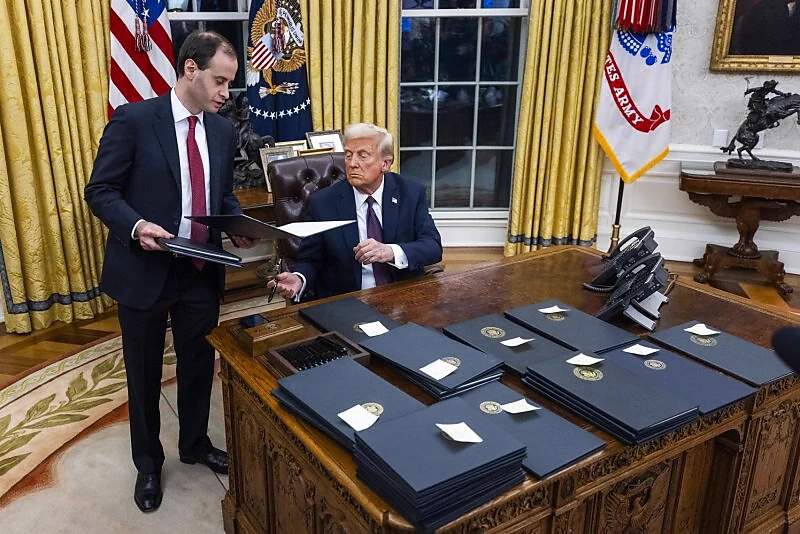
Donald Trump sits at the Resolute Desk in the Oval Office with a fountain pen in hand, signing executive orders. Several officials stand around him watching the signing ceremony in the historic Oval Office with its iconic windows.
George Santos — Fabricated Identity
Former Rep. George Santos (R-NY) was expelled from Congress after revelations that he had fabricated most of his biography, including his education, employment history, and family background. He pleaded guilty to identity fraud and wire fraud.
Trump commuted Santos's sentence in May 2025 and tweeted, "Good luck George, have a great life!"
The Chrisley pardon and Santos commutation raised questions about the criteria Trump used for clemency — celebrities who could generate media attention, not necessarily justice.
The Pardon Economy
Trump's pardons aren't just about mercy. They've become a market.
The Campaign Legal Center, a government watchdog group, has documented three types of Trump pardons:
| Pardon Type | Description | Examples |
|---|---|---|
| Reward Pardons | For donors, allies, or their family members who broke laws on Trump's behalf | Michael Flynn, Paul Manafort, Roger Stone, Steve Bannon |
| Corrupt Pardons | For public officials who abused power or engaged in corruption | Rod Blagojevich, Henry Cuellar, Jeremy Hutchinson |
| Brokered Pardons | For wealthy defendants who hire well-connected lobbyists or make political contributions | Trevor Milton, Paul Walczak, Adriana Camberos |
The Lobbying Fees
The New Yorker's investigation revealed that pardon recipients or their allies have paid lobbyists and middlemen millions to secure clemency:
- Trevor Milton — Nikola founder convicted of defrauding investors of more than $660 million. Milton and his wife contributed $3.6 million to Trump and Republican candidates and committees between fall 2024 and Trump's re-election. Trump pardoned Milton in March 2025.
- Paul Walczak — Florida nursing-home owner convicted of failing to pay employee taxes and using corporate funds for luxury purchases. Walczak's mother, Elizabeth Fago, a conservative activist, raised money for Trump. Walczak received a pardon in January 2026.
- Changpeng Zhao — Binance founder convicted of failing to implement anti-money laundering program. Zhao pleaded guilty to failing to prevent terrorists, Russian drug traffickers, and other criminals from moving billions of dollars. Binance paid $3.3 billion in penalties. Trump pardoned Zhao in April 2026.
- Adriana Camberos — Pardoned in 2025, followed by $100,000 in political contributions.
- Anne Pramaggiore — Paid $230,000 to Rod Blagojevich to lobby for pardon.
One Republican lobbyist quoted in The New Yorker described the pardon economy bluntly: "If you've got inside access or if you have money to spend to get the right lawyer or lobbyist in place — you can essentially buy a pardon."
The Million-Dollar Dinners
The surest strategy for obtaining a pardon is to tap into Trump's sense of victimhood — or attend a million-dollar fundraising dinner at Mar-a-Lago.
"I have great respect for you," Trump told Rod Blagojevich. "But, Rod, you're fired."
The line, delivered on "Celebrity Apprentice" in April 2010, shows the transactional nature of Trump's pardons. Blagojevich had broken the law. Trump pardoned him. Blagojevich became a pardon broker, selling access to Trump for others.
For wealthy pardon seekers, the surest route is political giving. Trevor Milton and his wife gave $3.6 million to Trump and Republican candidates. Paul Walczak's mother raised money for Trump. Both received pardons.
The Financial Toll: Nearly $2 Billion in Erased Penalties
According to Liz Oyer, who served as pardon attorney in the Biden Justice Department and now works as a lawyer opposing Trump's pardon practices, Trump's pardons have erased at least $1.5 billion in criminal penalties:
- Fines and forfeitures wiped out
- Restitution to victims cancelled
- Civil penalties eliminated
That's $1.5 billion that convicted criminals no longer have to pay.
The cost falls on taxpayers and victims. The woman defrauded by Paul Walczak — who died while Walczak was still in prison — never received the millions he owed her. The investors defrauded by Trevor Milton never saw the more than $660 million in restitution that Milton's pardon wiped out.
Justice is not just about mercy. It's about accountability. Trump's pardons erased accountability.
The Crypto Connection
Trump's family has ventured into the cryptocurrency industry through a company called World Liberty Financial, which launched in September 2024. The Trump family controls approximately 40% of the business.
The cryptocurrency pardon economy has followed a clear pattern:
| Cryptocurrency Figure | Conviction | Pardon | Connection to Trump |
|---|---|---|---|
| Changpeng Zhao (Binance) | Failed to implement anti-money laundering, $4.3B penalty | Pardoned April 2026; Binance hired McDowell lobbyist firm | |
| Timothy Leiweke | Wire fraud | Pardoned January 2026; company donated $250K to Trump inaugural | |
| World Liberty Financial | Trump family crypto company | Launched 2024; 40% owned by Trump family |
In December 2025, Binance hired Checkmate Government Relations, a Washington lobbying firm run by Ches McDowell, to lobby Trump for a pardon and on cyber-policy issues. Checkmate has been paid more than $1.3 million for its services.
McDowell's team includes a nephew of Robert F. Kennedy, Jr., and a son of Trump's campaign manager Chris LaCivita. McDowell met Trump Jr. shortly before the 2016 election and now counts him as a close friend.
In March 2025, Trump pardoned Zhao. Binance had paid a $3.3 billion penalty for failing to stop terrorists, drug traffickers, and other criminals from using its platform.
Then, in September 2025, Binance brought on McDowell's Checkmate to lobby for more pardons. Trump signed Zhao's pardon seven days later.
Leavitt, the former pardon attorney, explained that Trump's Zhao pardon "has officially ended the Biden Administration's war on cryptocurrency industry." The message was clear: crypto money buys pardons.
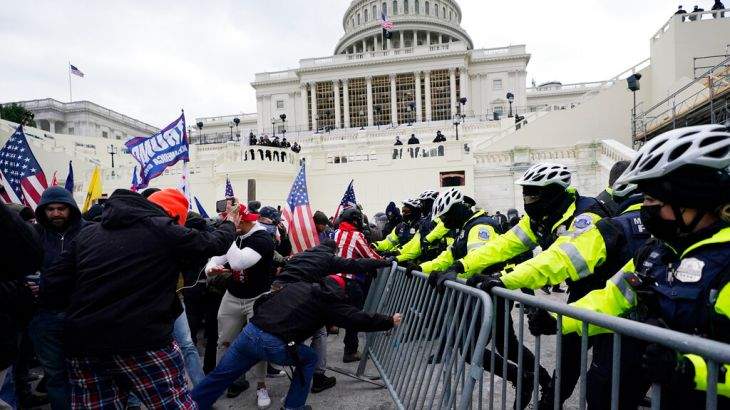
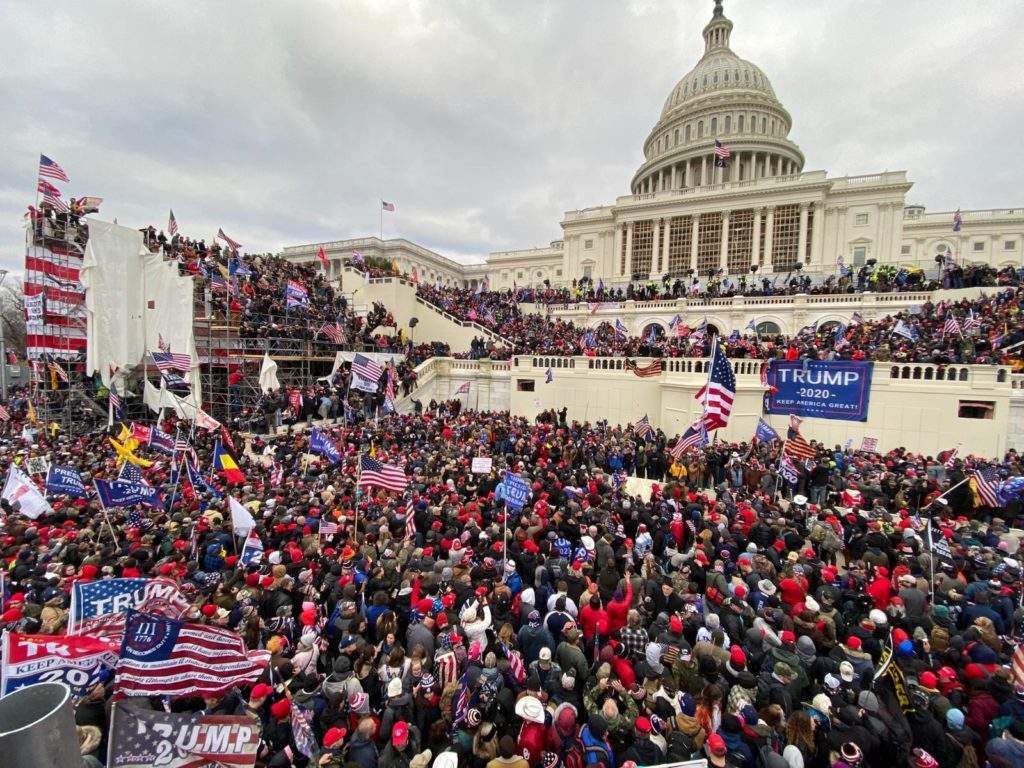
A chaotic scene at the U.S. Capitol building on January 6, 2021, showing a large crowd of pro-Trump supporters breaching security barriers and climbing the Capitol steps under overcast skies.
Congressional Investigation: "Pay-to-Play"
In May 2026, Congressional Democrats launched an investigation into whether Trump's pardons constitute "pay-to-play" corruption.
Senate and House Democrats sent letters to 17 people who received pardons or commutations from Trump, asking whether they obtained favorable treatment through intermediaries, financial contributions, or other forms of influence.
Among those being probed:
- Changpeng Zhao — Pardoned after Binance hired a McDowell-connected lobbyist firm
- Trevor Milton — Pardoned after contributing $3.6 million to Trump
- Paul Walczak — Pardoned after his mother raised money for Trump
- Various January 6 rioters — Pardoned in first hours of Trump's second term
- Adriana Camberos — Pardoned, followed by political contributions
According to CBS News, "Senate and House Democrats have launched an investigation into whether pardons and commutations issued by President Trump were driven by 'pay-to-play dynamics.'"
The Hill reported that Sen. Peter Welch (D-Vt.) and Rep. Dave Min (D-Calif.) sent letters seeking "whether the president granted them leniency... through intermediaries, financial contributions, or other forms of influence."
Dismantling Oversight
The Congressional investigation comes amid broader concerns that Trump is dismantling federal oversight institutions.
During Biden's presidency, the Justice Department, FBI, and other law enforcement agencies conducted investigations into Trump allies and supporters. Those investigations led to convictions and sentences.
Trump's pardons erased those convictions.
- The Justice Department investigation into Michael Flynn for lying to the FBI about his conversations with Russian Ambassador resulted in Flynn's conviction. Trump pardoned him.
- Special Counsel Robert Mueller's investigation into Paul Manafort for financial crimes, failing to register as a foreign agent, and witness tampering resulted in Manafort's conviction. Trump pardoned him.
- The investigation into Roger Stone for witness tampering, lying to Congress, and obstructing the January 6 investigation resulted in Stone's conviction. Trump pardoned him.
- The Justice Department case against Steve Bannon for contempt of Congress resulted in Bannon's conviction. Trump's Justice Department is now seeking to dismiss that conviction.
The pattern is clear: investigate, convict, pardon. It creates a system where the President's allies are untouchable.
The Broader Pattern: Protecting the Corrupt Elite
Trump's pardon economy rewards a specific class of people:
- Wealthy offenders who can afford top lawyers and lobbyists
- Political allies who broke laws on Trump's behalf or have personal connections
- High-profile defendants who generate media attention
- Crypto moguls with money to spend on influence
Not represented:
- The nonviolent drug offenders serving life sentences under mandatory minimum laws
- The low-level fraudsters who can't afford lobbyists
- The whistleblowers who exposed corruption
- The victims of white-collar crimes seeking restitution
Oyer, the former pardon attorney, described the effect: "If you're a wildly rich guy who's looking for a pardon, giving a contribution is probably the single best way to elevate your brand. But for regular people who have merit-based claims to clemency, there's no path forward."
Trump's pardon economy "has totally upended the clemency system as we know it," Oyer said. "There's no path forward for regular people who have merit-based claims to clemency. And, at the same time, there's a booming pardon economy where... you can essentially buy a pardon."
The Ultimate Question: Justice for Sale?
The Constitutional purpose of the pardon power is to promote "the benign prerogative of mercy," as the Supreme Court described it in 1866. The Founding Fathers intended it as a check on judicial excess, a tool for correcting miscarriages of justice.
Trump has transformed it into a reward system.
Corrupt officials convicted of bribery walk free. Political allies who broke laws for Trump receive clemency. Wealthy defendants who can navigate the pardon economy get relief. The victims of their crimes are left without restitution.
Congressional Democrats are investigating whether "pay-to-play" dynamics are driving Trump's clemency decisions. Lobbyists and middlemen earn millions navigating the pardon process. The Trump family crypto business positions itself to benefit from the crypto pardon economy.
The tally: more than 1,500 pardons, nearly $2 billion in erased penalties, a booming market for influence, and a system where access is for sale.
The Constitution grants the pardon power. Trump's use of it asks whether that power exists to serve justice — or to serve the President.
Sources & Methodology(5 sources)
- The New Yorker - Donald Trump's Pardon EconomyNews Article
April 27, 2026 - In-depth investigation by Ruth Marcus exposing Trump's pardon economy, including Rod Blagojevich's pardon lobbying, million-dollar Mar-a-Lago dinners, Trevor Milton's $3.6M political donations, Paul Walczak case, Binance pardon connections, and Liz Oyer's analysis that Trump's pardons have erased at least $1.5 billion in penalties.
- CBS News - Trump Pardon Recipients Face Congressional Investigation Over 'Pay-to-Play' QuestionsNews Article
May 6, 2026 - Reports that Senate and House Democrats launched investigation into whether Trump's pardons were driven by 'pay-to-play dynamics.' Probing whether clemency recipients obtained favorable treatment through intermediaries, financial contributions, or other forms of influence.
May 7, 2026 - Reports that Sen. Peter Welch (D-Vt.) and Rep. Dave Min (D-Calif.) sent letters to 17 Trump pardon recipients, asking whether clemency was granted through intermediaries, financial contributions, or other forms of influence.
- Wikipedia - List of People Granted Executive Clemency in the Second Trump PresidencyNews Article
Comprehensive Wikipedia entry documenting more than 1,500 pardons by Trump since January 2025. Lists recipients including Rod Blagojevich, Steve Bannon, Jeremy Hutchinson, Adriana Camberos, George Santos, Todd and Julie Chrisley, Juan Orlando Hernández, Changpeng Zhao, Trevor Milton, and Paul Walczak.
- Campaign Legal - Inside the Pardon Playbook: Analysis of President Trump's Clemency AbusesNews Article
Campaign Legal Center analysis documenting three types of Trump pardons: reward pardons for donors/allies, corrupt pardons for public officials who abused office, and brokered pardons for wealthy defendants who hire well-connected lobbyists.
Filed Under
Frequently Asked Questions
- How many people has Trump pardoned?
- Trump has granted clemency to more than 1,500 people in his second term. This is far more than any modern president. The pardons have erased nearly $2 billion in criminal penalties, fines, and restitution that courts imposed on convicted criminals.
- Who are some of the corrupt officials Trump has pardoned?
- Henry Cuellar (bribery $600,000), Rod Blagojevich (selling Senate seat), Jeremy Hutchinson (bribery and tax fraud), and multiple others convicted of corruption, fraud, and abuse of power. Each had their convictions erased by Trump's pardon power.
- What is the 'pardon economy'?
- Trump has created a market for presidential clemency. Wealthy defendants hire well-connected lobbyists (fees up to $6M) or make large political contributions to secure pardons. The New Yorker's investigation revealed a booming pardon economy where access can be purchased for the right price.
- What does 'pay-to-play' mean in this context?
- Congressional Democrats are investigating whether Trump's pardons constitute 'pay-to-play' corruption — whether clemency is granted based on political donations, personal relationships, or financial influence rather than merit or justice. The investigation targets 17 pardon recipients, including Changpeng Zhao, Trevor Milton, and Paul Walczak.
- How does the crypto connection work?
- Trump's family launched World Liberty Financial in September 2024, a cryptocurrency company they control. Cryptocurrency pardon recipients like Changpeng Zhao (Binance) and Timothy Leiweke (Kaiju) have close ties to the Trump crypto business or made political contributions to Trump after receiving pardons.
- What oversight institutions has Trump dismantled?
- Trump has systematically undermined federal oversight. Investigations into Michael Flynn, Paul Manafort, Roger Stone, Steve Bannon, and other Trump allies led to convictions during Biden's presidency. Trump's pardons erased those convictions. The Justice Department is now seeking to dismiss Bannon's contempt case, signaling end of accountability for allies.
- What is the constitutional purpose of pardon power?
- The Constitution intended pardon power as a 'benign prerogative of mercy' to correct judicial excess. Trump has transformed it into a reward system for corrupt elites, political allies, and wealthy donors — creating justice for sale rather than for all.