In the great state of Arizona, a safety pin hanging off a man's shorts is now a weapon of assault. A felony. Court records say so.
You know what isn't a crime in Arizona? Cutting Maricopa County's polling places from 200 down to 60, and leaving thousands of voters — disproportionately young, disproportionately brown, disproportionately poor — standing in line for up to five hours while their presidential primary melted down around them.
Let that sink in.
A pin prick gets you a felony charge and a trip to county jail. Stealing people's votes gets you an apology tour and a Senate reception. That's not a justice system. That's a class system — and this week, Arizona put it on full display.
What Happened Monday at the Capitol
Monday was supposed to be accountability day. The Arizona House Elections Committee held a special hearing on last Tuesday's electoral disaster, and Maricopa County Recorder Helen Purcell — the woman who personally signed off on gutting the polling places — showed up to apologize. Secretary of State Michele Reagan came too, to explain that she'd known all about the cuts and simply "didn't second-guess" them.
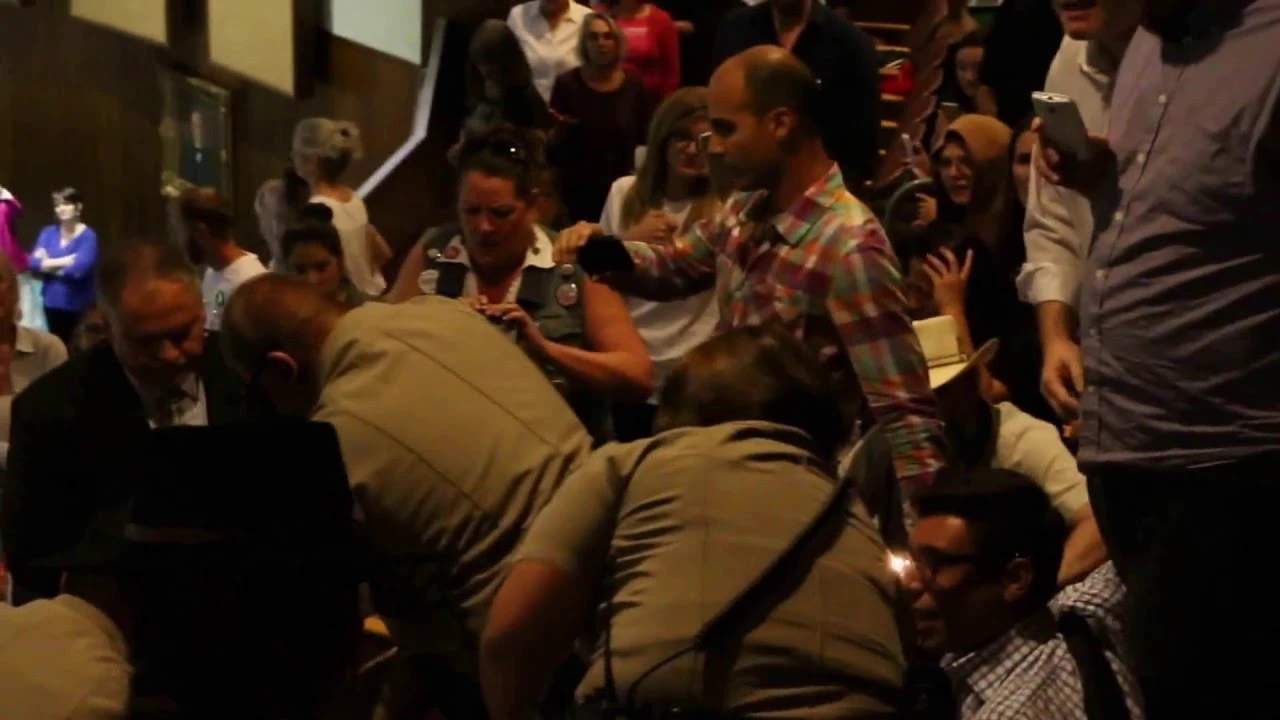
The gallery was packed. The gallery was furious. And when Purcell stood up to apologize for disenfranchising her own constituents, the crowd jeered her. Loudly. Some of them shouted "Go arrest Helen Purcell!"
They were joking. Mostly.
Enter Jonathan McRae, 23, of Paulden — wearing a Guy Fawkes mask, because apparently the universe was going for symbolism that day. Department of Public Safety Captain Damon Cecil told reporters that the House Sergeant at Arms wanted "the man in the mask" out of the building, and asked troopers to remove him. A security guard told McRae to leave at least four times, according to records. McRae refused. When a DPS officer physically tried to remove him, McRae grabbed a chair and wouldn't let go. Officers pried him loose and hauled him off to be searched before booking.
The gallery erupted. "Shame! Shame! Shame!" — the whole room chanting in one voice. "This is wrong!" "You're sending the wrong message, officer!"
They were right. And it was about to get so much worse.
The Weapon of Mass Destruction Was a Safety Pin
Here's where this stops being a protest story and becomes a dystopia joke.
Before booking, officers asked McRae if he had any weapons. He said no. During the search, according to the official record, "Trooper Ayala was pricked by a safety pin that was on the left hip of the subject" — a pin attached to McRae's shorts, point facing outward, end cap removed.
The trooper was treated at a nearby hospital.
Read that again. A grown man, a trained state trooper, was taken to a hospital because a safety pin on a protester's shorts poked him during a search. And the courts — the actual courts of the state of Arizona — formally identified that safety pin as a weapon of assault.
For this, Jonathan McRae faces aggravated assault — a felony. Plus criminal damage for the heinous chair-gripping, plus passive resisting arrest. A young man now has a felony hanging over his head because the state of Arizona needed to make an example out of somebody, and the guy in the Guy Fawkes mask was standing right there.
Remember, remember, the 28th of March.
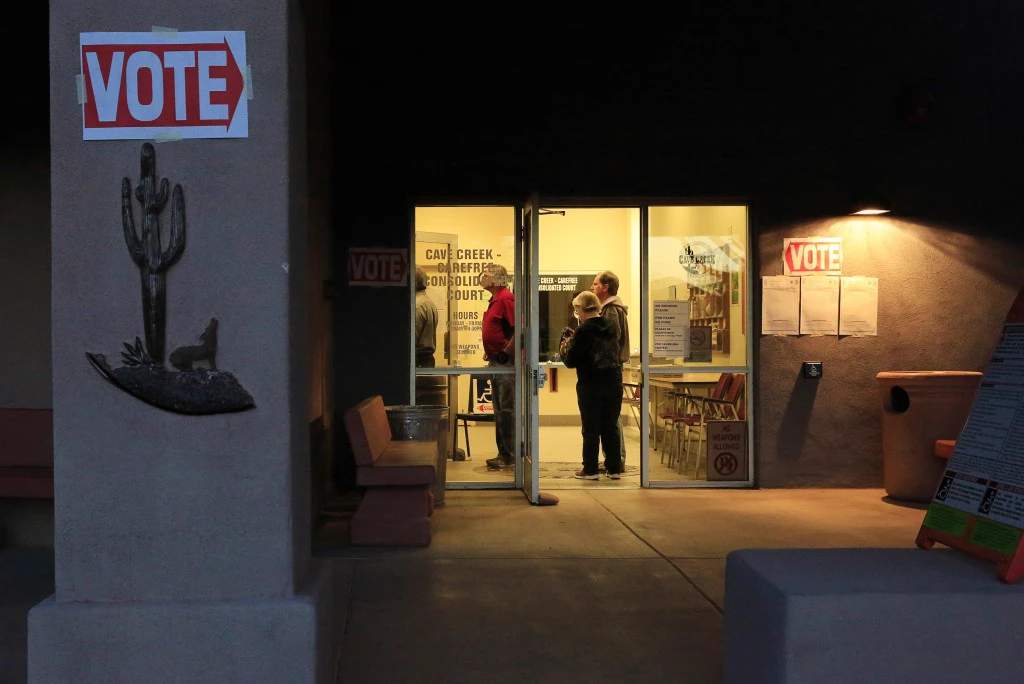
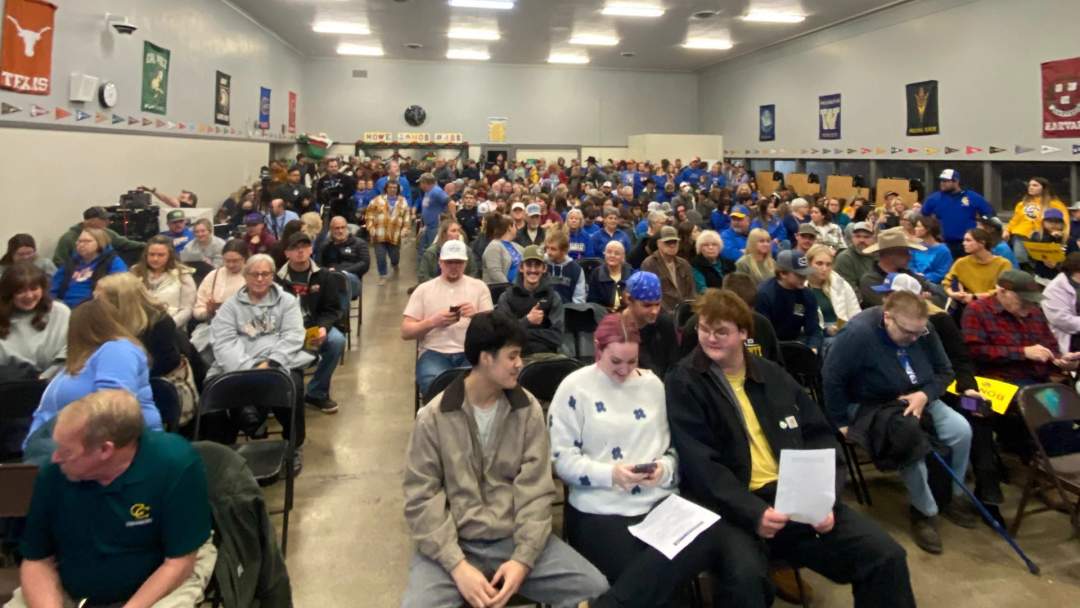
Demonstrators gather at a protest over long voting lines
Let's Talk About What the Police Didn't Get Arrested For
Now keep one eye on the timeline, because the contrast is the whole story.
On March 22, Arizona held its presidential primary. Maricopa County — the fourth largest county in America — had run 400 polling places in 2008 and 200 in 2012. This year, Helen Purcell cut it to 60. Sixty. For a presidential election that drew record turnout.
Wait times ranged from two minutes to five hours, depending on your zip code. Predictably, it was the working-class and Latino neighborhoods — the ones that had already been waiting years for Arizona to respect their vote — that drew the five-hour lines. People with jobs, with kids, with dialysis appointments, gave up and went home. Thousands of provisional ballots were handed out like consolation prizes. Countless more people just never got to vote at all.
And here's the part everyone in power would prefer you forget: until 2013, Arizona needed federal pre-clearance under the Voting Rights Act to make changes exactly like this. Then the Supreme Court's Shelby County decision gutted the VRA, Arizona's federal oversight evaporated, and three years later — presto — 60 polling places for the biggest election in a generation. Coincidence? Sure. And I've got a bridge in Mojave County to sell you.
Helen Purcell took "responsibility." She is refusing to resign. Michele Reagan knew about the cuts and "didn't second-guess" them. No one has been charged. No one has been arrested. No one has even lost a job. The state's response to depriving thousands of its own citizens of the right to vote is a shrug and a mistakes were made. Governments have always known that criminalizing protest is cheaper than answering it — and Arizona just proved it knows the trick too.
But a protester whose shorts poked a cop? FELONY.
This Is What a Police State Looks Like When It's Feeling Confident
Understand what happened Monday, underneath the circus.
Citizens showed up at their own Capitol to demand answers about a stolen election. The state responded by clearing the gallery, arresting the most visible protester, and charging him with a violent crime based on — I cannot stress this enough — a safety pin. Not because anyone was hurt. Nobody was hurt. But because the machinery of the state can find a "weapon of assault" anywhere it wants one, and it wants one whenever dissent gets loud.
Every cop, prosecutor, and judge who signs off on this knows exactly what it is: a retaliatory, trumped-up charge designed to scare the next crowd into silence. When movements get effective, the state starts turning solidarity itself into a crime — Arizona is just applying the technique with office supplies. You want to protest the people who stole your vote? Better check your shorts for sharp objects, citizen. The full force of the state will come down on you, and it will file the paperwork with a straight face.
"Go arrest Helen Purcell," the crowd shouted. The police arrested the man in the mask instead.
That's your two-tier justice system in one sentence.
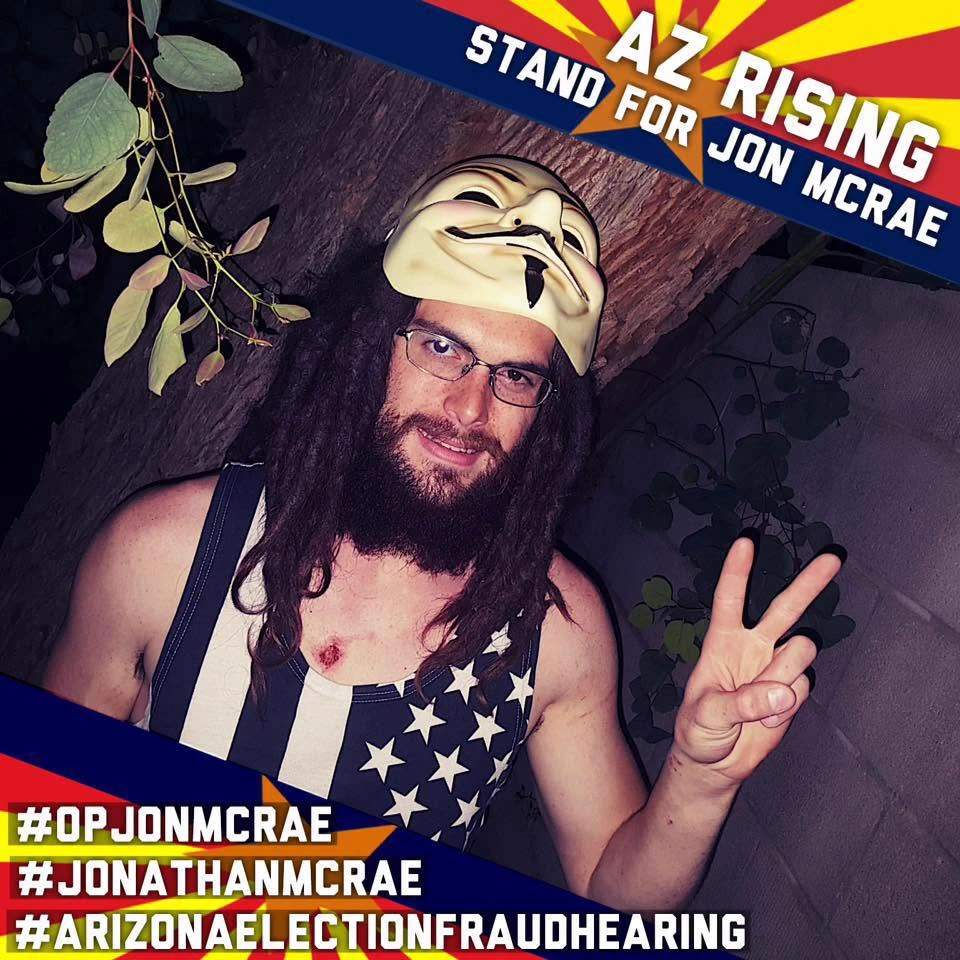
Photo of Jon McRae with Guy Fawkes mask.
What You Can Do
Jonathan McRae is due in court facing a felony that exists solely to punish him for being loud in the wrong room. That charge should be dropped. All of them.
Share this story. Every person who laughs at the absurdity of the "safety pin felony" is a person who might just notice the five-hour voting lines hiding behind it. If you're in Arizona, show up at his court date. Pack the gallery. Bring your own safety pins — openly, peacefully, on your jackets, on your bags — and dare the state of Arizona to arrest you all.
Because here's the thing the DPS and the House Sergeant at Arms and Helen Purcell all seem to have forgotten: the crowd wasn't the problem Monday. The crowd was the diagnosis.
And no amount of felonies cures that.
Sources & Methodology(7 sources)
- Arizona Capitol Times — One arrested as crowd in House gallery protests voting snafus (Mar 28, 2016)News Article
Contemporaneous reporting on the arrest at the Arizona House. DPS Capt. Damon Cecil said the House Sergeant at Arms wanted the man in the mask removed and asked troopers to do it.
- Arizona Republic — Safety pin leads to felony assault charge against disruptive protester (Mar 29, 2016)News Article
Court records identified the safety pin as a weapon of assault, and the trooper sought medical assistance for his injury. McRae said he had no weapons before the search.
- Phoenix New Times — Safety Pin in Protester's Pants Pricks Officer at Arizona State Capitol (Mar 29, 2016)News Article
Booking sheet details: Jonathan McRae, 23, of Paulden; guard ordered him to leave four times; he grabbed a chair; charges of aggravated assault, criminal damage, passive resisting arrest; booking-sheet quote on Trooper Ayala and the safety pin; crowd chants including 'Go arrest Helen Purcell' and 'Shame!'
- The New York Times — Arizona Election Official Apologizes for Long Wait at Polls (Mar 28, 2016)News Article
Helen Purcell cut the number of polling places in Maricopa County to 60 from 200; apologized at a hearing at the State Capitol as anger bubbled over.
Purcell took responsibility for the hours-long lines that enraged voters and prompted calls for her resignation.
Secretary of State Michele Reagan knew of the cuts to 60 from 200 in 2012 and 400 in 2008 but 'didn't second-guess' Purcell. One arrested after disrupting the House.
Democratic voters protested the long waits during Arizona's presidential preference election; source of the Reuters protest photograph.
Methodology
Written in the contemporary voice of March 2016 from contemporaneous published reporting: Arizona Capitol Times and The New York Times (Mar 28, 2016), Arizona Republic and Phoenix New Times (Mar 29, 2016), Washington Times hearing updates, and Arizona Republic reporting on Recorder Helen Purcell's remarks. Quotes from DPS booking records and court records are as transcribed by those outlets. Names, ages, charges, polling-place counts, and dates were verified across multiple contemporaneous sources.
Filed Under
Frequently Asked Questions
- What was Jonathan McRae charged with after his arrest at the Arizona Capitol?
- McRae, 23, of Paulden, faced a felony charge of aggravated assault — with court records identifying a safety pin hanging from his shorts as the weapon of assault — plus misdemeanor counts of criminal damage and passive resisting arrest stemming from his refusal to leave the Arizona House gallery during a March 28, 2016 hearing on the state's botched presidential primary.
- How did a safety pin become a 'weapon of assault' in the McRae case?
- After McRae told officers he had no weapons, a trooper searching him before booking was pricked by an open safety pin attached to the left hip of his shorts, with the sharp end facing outward and its cap removed. Court records identified the pin as a weapon of assault, and the trooper sought medical assistance at a nearby hospital.
- Why were protesters at the Arizona Capitol on March 28, 2016?
- The Arizona House Elections Committee held a special hearing on the March 22 presidential primary, in which Maricopa County Recorder Helen Purcell cut polling places from 200 to 60, producing wait times of up to five hours that fell hardest on working-class and Latino neighborhoods. Purcell apologized but refused to resign; the packed gallery jeered officials, and one protester, Jonathan McRae, was arrested.
![A restaurant's takeout window area with a large jagged hole smashed through the glass, tables and string lights visible inside. [Radical Edward - Untelevised Media]](https://cdn.sanity.io/images/ypejdt32/articles/6ce43fc29caba434d5be0701130cda948f122c1a-1030x691.png?fit=max&auto=format&w=1080&q=65)