On February 28, 2026, the United States launched the largest military assault on a sovereign nation since the 2003 invasion of Iraq. Operation Epic Fury — a joint US-Israeli bombing campaign involving 40,000 troops, multiple carrier strike groups, and B-2 stealth bombers flying 30-hour missions from Missouri — struck over 2,500 Iranian military and government facilities simultaneously. Within hours, Supreme Leader Ayatollah Ali Khamenei was dead, killed in a decapitation strike on his compound in Tehran. Defense Minister Nasirzadeh, IRGC Commander Hossein Salami, Armed Forces Chief of Staff Mohammad Bagheri, and at least 48 other senior officials were wiped out in the opening salvo.
The administration called it a historic victory. Five months, $113 billion, and nearly 9,000 dead later, it is clear that what happened on February 28 was not the start of a victory. It was the start of one of the most consequential strategic defeats in modern American military history.
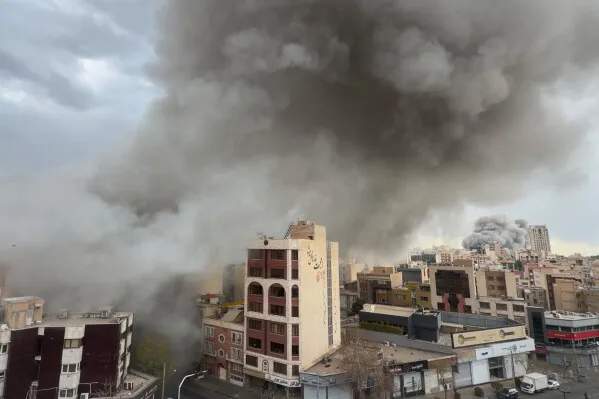
Smoke rising from multiple targets across Tehran during Operation Epic Fury's opening salvo on February 28, 2026
The Four Goals — And Zero Achieved
When the bombs started falling, the United States and Israel had four stated objectives.
- First: regime change in Iran — eliminating the clerical leadership and replacing it with a government friendly to American and Israeli interests.
- Second: destroying Iran's uranium enrichment capability, preventing any path to a nuclear weapon.
- Third: eliminating Iran's long-range ballistic missile program.
- Fourth: severing Iran's support for Hamas, Hezbollah, and the Houthis — the so-called "Axis of Resistance."
As political scientist John Mearsheimer argued in a July 2026 analysis, regime change was the linchpin. Without it, the other three goals were effectively impossible. "If you didn't achieve regime change, you really could not achieve the other three goals," Mearsheimer said. "Regime change was the numero uno goal."
None of them were achieved. Not one.
The regime was decapitated — but not destroyed. A new Supreme Leader, Mojtaba Khamenei, emerged. Iran's enrichment capability was degraded, not eliminated, and under the terms of the Islamabad Memorandum signed on June 17, the United States conceded that Iran would maintain a nuclear enrichment program. The ballistic missile program was not addressed at all in the final agreement. And Iran's support for its regional allies — Hezbollah, Hamas, the Houthis — was never on the table.
"Iran has lost its fear of war."
— The Economist, June 2026
How the War Was Fought — And Why It Failed
The American war machine deployed three strategies in succession. Each failed. Two were never tried at all.
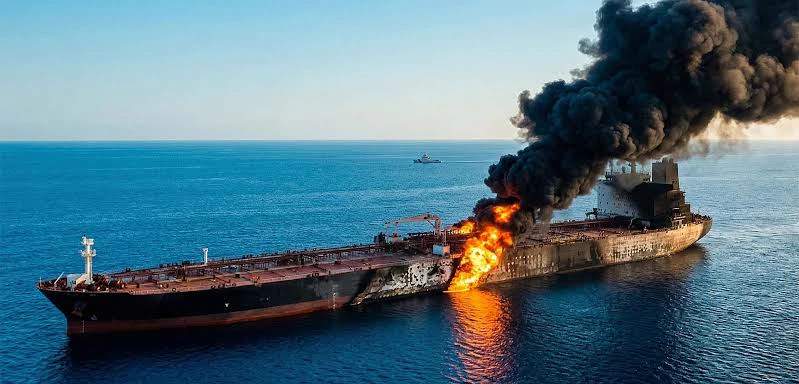
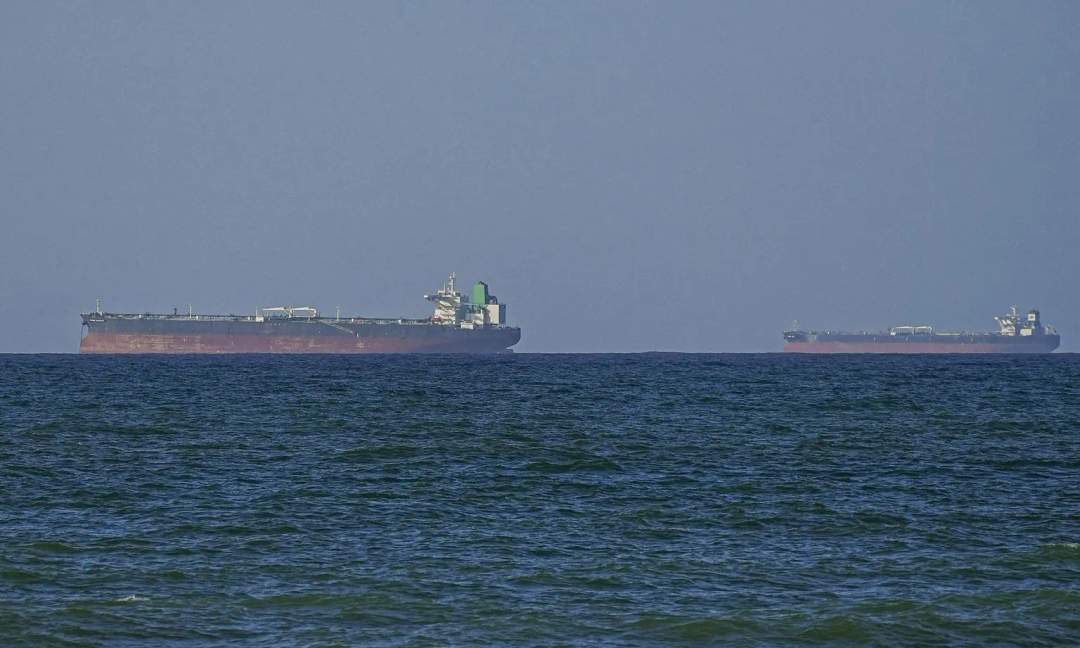
An oil tanker on fire in the Sea of Oman, near to the Strait of Hormuz, on June 13.
Phase 1: The Discriminate Air Campaign (February 28 – April 8)
The opening 40-day bombing campaign was, by design, a discriminate strategic bombing campaign — military targets, a handful of government sites, but no systematic destruction of civilian infrastructure, power plants, bridges, or oil facilities. It began with shock and awe: a decapitation campaign designed to kill the Iranian leadership and collapse the state from the top.
It killed Khamenei and 52 senior officials. It did not collapse the state. Iranian command structures adapted. A successor was named. The IRGC reorganized. The war continued.
On April 7, with the bombing campaign faltering, Trump issued a public threat: Iran would be put "back in the stone age." He wrote on Truth Social that "a whole civilization will die tonight" if Iran refused to comply. Secretary of Defense Pete Hegseth declared "no quarter, no mercy for our enemies" — a statement that legal experts identified as a potential war crime under both international law and the US military's own law of war manual.
The next day, Trump pivoted. He announced a ceasefire. The 40-day bombing campaign was over.
Phase 2: The Naval Blockade (April 13 – June 17)
When Vance's negotiations with Iran in Islamabad failed, the United States imposed a naval blockade on Iran — interdicting any ships entering or departing Iranian ports. The Strait of Hormuz, through which roughly 21 million barrels of oil per day flow — about 20% of global supply — became a weaponized chokepoint.
But the weapon cut both ways. Iran responded by mining the strait, deploying fast attack boats and anti-ship missiles, and ultimately seizing control of the waterway entirely. Oil prices surged from $75 to over $130 per barrel. Fuel crises hit Vietnam, India, Pakistan, and nations across Southeast Asia and East Africa. The International Energy Agency characterized the disruption as the "largest supply shock since the 1973 oil crisis."
The blockade did not break Iran. It broke the global economy.
"In the attempt to try to prevent Iran from developing a weapon of mass destruction, the US handed Iran a weapon of mass disruption."
— Ali Vaez, Iran Project Director, International Crisis Group
Phase 3: The Surrender Document (June 17, 2026)
On June 17, Trump signed the Islamabad Memorandum of Understanding at the Palace of Versailles, with French President Emmanuel Macron beside him. The document was brokered by Pakistan, with Saudi Arabia, Qatar, Turkey, and Egypt facilitating. Vice President JD Vance, Jared Kushner, and Steve Witkoff negotiated for the United States. Iranian parliamentary speaker Mohammad Bagher Ghalibaf and Foreign Minister Abbas Araghchi negotiated for Tehran.
Mearsheimer's assessment was blunt: "That was basically a surrender document. The United States conceded on every key issue."
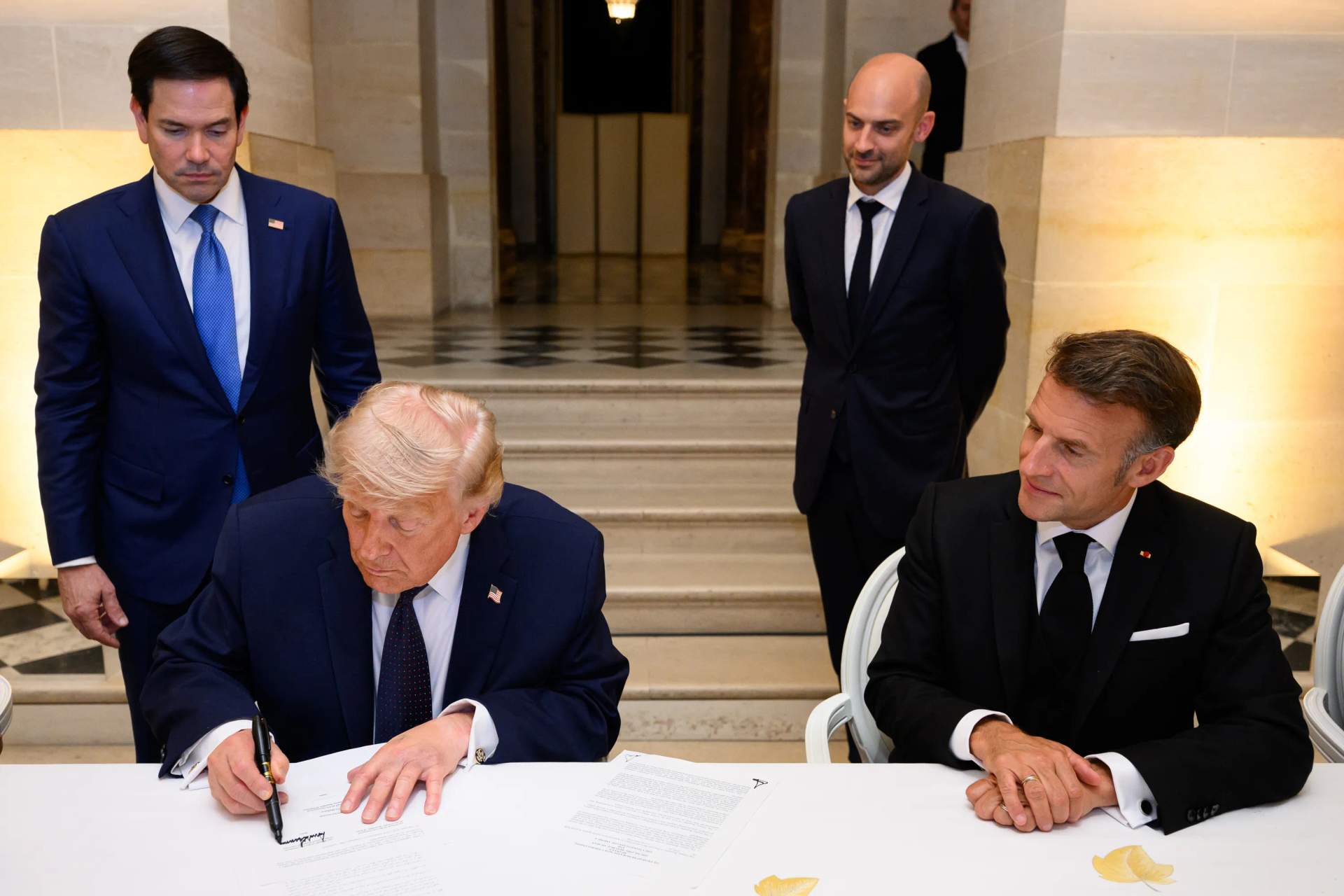
Trump signs the Islamabad Memorandum of Understanding at the Palace of Versailles on June 17, 2026, with French President Emmanuel Macron beside him
Under the memorandum, the United States agreed to:
- An immediate and permanent ceasefire on all fronts, including Lebanon
- The reopening of the Strait of Hormuz — toll-free for 60 days, after which Iran could charge fees for transit
- An end to the US naval blockade
- A waiver of sanctions on Iranian oil exports, restoring a revenue stream worth hundreds of billions of dollars
- The release of all frozen Iranian assets
- Reparations to Iran for war damage
- A $300 billion private investment fund for Iran
- A 60-day negotiating period on nuclear issues, during which Iran would maintain its enrichment capability
What did the United States get? A promise that Iran would not produce nuclear weapons — a pledge Iran had already made when it ratified the Nuclear Non-Proliferation Treaty over half a century ago, and reaffirmed in the 2015 JCPOA. Nothing on ballistic missiles. Nothing on the Axis of Resistance. Nothing that resembled the four goals the war was launched to achieve.
By July 8, the MoU was effectively dead — Iran struck commercial ships in the Strait, and Trump declared the agreement "over." On July 18, Iran's Deputy Foreign Minister announced the suspension of all commitments under the memorandum, citing American breaches.
The Cost — In Blood and Money
The human toll of this war is staggering, and the numbers remain contested.
| Category | Casualties | Source |
|---|---|---|
| US military killed | 18–20 confirmed | CENTCOM / CRS R48887 |
| US military wounded | 687–900+ | CENTCOM / The Intercept |
| Iranian military killed | 1,800–7,650 | HRANA / IDF (disputed) |
| Iranian civilians killed | 1,701–3,636 | HRANA / Iran MoH (disputed) |
| Lebanese civilians killed | 4,328 | Lebanese Ministry of Health |
| Hezbollah fighters killed | 1,000–2,500 | Wikipedia / Long War Journal |
| Israeli civilians killed | 28 | Israeli MoH / Times of Israel |
| Gulf states civilians killed | 43–51 | Wikipedia / The National |
| Third-country nationals killed | 10–45 | Wikipedia (unverified) |
| **Total killed — all parties** | **8,976–18,310** | Aggregated from 205 sources |
The opening day alone saw the Minab Girls' School in Hormozgan Province hit by a precision strike, killing at least 108 schoolgirls — later revised to 168. The Pentagon claimed the school was being used as an IRGC command center. Security camera footage, broadcast worldwide, showed a classroom full of teenage girls moments before the explosion. No evidence was ever provided to support the military's claim.
US equipment losses exceeded $5.14 billion: four F-15E Strike Eagles, 24 MQ-9 Reaper drones, four AN/TPY-2 THAAD radars, one E-3 Sentry AWACS aircraft, two RQ-4 Global Hawks, one MQ-4C Triton, seven KC-135 Stratotankers, and one A-10 Thunderbolt II.
The first six days alone cost $11.3 billion — nearly $1.9 billion per day, or $21,800 per second. The total war cost reached an estimated $113 billion by August 2026.
The Wars That Were Never Fought
Mearsheimer identifies five possible strategies the United States could have pursued. It chose three. It never tried the other two — and understanding why reveals the political constraints that doomed the entire enterprise.
The five strategies: a discriminate air campaign, an indiscriminate air campaign, tit-for-tat strikes, a naval blockade, and a ground invasion.
The discriminate campaign failed because decapitation without ground forces cannot achieve regime change. The naval blockade failed because Iran weaponized the Strait of Hormuz faster and more effectively than the US Navy could neutralize it. The tit-for-tat exchanges that followed accomplished nothing except more casualties.
The indiscriminate campaign — destroying Iran's power grid, bridges, oil facilities, and civilian infrastructure — was never implemented. Trump threatened it repeatedly, but even his own administration recognized that such an attack would constitute a war crime, kill hundreds of thousands of civilians through secondary effects on hospitals, water systems, and food supply chains, and trigger an international backlash that would make Iraq 2003 look like a diplomatic success.
A ground invasion was never seriously considered. The American public, Congress, and the military establishment had no appetite for another Iraq-style occupation of a country of 88 million people with terrain far more hostile than anything encountered in Mesopotamia. The wars the United States chose not to fight were the wars it could not win — and the wars it did fight were the wars it could not win either.
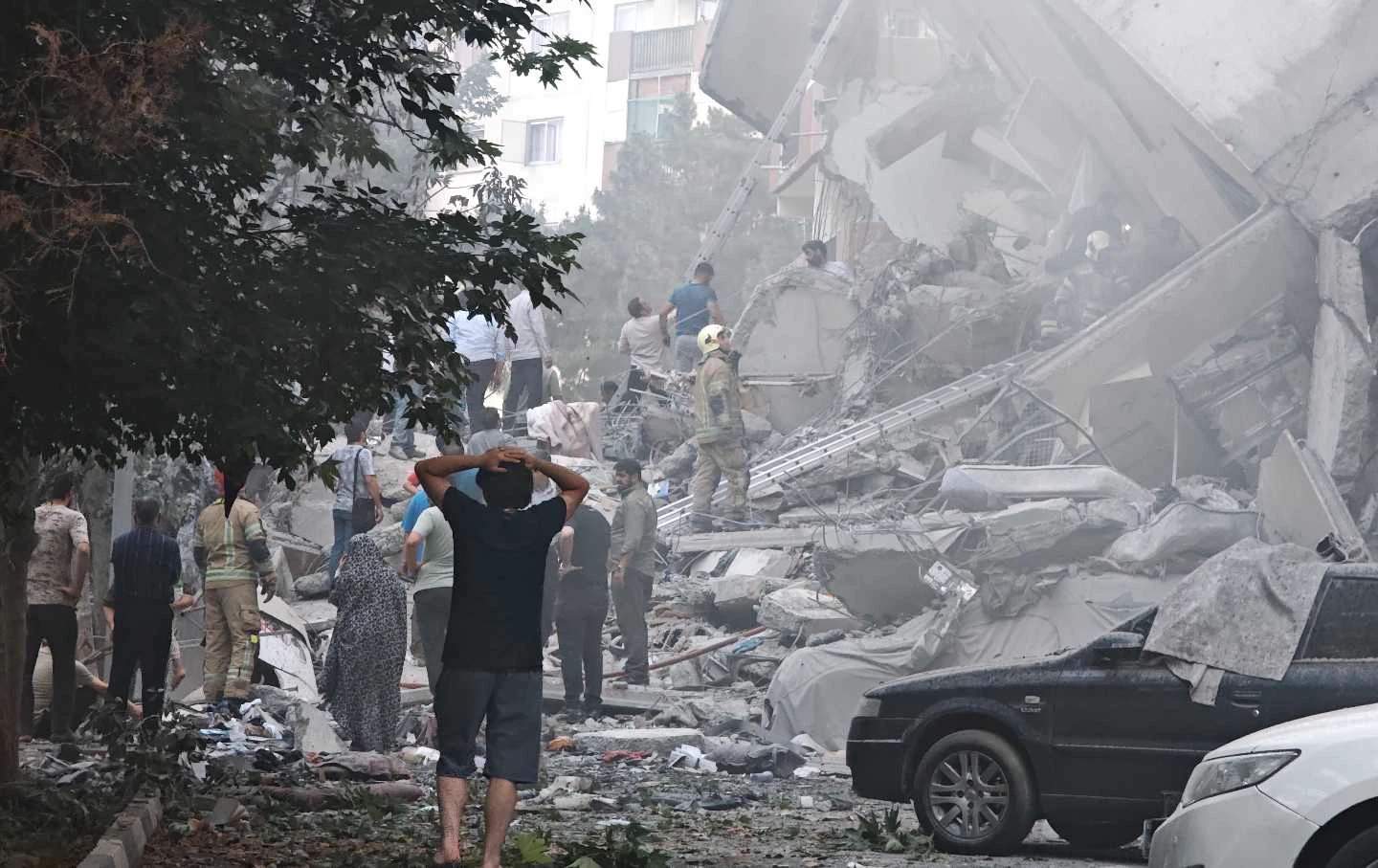
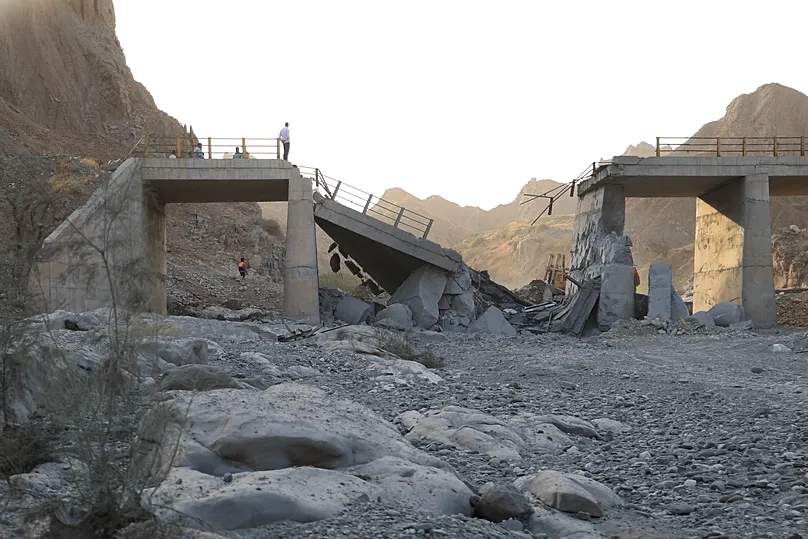
Damage to a residential neighborhood in Tehran after US airstrikes during Operation Epic Fury
Israel's War, America's Blood
From the first bombs that fell on February 28, this was never primarily an American war. It was an Israeli objective executed with American firepower.
The pretext was Iran's nuclear program — a program that, as UN Special Rapporteur Ben Saul noted, had not produced weapons-grade material, and that every expert assessment agreed was nowhere near producing a nuclear device. The timing was driven by Israeli pressure, not American strategic interest. The legal justification — "collective self-defense" of Israel — was constructed by State Department Legal Adviser Reed Rubinstein after the fact, and was rejected by over 100 international law experts who signed an open letter calling the attacks a war of aggression.
The war violated the Algiers Accords of 1981, in which the United States formally pledged "not to intervene, directly or indirectly, politically or militarily, in Iran's internal affairs." Iran has now sued the United States at the Iran-United States Claims Tribunal in The Hague over the violation.
More than 100 international law experts identified the attacks as violations of the UN Charter's prohibition on the use of force. Luis Moreno Ocampo, the founding chief prosecutor of the International Criminal Court, argued that Trump's threats to destroy Iranian infrastructure alongside mutual attacks on energy infrastructure "do not constitute legitimate military targets under international humanitarian law and are war crimes under the Rome Statute" — the same statute under which Russian leaders were indicted for attacks on Ukrainian energy infrastructure.
Stephen Rapp, the former US ambassador-at-large for war crimes, said the conduct “risks making the US a rogue state”.
The Real Winner
If the United States lost, who won?
The question answers itself. Iran survived a full-scale American military assault. Its leadership adapted. Its control of the Strait of Hormuz — the most powerful asymmetric weapon in modern Middle Eastern geopolitics — was demonstrated, not theorized. Its nuclear program was not destroyed. Its regional alliances held.
China, which the Trump administration identifies as America's principal adversary, benefited enormously. The war demonstrated the limits of American military power, consumed American resources and attention, and undermined confidence in American security guarantees across Asia and the Gulf. Gulf states that had hosted American bases saw those bases damaged or destroyed by Iranian missiles. The alliance structure the United States built over decades was, in Mearsheimer's words, "torn to tatters."
The international economy teeters on the edge of a depression triggered by a war that achieved nothing. Oil prices remain elevated. Global supply chains are disrupted. As we documented when the war was still spiraling in its fifth month, the pattern of escalation without strategy was already visible from Washington. The Strait of Hormuz — through which one-fifth of the world's oil passes — is controlled by a country that the United States just spent $113 billion trying to destroy.
"There is no way that Iran is going to back down from this position and the US has no viable military strategy for getting Iran's leaders to change their minds."
— John Mearsheimer, July 2026
The Surrender is Inevitable
Trump's war on Iran was not a miscalculation. It was the logical endpoint of decades of American policy in the Middle East — a policy built on the assumption that overwhelming military force can substitute for political strategy, that American interests and Israeli interests are identical, and that the United States can dictate terms to any nation on earth.
It was wrong on all three counts. Iran proved that a determined nation can survive full-scale American assault. Israel proved that it can drag the United States into wars that serve Israeli strategic objectives at American expense. And the international order proved that a superpower which launches wars of aggression undermines the very rules-based system it claims to defend.
The Islamabad Memorandum was a surrender document. But the war it temporarily paused is not over. Iran still controls the Strait of Hormuz. The nuclear issue is unresolved. The missile program is untouched. The Axis of Resistance is intact. And the United States — having demonstrated the full extent of its military power and the full extent of its strategic impotence — has no good options left.
America lost this war. The only question now is how long it takes Washington to admit it.
Sources & Methodology
Methodology
Reported using the Mearsheimer transcript (Deep Dive with Danny Davis, July 2026), Mearsheimer's Substack analysis, WarCosts.org casualty and cost tracker, MilitarySpend.org casualty tracker with 205 sources, Wikipedia analysis pages, the full text of the Islamabad Memorandum (Arab Center DC), CGTN, BBC (Jeremy Bowen), The Economist, Just Security (100+ international law experts), CounterPunch (Algiers Accords), and the International Crisis Group. casualty ranges reflect low-high sourced estimates from conflicting official and independent sources.
Filed Under
Frequently Asked Questions
- What was Operation Epic Fury?
- Operation Epic Fury was the codename for the joint US-Israeli military campaign launched against Iran on February 28, 2026. It involved 40,000 troops, multiple carrier strike groups, B-2 stealth bombers, and coordinated strikes on over 2,500 Iranian military and government facilities.
- What were America's four goals in the Iran war?
- The US and Israel had four stated objectives: regime change in Iran, destruction of Iran's uranium enrichment capability, elimination of Iran's ballistic missile program, and severing Iran's support for Hamas, Hezbollah, and the Houthis. None were achieved.
- What is the Islamabad Memorandum?
- The Islamabad Memorandum of Understanding was signed on June 17, 2026, at the Palace of Versailles. Brokered by Pakistan with Qatar, Saudi Arabia, Turkey, and Egypt, it provided for a ceasefire, reopening of the Strait of Hormuz, an end to the US naval blockade, sanctions waivers on Iranian oil, release of frozen assets, and reparations to Iran. Analysts including John Mearsheimer called it a surrender document.
- How many people died in the US-Iran war?
- Total estimated deaths across all parties range from 8,976 to 18,310 as of August 2026. This includes 18-20 US military killed, 1,701-3,636 Iranian civilians, 4,328 Lebanese civilians, 1,000-2,500 Hezbollah fighters, 28 Israeli civilians, and 1,800-7,650 Iranian military personnel.
- How much did the Iran war cost?
- The first six days alone cost $11.3 billion ($1.9 billion per day). Total estimated war cost reached $113 billion by August 2026. US equipment losses exceeded $5.14 billion including four F-15E Strike Eagles and 24 MQ-9 Reaper drones.