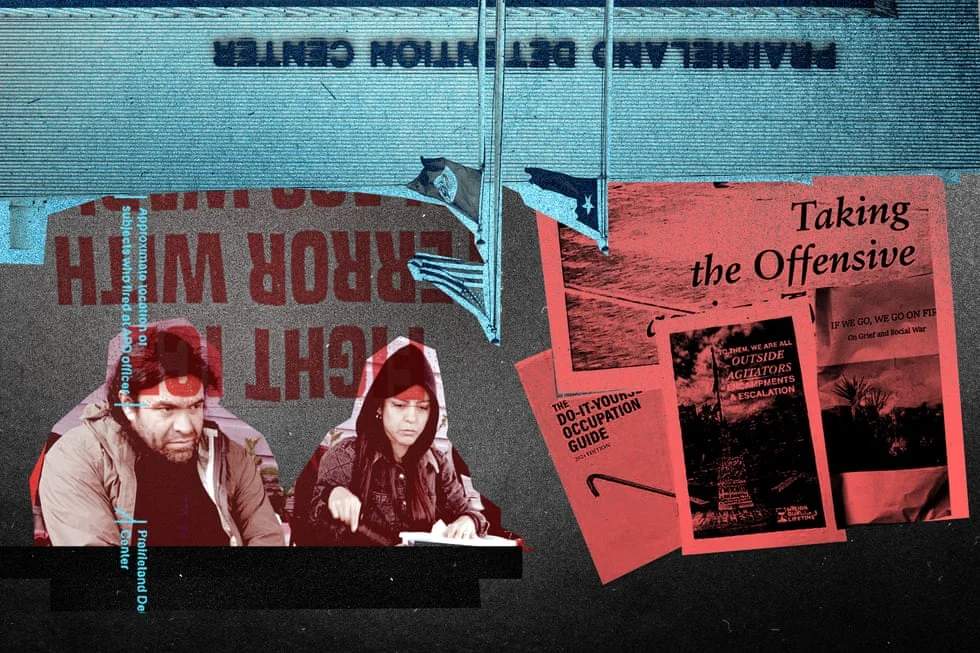
Fifteen people who attended or were connected to a July 4, 2025 protest outside a Texas immigration detention center have been sentenced to a combined 562 years in federal prison — the longest combined sentence a U.S. court has ever handed to a group of political defendants. Three of the nine who went to trial received 50-year terms each for crimes that required no proof of violence, no weapons, and no intent to harm anyone. One received 30 years for moving a box of books — despite never attending the protest at all. The leader received a century.
As we documented when the verdict came down, the trial itself was a charade: no defense witnesses called, no ballistic evidence submitted, no medical evidence linking the shooter's bullet to the officer's wound. The jury was stacked. The judges were Trump appointees who called the demonstration "an assault on democracy." Now the sentences have confirmed what the verdict promised: this is not justice. It is a war against anyone who opposes the machinery of state violence.
This is the full picture — every defendant, every year, every lie the government told to put them in cages, and the nationwide crackdown the Prairieland case was designed to accelerate.
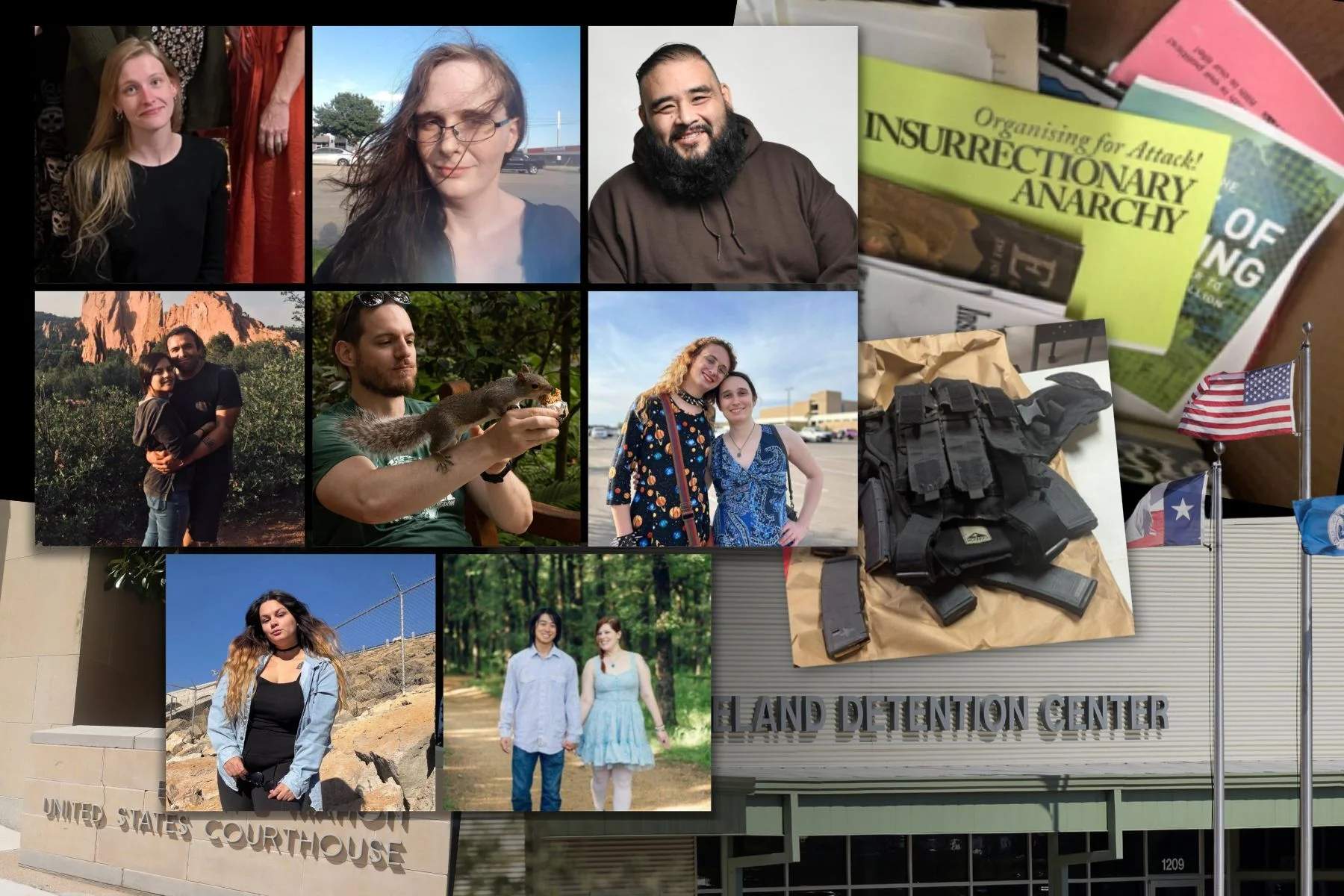
Composite of the eight Prairieland defendants sentenced to federal prison.
The Complete Sentencing Table
On June 23, 2026, eight of the nine trial defendants were sentenced. On July 1, the ninth was added. On July 6, the final defendant was sentenced. The combined total: 562 years.
| Defendant | Age | Sentence | Key Convictions | Key Facts |
|---|---|---|---|---|
| Benjamin "Champagne" Song | 32 | 100 years | Attempted murder of LE officer; riot; material support; explosives conspiracy | Fired shots during confrontation. Officer struck in back (direction disputed). No ballistic or medical evidence submitted at trial. |
| Maricela Rueda | — | 70 years | Riot; material support; explosives; concealment | Present at protest. Additional conviction for allegedly directing Estrada to move zines. |
| Ines Soto | — | 50 years | Riot; material support; explosives conspiracy | Elizabeth Soto's spouse. DOJ called her the "cell head of Antifa DFW" operating under the "front" of the Emma Goldman Book Club. |
| Cameron "Autumn Hill" Arnold | — | 50 years | Riot; material support; explosives conspiracy | Left the protest before shots fired. Trial transcript confirms. FBI and police witnesses could not contradict this. Acquitted of attempted murder and firearms charges. |
| Savanna Batten | — | 50 years | Riot; material support; explosives conspiracy | Arrived separately. Arrested in a tank top. No evidence she brought a weapon. Not alleged to have participated in planning. |
| Zachary Evetts | — | 50 years | Riot; material support; explosives conspiracy | Mechanical engineer. No criminal history. Acquitted of attempted murder. |
| Elizabeth Soto | — | 50 years | Riot; material support; explosives conspiracy | Ran a small anarchist zine printing press with her spouse Ines. |
| Bradford \"Meagan Morris\" | — | 50 years | Riot; material support; explosives conspiracy | Stayed in van during the protest. Did not exit the vehicle. |
| Daniel "Des" Sanchez Estrada | — | 30 years | Corruptly concealing a document; conspiracy to conceal | Not present at the protest. Convicted for moving a box of his own zines, artwork, poetry, and journals. |
| Rowan "Joy" Gibson | — | 15 years | Material support (guilty plea, non-cooperating) | Refused to cooperate with prosecution. |
| Rebecca Morgan | — | 15 years | Material support (guilty plea, non-cooperating) | Refused to cooperate with prosecution. |
| Susan Kent | — | 6 years | Material support (guilty plea, cooperating) | Cooperated and pleaded guilty. |
| Seth Sikes | — | 6 years | Material support (guilty plea, cooperating) | Cooperated in exchange for reduced sentence. |
| Lynette Sharp | — | 110 months (~9 years) | Material support (guilty plea, cooperating) | Testified against former friends. |
| John Thomas | — | 22 months (~2 years) | Material support (guilty plea, cooperating) | Received lightest sentence for cooperating. Only defendant to admit to vandalism. |
Combined: 562 years.
How We Got Here: What Actually Happened
On the night of July 4, 2025, a group of activists from Dallas-Fort Worth arrived at the Prairieland ICE Detention Center in Alvarado, Texas, about 40 miles south of Dallas. They intended to hold what they described as a "noise demonstration" — setting off fireworks to let the people detained inside know they were not forgotten. Independence Day fireworks, at an immigration prison, in the country that invented both.
As we've reported extensively on ICE's killing machine, the conditions inside detention centers are monstrous. People die in custody. Private prison companies like GEO Group guard these facilities with impunity. The federal government has poured $529 million into building new detention centers while cutting food assistance for the poor. People who show up to say this is wrong are now being treated as terrorists.
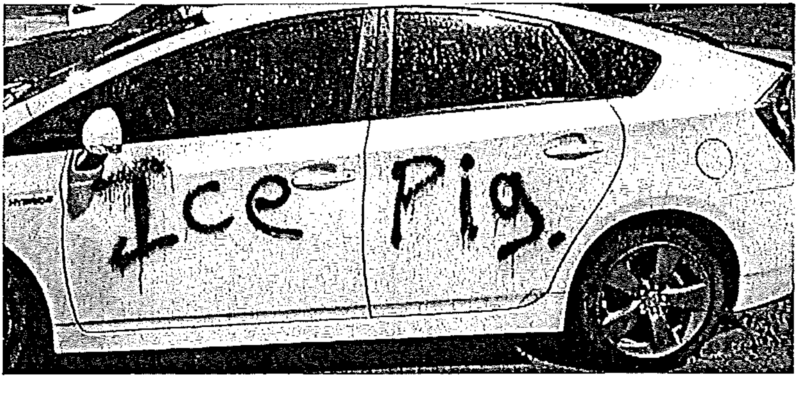
Some in the Prairieland group broke off and vandalized vehicles and a guard shack — spray-painting slogans, slashing tires, breaking a security camera. Nathan Baumann, who admitted to the vandalism, received the lightest sentence in the entire case: under two years. Those who merely attended the protest received 50.
When Alvarado Police Lt. Thomas Gross arrived on scene and drew his weapon, Song opened fire with an AR-15. The bullet entered above Gross's collarbone and exited through his upper back. Gross was airlifted to a hospital and released within 24 hours. He has fully recovered.
The critical dispute: Song says he fired at the ground as suppressive fire because Gross had drawn his gun on another fleeing protester — a fact Gross admitted under cross-examination. The defense argued a ricochet struck the officer. Judge Pittman refused to allow the ricochet argument. No ballistic report was submitted at trial. No medical evidence was introduced. The prosecution's case that Song intended to murder Gross rested entirely on inference.
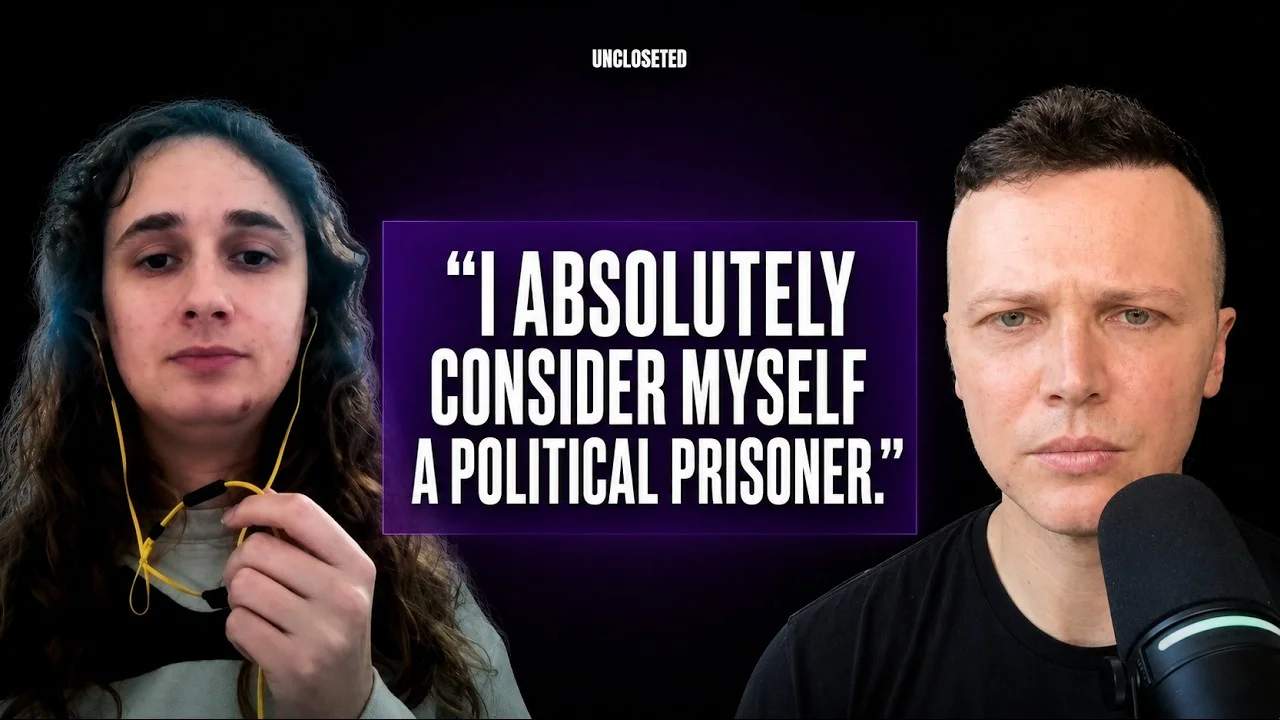
Autumn Hill "I absolutely consider myself a political prisoner."
Autumn Hill Speaks: "I Am a Political Prisoner"
On July 25, 2026, Uncloseted Media published Autumn Hill's first video interview from Johnson County Jail. What she said matters — because the state that sentenced her to 50 years does not want you to hear it.
Hill — also known by her drag name Lady Hell — is a neuroqueer self-advocate who lived at what her housemates called the "Big Gay House" in South Dallas, a home purchased by Meagan Morris and her friend Taylor specifically to provide shelter to housing-insecure queer and trans people. Hill describes the house as an intentional community space. She met her housemates through activist circles. She dated first Shelby, then Meagan.
She attended the Prairieland protest and left hours before the shooting. The trial transcript confirms this. The FBI and Alvarado police witnesses were unable to produce evidence placing her at the scene when shots were fired. She was acquitted of attempted murder and firearms charges.
None of this mattered.
"I never believed for a minute leading up to the trial that Champagne had attempted to murder someone in cold blood," Hill told Uncloseted Media. "Champagne is one of the most calm, level-headed and principled people I know."
On the raid itself: "They're ordering me to stay where I am, and then they're ordering the person in the red dress to come forward... They order me to turn around and walk backward toward them, and then they put me in handcuffs, and then they sit me on the pavement outside of my house and they leave me there for like 30 minutes under guard."
On antifa: "There's no membership in antifa. They want to create a narrative of leftist political violence as being as much or more of a problem in the United States than, you know, right-wing stochastic terrorism. You know, they want to create a false equivalency which the data shows just doesn't exist."
On her 80 days in solitary confinement — what the jail calls "administrative segregation": "These cells are very small, like the size of a bathroom, right? So you've got like a bunk, you've got a little table, and you've got a shower and a toilet..."
Hill is one of three trans defendants in the case. Since her arrest, she has been incarcerated in men's facilities. The Trump administration's new counterterrorism strategy, released in May 2026, explicitly highlights "radically pro-transgender" people as a threat — despite no evidence that trans people are disproportionately likely to commit acts of violence. The administration's narrative linking trans identity to terrorism is a fabrication, but it is a fabrication with 50-year prison sentences behind it.
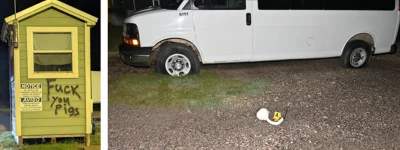
Government evidence exhibit: Vandalized guard shack & van.
The Weapons of a Noise Demonstration
The entire trial was a stretch of “evidence” well beyond the realms of imagination. The government's evidence of a "terrorist cell" is worth examining in detail, because it reveals the absurdity — and the danger — of what has been normalized.
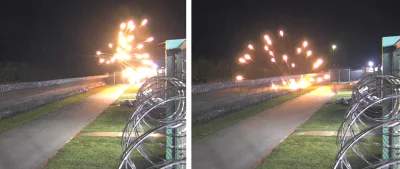
Government evidence exhibit: Fireworks exploding near no one.
- The "explosives": Fireworks. Commercial fireworks. The kind Americans set off on every street corner on July 4th. No people were injured by the fireworks. No buildings were damaged by the fireworks. They were fired into the air.
- The "material support for terrorists": Providing "training," transportation, and "personnel" — meaning the protesters themselves — for the commission of the federal crime of Riot. The "riot" consisted of setting off fireworks, Baumann's vandalism, and forming what prosecutors called a "black bloc."
- The "black bloc": Wearing dark clothing. This is a tactic, not an organization — commonly associated with anarchism as a means of showing political solidarity and evading surveillance. Police bodycam footage from the trial showed that arrestees were not uniformly dressed in black. Savanna Batten was arrested in a tank top. Ines Soto was wearing blue work pants. Song was wearing a neon green mask.
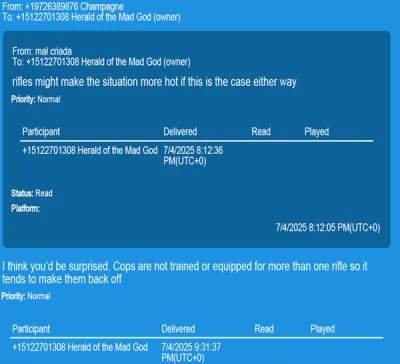
Government evidence exhibit: Text message exchanges between members.
- The "cell structure": Signal group chats, zines produced on a small printing press, attendance at an Emma Goldman Book Club (named after the immigrant anarchist labor organizer persecuted by the federal government in the early 20th century), and the books they read — entered as evidence of ideology.
- The expert witness: Kyle Shideler of the Center for Security Policy, a group the Southern Poverty Law Center describes as a "conspiracy-oriented mouthpiece for the anti-Muslim movement." Shideler testified that antifa members typically espouse "strong anarchist ideology or some of these other non-authoritarian socialist ideologies." He has published pieces warning of an impending "anarcho-communist insurgency."
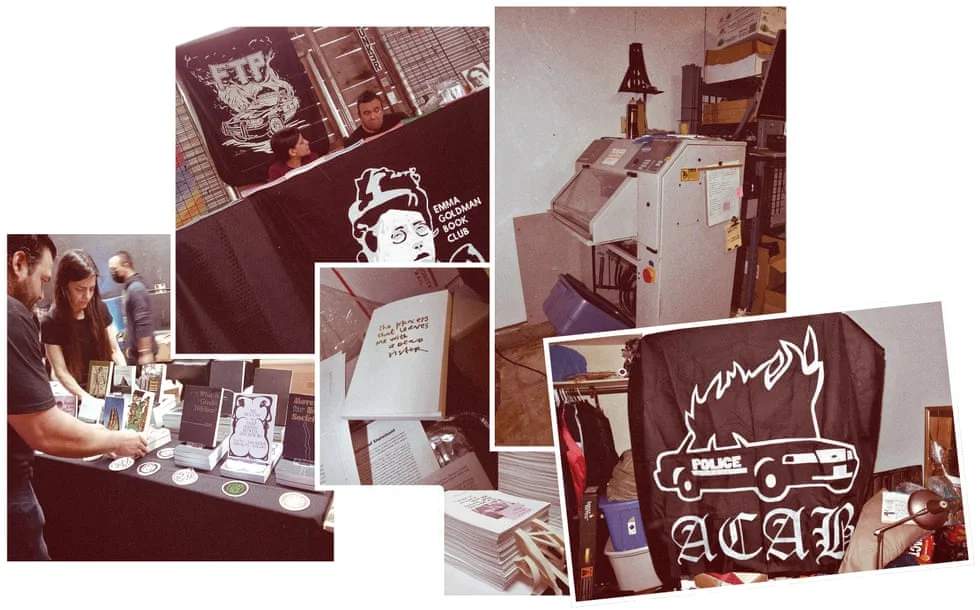
Government evidence exhibit: Printing press, anarchist literature & flags.
- The evidence of terrorism: Radical literature, encrypted messaging apps, a book club named after a deported anarchist, and the fact that some of them attended gun ranges. These are the behaviors of millions of Americans. They are now the profile of a terrorist.
As Albert from the DFW Support Committee told Unicorn Riot:
"A black bloc did not occur at the demonstration. And so what's even crazier is that they have now successfully used black bloc to get a conspiracy conviction without people wearing black bloc."
The Precedent: What Prairieland Means for Every Protester
The Prairieland case was designed to be a template. The DOJ itself called it "the first sentencing of defendants affiliated with Antifa following President Donald J. Trump's executive order designating the group as a Domestic Terrorist Organization." That language is not incidental — it is a product announcement. The case was announced with statements from Acting Attorney General Todd Blanche, FBI Director Kash Patel, Acting ICE Director David J. Venturella, and U.S. Attorney Ryan Raybould. The full weight of the national security apparatus, mobilized for a noise demonstration at a county detention center.
Xavier de Janon, Director of Mass Defense for the National Lawyers Guild, called it plainly: "It is a criminalization of protest."
Consider the legal precedents now established:
- Attending a protest while wearing dark clothing can be used as evidence of terrorism.
- Owning legally purchased firearms — all 11 recovered guns were legally owned — can justify consecutive terrorism sentences.
- Reading radical literature can be introduced as evidence of a terrorist conspiracy.
- Using encrypted messaging apps — Signal, used by journalists, activists, and ordinary citizens — is evidence of criminal coordination.
- Moving a box of zines and personal journals can get you 30 years.
- Attending a book club named after an anarchist labor organizer is evidence of operating a terrorist cell under a \"front.\"
- Being trans is part of the government's counterterrorism framework.
- Standing in solidarity with people in cages is now treated as an act of domestic terrorism.
Suzanne Adely, interim president of the National Lawyers Guild, told NBC 5: "That opposition is something that the government wants to squash so a case like this helps the government kind of see how far they can go in criminalizing constitutionally protected protests and also helps them kind of intimidate, increase the fear, hoping that folks in other cities then will think twice over protesting."
Tamera Hutcherson, who served on Savanna Batten's defense team: "If we are to bring a medical kit to a protest, does that mean we are a criminal now? If we are to even just attend a noise demonstration, does that mean we are a criminal now, and we may not return home to our loved ones?"
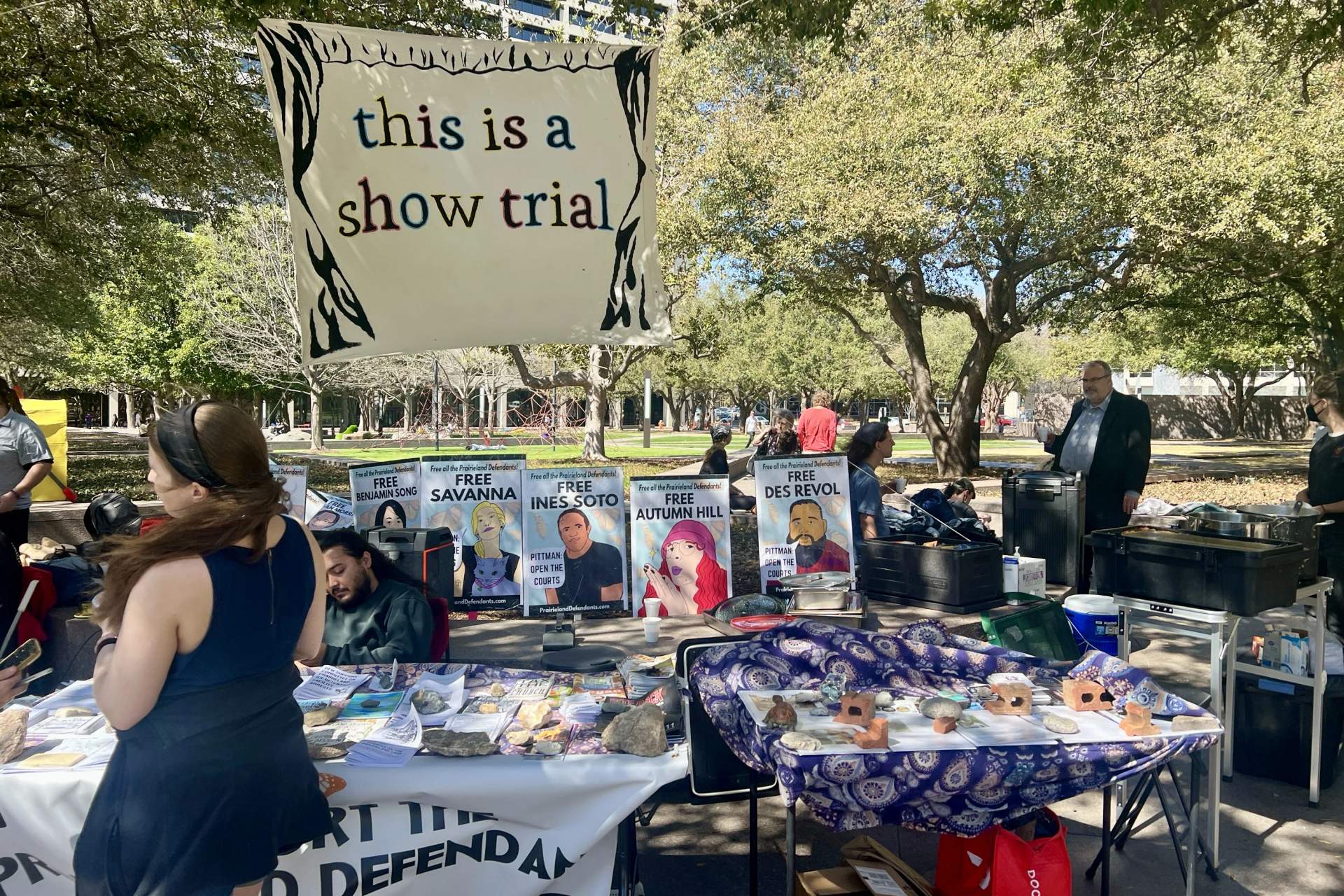
"This is a show trial" Banner displayed at protest outside the federal courthouse.
The Asymmetry: Terror for the Left, Pardons for the Right
The sentencing disparity is not incidental. It is the point.
| Case | Defendants | Conduct | Longest Sentence | Outcome |
|---|---|---|---|---|
| Prairieland (ICE protest) | 15 | Noise demonstration, fireworks, vandalism | 100 years (Song) | 562 combined years |
| January 6 (Capitol attack) | 1,500+ | Armed insurrection, 5 deaths, 140 officers injured | 22 years (Tarrio) | Average sentence: ~2 years. Trump mass-pardoned all. |
| Proud Boys (seditious conspiracy) | Multiple leaders | Organized armed attack on seat of government | 22 years (Tarrio) | Trump pardoned. |
| Oath Keepers (seditious conspiracy) | Multiple leaders | Organized armed attack on seat of government | 18 years (Rhodes) | Trump pardoned. |
Enrique Tarrio, the Proud Boys leader convicted of seditious conspiracy for his role in an armed attack that killed five people and injured 140 officers, received 22 years. He was pardoned by Trump on his first day back in office. Stewart Rhodes, the Oath Keepers founder convicted of the same charge, got 18 years. Pardoned.
People who attended a protest with fireworks and spray paint are now serving sentences that are five to ten times longer than the leaders of an actual armed insurrection — an insurrection whose participants the President personally freed.
Sufia Khalid, deputy director of the National Security Criminal Defense Center at the Muslim Legal Fund of America, drew the comparison directly: "There were people who were up in arms about the Jan. 6 prosecutions... but we had far more serious, egregious conduct in those cases, and in the vast majority of those 1,500 cases, they didn't seek the terrorism enhancement."
The terrorism enhancement — the legal mechanism that turns a 15-year sentence into 50 — was available in every January 6 case. Prosecutors chose not to use it. For people who actually breached the Capitol. For people who actually chanted about hanging the Vice President. For people who actually beat police officers with flagpoles.
But for a noise demonstration at an ICE detention center? The full weight of the terrorism apparatus, deployed without restraint.
The Crackdown Template Is Already Spreading
The Prairieland playbook is being replicated across the country. As we documented in our coverage of the DOJ's conspiracy campaign against immigration protesters, the legal machinery is already in motion:
- Minneapolis: Federal prosecutors charged 15 people with criminal conspiracy for allegedly impeding ICE agents during deportation operations. The indictment centered on antifa affiliation.
- Spokane, Washington: A federal jury convicted three protesters of conspiracy for a 2025 protest at an ICE facility.
- Chicago: Similar charges against protesters were dismissed after grand jury misconduct was revealed — but the chilling effect had already done its work.
- Alabama: Prosecutors brought material support for terrorism charges against two people who allegedly set a shopping cart on fire after a BLM protest.
- Burlington, Vermont: Eleven mainstream protesters crossed the line at an ICE facility — the kind of people who had never been arrested before, representing the moment the liberal handbrake slipped.
The point is not precision. It is fear. The government wants you to calculate the cost of showing up before you decide whether to show up.
The Broader Context: A State at War With Its Own People
The Prairieland sentences do not exist in isolation. They are one front in a broader campaign to criminalize dissent, expand the carceral state, and crush resistance to the immigration enforcement apparatus.
The immigrant prison boom has seen billions poured into detention infrastructure while communities are stripped of resources. ICE raids in Oregon have met with fierce community resistance. Over 330 cities have taken to the streets demanding justice for the dead. Brooklyn protesters shut down the Metropolitan Detention Center. Hunger strikes at Delaney Hall exposed the conditions the state wants hidden.
The fires are not random. America is boiling over. And the Prairieland sentences are the state's response: not reform, not accountability, not dialogue — but the maximum possible violence against those who dare to speak.
National Security Presidential Memorandum-7, signed by Trump in September 2025, inaugurated what Homeland Security Advisor Stephen Miller called "an all-of-government effort to dismantle" anti-fascist organizing. In January 2026, the FBI released a report warning law enforcement of "anarchist violent extremists, (...)citing graffiti as evidence of\"AVE mobilization to violence."
Judge Reed O'Connor said at sentencing that he \wants to send a message to anyone else with similar ideology." FBI Director Kash Patel called the case the first prosecution of "Antifa-aligned anarchists." The ideology on trial is not violence — it is the belief that people in cages deserve to know someone is out there, that no human being is illegal, that solidarity is not a crime.
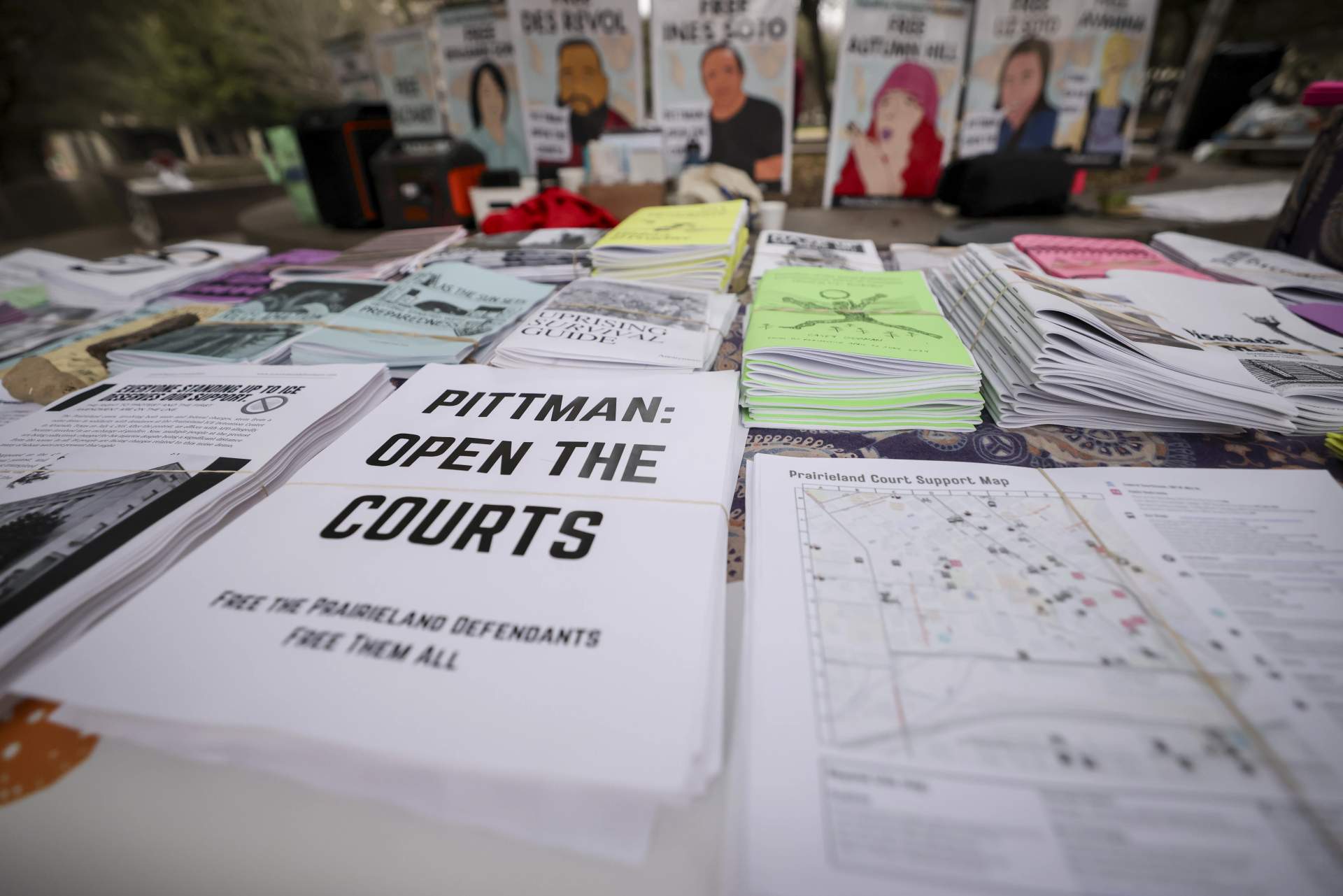
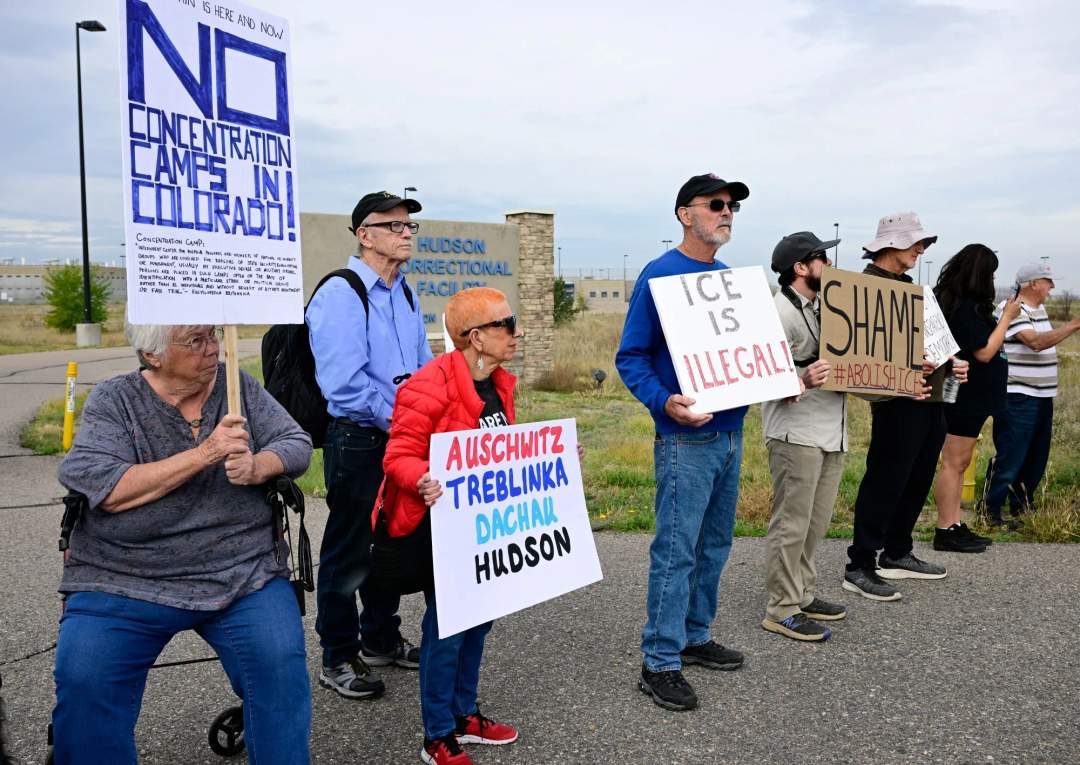
Supporters spread flyers outside the Prairieland ICE shooting trial at federal courthouse, Feb. 26, 2026
The Voices They're Trying to Silence
The defendants and their families have spoken at every opportunity. Their words deserve to be amplified — because the system that sentenced them is counting on silence.
- Song's statement to the court: "What kind of people are not against fascism? I never want to see good people, standing for what they believe in, gunned down in the street. Now 21 people have been arrested, have been persecuted, have been punished. For knowing me or being my friend? This is wrong. This is mass punishment. Collective punishment. This is guilt by association. This is injustice."
- Song's mother, Hope Song: "He's accepted full responsibility for what actually happened. But he will never accept responsibility for a lie — a government lie made to prosecute innocent people in order to get political persecutions."
- Lydia Koza, Hill's wife: "In the face of this grotesque distortion of anything that could ever have called itself due process, I am livid. They have chosen to lay to ruin the lives of, not just all of the defendants, but their family members, their loved ones, their communities."
- Amber Lowrey, Batten's sister: "This case has relied on lies and misinformation from the start. But we will keep fighting to overturn these unjust convictions and to free Savanna and all the Prairieland defendants. We will not rest until they are free!"
- Albert, DFW Support Committee: "The fantasy that there is a militant underground left-wing violent movement in the United States has no basis in reality, but it's being used by the right wing to justify their authoritarianism and to build the legitimacy of their power."
- Ana Maria Thorne, All Peoples Church Unitarian Universalist: "Suppressive fire that had no intention to harm anyone, that may or may not have accidentally harmed someone, is not a reason to withhold support from people whose ultimate principles are good."
- Muslims for Just Futures: "These convictions for what was intended to be a noise demonstration in solidarity with people detained at the facility send a message that anyone exercising their right to protest and more broadly, anyone critical of the government, will face the full wrath of the state, decrying the federal government's willingness to stretch national security and terrorism frameworks to their maximum, terrifying edges."
The DFW Support Committee issued a statement after sentencing: "Our loved ones did nothing wrong and they are being thrown away for the rest of their lives. Not only does the evidence prove their innocence, but the actions of ICE and the federal government over the past year have proved the righteousness of their actions. This sentencing is a punishment for solidarity itself."
Appeals and the Road Ahead
All 15 defendants are pursuing appeals. The legal basis is strong: no ballistic evidence, no medical evidence, a trial with no defense witnesses, a judge who called the demonstration an "assault on democracy" before sentencing, and the unprecedented application of terrorism enhancements to protest-related charges.
But appeals take years. The defendants are sitting in cages now. Autumn Hill is in a men's facility, staring down half a century for leaving a protest early. Elizabeth and Ines Soto — a married couple — are both serving 50 years for running a zine press and attending a book club. Daniel Estrada is serving 30 years for moving a box of his own poetry.
Additionally, the State of Texas intends to hold its own trials in connection with this protest. The federal sentencing may not be the end. It may be the beginning.
How to Support the Prairieland Defendants
The defendants need commissary funds, legal fees, and the knowledge that they are not forgotten.
- DFW Support Committee (General Fund): givesendgo.com/supportDFWprotestors
- Maricela Rueda Family Support: gofundme.com/f/help-maricelas-family-while-she-fights-for-justice
- Daniel \"Des\" Sanchez Estrada Legal/Immigration Fund: gofundme.com/f/get-artist-des-revol-an-immigration-attorney
- Official Case Website: prairielanddefendants.com
- Write to the defendants: Addresses are posted on the defendants' profile page. Letters are essential. Write often.
- Contact: dfwsupportcommittee@hacari.com
The DFW Support Committee also encourages supporters to organize letter-writing nights, host fundraisers, carry out noise demonstrations at local detention centers, and — in the finest tradition of resistance — start Emma Goldman Book Clubs to discuss the very literature that was used as evidence of terrorism.
If reading books about anarchism makes you a terrorist, then read them anyway. If standing with people in cages makes you a target, stand anyway. If the state wants you to be afraid, the most radical thing you can do is refuse.
The Prairieland defendants showed up. They brought fireworks and they brought solidarity. They named themselves after an immigrant anarchist who was deported by the same government that is now putting her readers in cages for a century.
The state calls it terrorism. History will call it resistance.
Sources & Methodology(15 sources)
- NBC 5 Dallas-Fort Worth — Sentencing CoverageVideo / Audio
Methodology
Reporting based on DOJ press releases, trial testimony reported by KERA News, AP, The Guardian, The Intercept, Al Jazeera, BBC, and Salon. Autumn Hill jailhouse interview from Uncloseted Media (July 25, 2026). Complete sentencing data from Unicorn Riot, WSWS, TPR, and KERA. Court notes and defendant profiles from DFW Support Committee. Support committee information verified via official website.
Filed Under
Frequently Asked Questions
- How many people were sentenced in the Prairieland case?
- Fifteen people in total received sentences ranging from 22 months to 100 years, for a combined 562 years. Eight defendants from the March trial were sentenced June 23, 2026. The ninth trial defendant was sentenced July 1. Six additional defendants who pleaded guilty received sentences July 1 and July 6.
- What was Autumn Hill's role and why was she sentenced to 50 years?
- Autumn Hill attended the protest and left hours before shots were fired — confirmed by the trial transcript and the inability of FBI and police witnesses to contradict this. She was acquitted of attempted murder and firearms charges but convicted of riot, material support, and explosives conspiracy for attending a protest where fireworks were set off. She received 50 years.
- How do these sentences compare to January 6 sentences?
- The Proud Boys leader Enrique Tarrio received 22 years for seditious conspiracy, and Oath Keepers founder Stewart Rhodes received 18 years. Both were pardoned by Trump. The Prairieland defendants — who attended a protest with fireworks — received sentences five to ten times longer than the leaders of an actual armed insurrection.
- What evidence did the government use to prove a 'terrorist cell'?
- The government's evidence of an organized cell consisted of: Signal group chats discussing fireworks, zines produced on a small printing press, attendance at an Emma Goldman Book Club, the books they read (entered as evidence of ideology), legally-owned firearms, dark clothing, and testimony from a Center for Security Policy expert who has warned of an 'anarcho-communist insurgency.' No ballistic or medical evidence was submitted at trial.
- How can I support the Prairieland defendants?
- Donate through the DFW Support Committee at givesendgo.com/supportDFWprotestors, write letters to the defendants at prairielanddefendants.com/meet-the-defendants/, or organize fundraisers and noise demonstrations at local detention centers. The defendants are pursuing appeals.