The Ballroom Blitz: White House Correspondents' Dinner Shooting Marks Escalation in Infrastructure Attacks
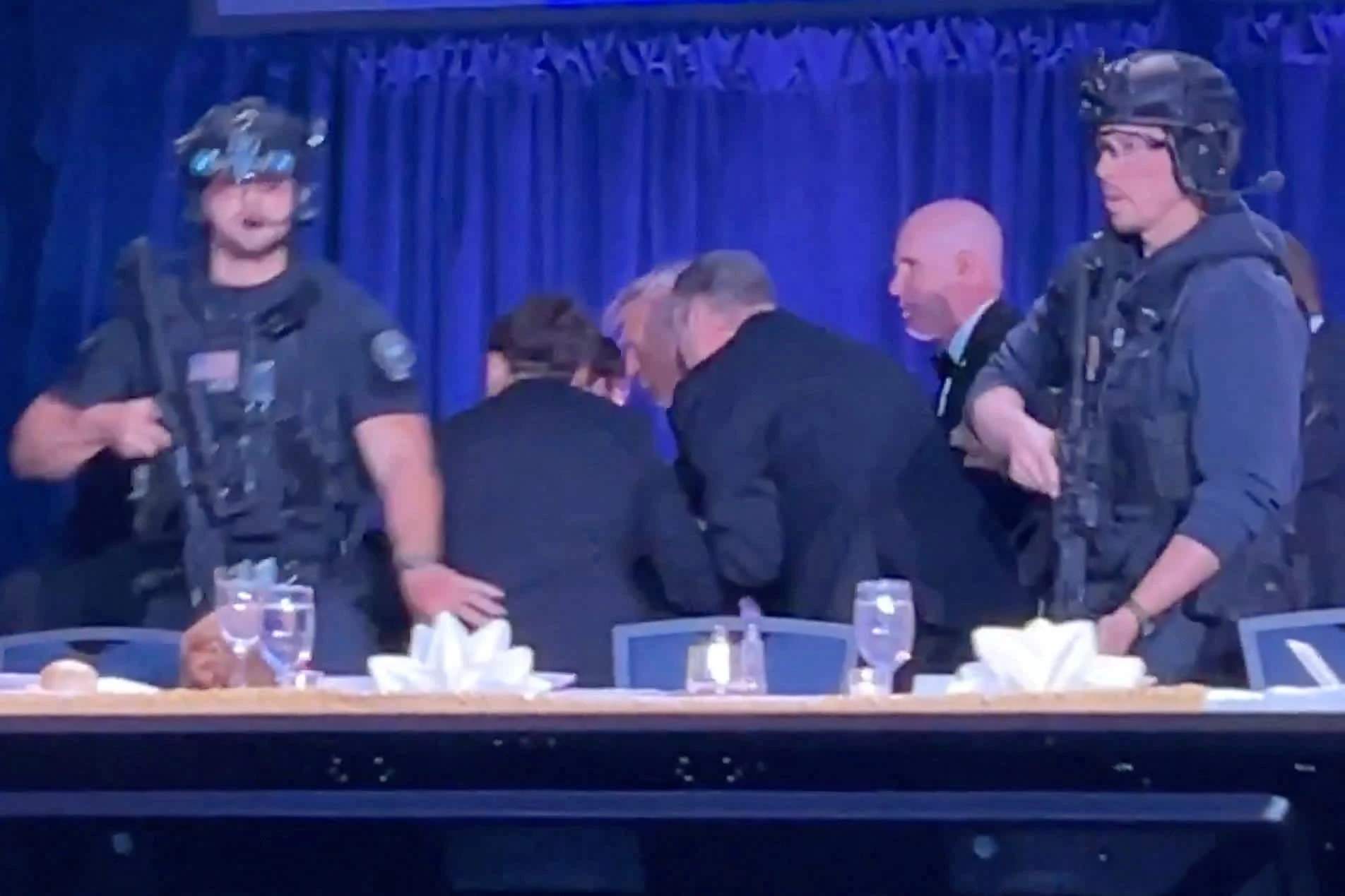
On April 25, 2026, at approximately 8:30 PM, shots rang out at the Washington Hilton where the White House Correspondents' Association dinner was underway. President Donald Trump, who had just arrived for his first appearance at the event as president, was rushed off stage by Secret Service agents within seconds of the first shot.
Five to eight rounds were fired at the security checkpoint near metal detectors outside the ballroom, where the shooter charged Secret Service agents. Gunpowder drifted through the cavernous ballroom. CNN's Wolf Blitzer, who was in attendance, reported being "a few feet away from a gunman as he was shooting" with a "very, very serious weapon."
The shooter, armed with multiple weapons including a shotgun and handgun, was "taken down" by Secret Service agents. One Secret Service agent was struck by a round but was wearing a bulletproof vest and is expected to be OK. Trump, Vice President JD Vance, First Lady Melania Trump, and multiple Cabinet members including Secretary of State Marco Rubio, Defense Secretary Pete Hegseth, and Health and Human Services Secretary Robert F. Kennedy Jr. were all evacuated safely.
But this was not an isolated incident. It was the latest and most alarming escalation in a wave of arson, sabotage, and attacks on political and economic infrastructure that has swept across the United States and Europe in 2026 alone.
A Chilling Prophesy
Less than an hour before the shots rang out, White House Press Secretary Karoline Leavitt gave an interview on Fox News that would take on an altogether more sinister meaning within minutes.
"He is ready to rumble, I will tell you. This speech tonight will be classic Donald J. Trump," Leavitt told Fox News from the red carpet. "It'll be funny, it'll be entertaining. There will be some shots fired tonight, so everyone should tune in. It's gonna be really great. I'm looking forward to hearing it."
At the time, Leavitt's comment appeared to be a figurative reference to Trump taking verbal jabs during his speech — the kind of combative rhetoric he's known for. But moments later, as loud bangs believed to be gunshots echoed through the Washington Hilton ballroom and guests dove under tables, the comment took on a far more unsettling meaning.
A video of Leavitt's interview has since crossed 4 million views on X, with users commenting that "this didn't age well" and predicting that "the Facebook groups and WhatsApp aunties gonna have a field day with the conspiracy theories."
The Call That Went Silent
But there's another part of the Leavitt story that Fox News would rather you forget.
Minutes after the shooting, Fox News brought Leavitt back on air — this time by phone — to discuss what was happening. She was mid-sentence, talking about how she had been warned to be safe, when the call suddenly went dead.
Fox News anchors played it off as a dropped connection, a technical glitch. But here's the thing: they never brought her back.
In a normal live broadcast, when a call drops, you see the anchor apologize, try to reconnect, or move on. You don't see the network simply cut away and pretend the conversation never happened.
What was Leavitt about to say? Who had warned her to be safe? And why did Fox News cut the call the moment she started talking about that warning?
The most charitable reading is that Fox News was concerned about operational security in a chaotic situation. The more obvious reading — the one that 4 million people watching that original video are now wondering about — is that Leavitt was about to say something that implicated foreknowledge or pre-planning.
"There will be some shots fired tonight," she said an hour before it happened. Then, after it happened, she was about to tell the world who had warned her — and Fox News cut the feed.
They never brought her back on that night. They never explained what she was about to say. They just moved on to the next segment.
If this was a movie, you'd call it heavy-handed foreshadowing. In real life, you call it what it looks like.
Eric Spracklen, a verified user on X with a U.S. flag badge, caught it in real time: "wtf is this... The phone call didn't drop, Fox News cut it..." He retweeted Chris Menahan's coverage showing the exact moment the broadcast cut away. The evidence was there for anyone watching live — Fox News didn't try to reconnect Leavitt. They just moved on.
What Actually Happened
Trump later provided details about the shooting during a press briefing in the Brady Briefing Room at the White House, where he had returned safely after being evacuated from the Hilton.
"A man armed with multiple weapons charged a security checkpoint at the White House Correspondents' Dinner on Saturday night before being 'taken down' by U.S. Secret Service agents," Trump told reporters.
According to Trump and sources briefed by Secret Service, a man armed with multiple weapons charged the security checkpoint at the metal detectors outside the Washington Hilton ballroom. That's where the engagement happened — Secret Service agents fired, striking the shooter before he could reach the president and 2,000-plus guests inside. The shooter was taken away in handcuffs and faces charges: two counts of using a firearm during a crime of violence, and one count of using a dangerous weapon during assault on an officer.
"One officer was shot, but he was 'saved by the fact that he was wearing obviously a very good bulletproof vest,'" Trump told reporters. "I just spoke to the officer, and he's doing great."
Trump said he "fought like hell" to stay at the dinner, where he was set to speak for the first time as president, but that law enforcement had asked him and other administration officials to leave the premises.
At least five shots were heard at the event around 8:35 p.m. The shots seemed to ring out from the back of the ballroom as attendees were eating their first course, several minutes after White House Correspondents' Association President Weija Jiang delivered remarks.
During his press briefing, Trump called the alleged shooter "a very sick person" and said the man had been captured and authorities were going to his apartment. Trump appeared to back early reports that the alleged shooter was from California.
"The man has been captured, they're going to his apartment," Trump said. "I guess he lives in California. He's a sick person, a very sick person."
The shooter faces multiple federal charges: two counts of using a firearm during a crime of violence, and one count of using a dangerous weapon during assault on an officer. One Secret Service agent was shot during the engagement at the checkpoint but was saved by his bulletproof vest and is expected to recover.
The Pattern: 25+ Attacks on Infrastructure
In the four months leading up to April 25, 2026, there have been at least 25 major fires and infrastructure attacks targeting symbols of capitalism, militarism, and ecological destruction. These are not random acts. They are deliberate, political, and increasingly coordinated.
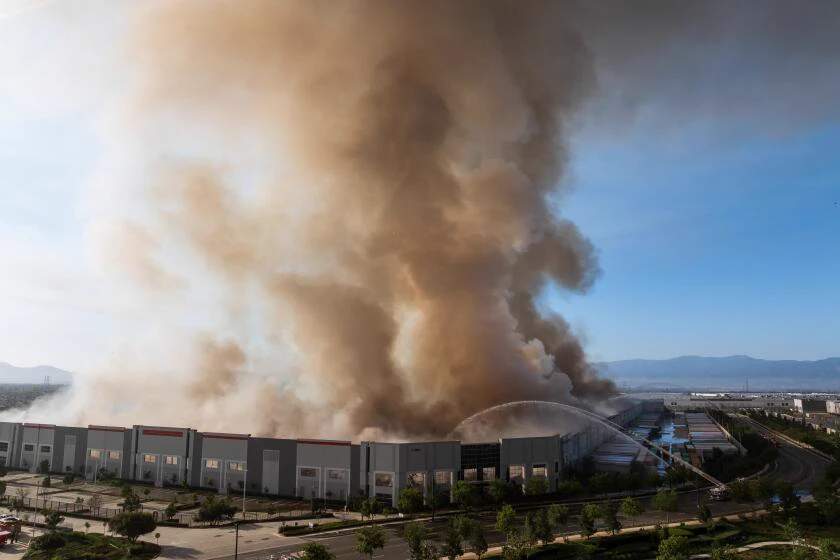
The $600 million Kimberly-Clark warehouse fire in Ontario, California, on April 7, 2026, set the tone. A 1.2-million-square-foot facility storing Scott-brand paper products was reduced to ash after Chamel Abdulkarim, a 29-year-old employee, allegedly used a lighter to ignite six separate points in the facility. Abdulkarim live-streamed the fire and later texted a coworker: "All you had to do was pay us enough to live." He compared himself to Luigi Mangione, the anti-capitalist figure who assassinated a health insurance CEO in 2024.
But the wave of attacks goes far beyond workplace sabotage:
- March 2026: A predawn arson attack destroyed an Elbit Systems facility in Pardubice, Czech Republic. The Earthquake Faction, a previously unknown underground group, claimed responsibility, calling the site a "key manufacturing hub for Israeli weapons used in Gaza."
- February 2026: Six activists with Palestine Action were acquitted of aggravated burglary after using a repurposed prison van as a battering ram to breach Elbit Systems' UK facility in Filton, Bristol, smashing equipment with sledgehammers and spraying red paint. The site, a research and development hub for military drones and surveillance tech used in Gaza and Yemen, closed in September 2025 due to repeated disruptions.
- April 2026: The Vulkangruppe (Volcano Group), a far-left militant organization, set fire to an electricity pylon supplying Tesla's Gigafactory near Berlin, shutting down production for three days and causing millions in damages.
- March 2026: Allianz ended its insurance coverage of Elbit Systems UK following months of direct action by Palestine Action and Shut the System, who had occupied Allianz's London headquarters and coordinated actions at 10 Allianz offices in one day.
- Ongoing 2025-2026: Dozens of Barclays branches across the UK were hit with shattered windows and red paint in coordinated campaigns targeting the bank's investments in Elbit, BAE Systems, and Lockheed Martin.
- July-August 2024: During the Paris Olympics, coordinated arson attacks hit France's high-speed rail and fiber optic networks, disrupting internet and train services for days and costing millions.
- March 2026: A small-scale arson attack and paint-bombing targeted Leonardo's Edinburgh facility, which produces components for fighter jets and drones used in Gaza and Ukraine.
These are not isolated incidents. They are part of a coordinated campaign targeting the infrastructure of capitalism and militarism.
The Escalation: From Economic to Political Targets
What changed on April 25, 2026, was the target.
Previous attacks focused on economic infrastructure: warehouses, factories, power lines, rail networks, bank branches. The message was clear: if you won't stop the war, we'll stop the machines that make it possible. If you won't pay us enough to live, we'll burn the warehouses that profit from our labor.
But the White House Correspondents' Dinner shooting marked a shift to political targets. The shooter didn't target a warehouse or a factory. He targeted the sitting president of the United States, surrounded by the political and media elite.
This is not a new phenomenon in American history. Ronald Reagan was shot and wounded leaving the Washington Hilton in 1981 after delivering a speech to AFL-CIO leaders. The difference is context.
Reagan's shooter, John Hinckley Jr., was driven by a personal obsession with actress Jodie Foster. The pattern of attacks in 2026 is driven by systemic rage.
Why This Is Happening
The oligarchy — that shadowy network of billionaires, politicians, and corporate executives — has made it clear: they are not listening. And so, the people are speaking in the only language left that guarantees attention: fire.
The global elite have never been richer or more powerful. Yet, for the vast majority of people, life has never been more precarious:
- Wages are stagnant while CEO pay soars.
- Housing is unaffordable while luxury real estate booms.
- Healthcare is a privilege while pharma companies rake in record profits.
- The planet is burning while fossil fuel executives get bonuses.
- Gaza is a graveyard.
- Ukraine is a meat grinder.
- Yemen is a famine zone.
- Sudan is a forgotten genocide.
And yet, the military-industrial complex thrives. Lockheed Martin, Raytheon, BAE Systems — these companies profit from every bomb dropped, every drone strike, every life lost. The U.S. military budget is $1 trillion a year, while schools, hospitals, and infrastructure crumble.
The political process is broken:
- Elections are bought by the highest bidder.
- Lobbyists write the laws.
- Police brutalize protesters while corporate criminals go free.
When peaceful protest fails, when voting changes nothing, when petitions are ignored, people turn to more drastic measures. The arsonists and attackers of 2026 are the logical endpoint of a system that refuses to reform.
What Comes Next
The powerful will respond exactly as planned:
- More surveillance: Facial recognition, predictive policing, and mass data collection will be deployed to crush dissent — all in the name of "protecting the president."
- More repression: New laws will be passed to criminalize protest, with harsher penalties for "economic sabotage" and "domestic terrorism" — all because of what happened at the Hilton.
- More militarization: Private security firms, drones, and AI-driven policing will be used to protect corporate assets — justified by the "threat" to political targets.
- More propaganda: The media and politicians will frame activists as "terrorists" while ignoring the root causes of their anger — conflating genuine resistance with a staged spectacle.
This isn't repression fueling the fire. This is the arsonists burning their own building.
The Fire That Wasn't
Let's connect the dots, because they're screaming at us.
An hour before shots rang out at the Washington Hilton, the White House Press Secretary went on Fox News and said: "There will be some shots fired tonight." Then, moments after the shooting, she called back in and started talking about who had "warned" her to be safe — and the call went dead. Fox News didn't try to reconnect. They just moved on.
The shooter — if he even was a shooter — was "taken down" instantly. Trump was rushed to safety. The narrative was written before the smoke cleared.
This has the same stench as Butler, Pennsylvania. Different target, same playbook: create a crisis, rush to the cameras, and use the chaos to justify the crackdown they've been waiting to unleash.
The real attacks — the Kimberly-Clark warehouse fire, the Elbit Systems facility in Czech Republic, the Tesla Gigafactory blackout — those were genuine resistance. Working people burning the machines that exploit them. Anti-war activists destroying the weapons that slaughter children in Gaza.
But this? This is something else.
This is a Reichstag fire for the surveillance state. A manufactured incident designed to do what real resistance couldn't: give the oligarchy the pretext to unleash the full force of the state against anyone who dares to say "no."
The timing is too perfect. The warning was too on-the-nose. The media coverage was too rehearsed. The Fox News call didn't drop — it was cut.
The fires burning warehouses and factories are the language of people who have nothing left to lose. The spectacle at the White House Correspondents' Dinner is the language of people who have everything — and are terrified of losing it.
They needed a villain. They needed a crisis. They needed an excuse.
And they got exactly what they paid for.
The timing is too convenient. Right after the shooting at the Hilton ballroom, the push for Trump's "ballroom project" went into overdrive. The narrative was already written, the legislation was already drafted, the contracts were already signed. All they needed was the smoke.
This isn't conspiracy theory. It's pattern recognition. And the pattern is getting harder to ignore.
Sources & Methodology(5 sources)
- Deadline — Shots Fired At White House Correspondents Dinner, Trump Evacuated, Guests On The FloorNews Article
April 25, 2026 - Deadline report on the White House Correspondents' Dinner shooting, including accounts from CNN's Wolf Blitzer who was 'a few feet away from the gunman,' confirmation that the shooter is dead from Education Secretary Linda McMahon's security, and Ted Johnson's account of hearing what sounded like four shots from the hall near his table.
April 25, 2026 - CNN report on Trump being swiftly escorted off stage by Secret Service after possible shots were fired at the White House Correspondents' Dinner, with Vice President JD Vance and Cabinet members also rushed out. Wolf Blitzer reported being 'a few feet away from a gunman' as he was shooting with a 'very, very serious weapon.'
- CBS News — Live Updates: Trump safe after shots fired at White House Correspondents' Dinner; suspect in custodyVideo / Audio
April 25, 2026 - CBS News live coverage of the White House Correspondents' Dinner shooting, including details that the suspect had a shotgun and handgun, 5-8 shots fired, a Secret Service agent was injured but wearing a bulletproof vest, and the gunman is alive but injured and hospitalized.
April 24, 2026 - Comprehensive report documenting 25+ major fires and infrastructure attacks in 2026, from the $600 million Kimberly-Clark warehouse fire to Elbit Systems facilities in Czech Republic and UK, Tesla's Berlin Gigafactory attack, Leonardo Edinburgh facility, Barclays branches across UK, and French high-speed rail sabotage during Paris Olympics.
- Eric Spracklen (@EricSpracklen) - X Tweet: 'The phone call didn't drop, Fox News cut it'Video / Audio
April 25, 2026 - Verified user Eric Spracklen calls out Fox News for cutting the call to Karoline Leavitt mid-sentence, not a dropped connection. Retweeted Chris Menahan's coverage showing the moment the broadcast cut away.
Frequently Asked Questions
- What happened at the White House Correspondents' Dinner on April 25, 2026?
- At approximately 8:30 PM, shots rang out at the Washington Hilton where the White House Correspondents' Association dinner was being held. Five to eight rounds were fired outside the ballroom near a back stairwell. President Trump, Vice President JD Vance, First Lady Melania Trump, and multiple Cabinet members were evacuated safely. One Secret Service agent was struck by a round but was wearing a bulletproof vest and is expected to be OK. The shooter, armed with a shotgun and handgun, was neutralized by law enforcement.
- Who was at the White House Correspondents' Dinner during the shooting?
- President Donald Trump, who was making his first appearance at the event as president, was on stage when shots were fired. Vice President JD Vance, First Lady Melania Trump, and multiple Cabinet members were in attendance, including Secretary of State Marco Rubio, Defense Secretary Pete Hegseth, and Health and Human Services Secretary Robert F. Kennedy Jr. CNN's Wolf Blitzer was also present and reported being 'a few feet away from a gunman as he was shooting.'
- How does this fit into the broader pattern of attacks in 2026?
- The White House Correspondents' Dinner shooting is the latest and most alarming escalation in a wave of 25+ major fires and infrastructure attacks across the United States and Europe in 2026 alone. Previous attacks targeted economic infrastructure like the $600 million Kimberly-Clark warehouse in California, Elbit Systems facilities in Czech Republic and the UK, Tesla's Berlin Gigafactory, and Barclays bank branches across the UK. The shooting marks a shift from economic to political targets.
- What is the connection between these attacks?
- These attacks are not random acts. They are deliberate, political, and increasingly coordinated. They target symbols of capitalism, militarism, and ecological destruction. The common theme is rage at a system where wages are stagnant while CEO pay soars, housing is unaffordable while luxury real estate booms, and the military-industrial complex profits from war while schools and hospitals crumble. The attackers argue that peaceful protest has failed, voting changes nothing, and petitions are ignored.
- How was the White House Correspondents' Dinner shooting different from previous attacks?
- Previous attacks focused on economic infrastructure: warehouses, factories, power lines, rail networks, and bank branches. The message was: if you won't stop the war, we'll stop the machines that make it possible. If you won't pay us enough to live, we'll burn the warehouses that profit from our labor. The White House Correspondents' Dinner shooting marked a shift to political targets — the shooter targeted the sitting president of the United States, surrounded by the political and media elite, rather than economic infrastructure.