

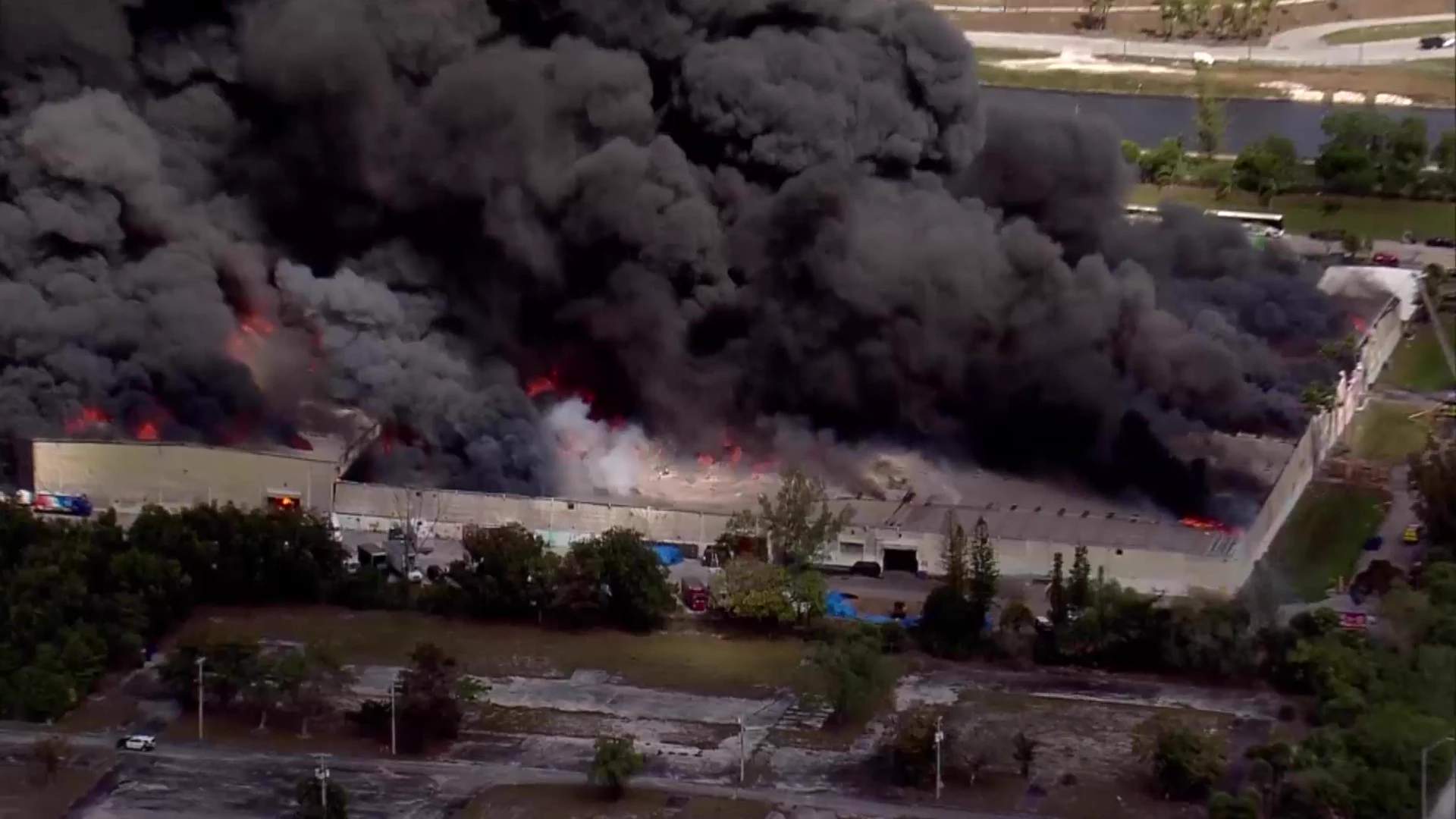
For five days, thick black smoke poured from the Global Warehouse Solutions facility in northwest Miami-Dade County, a five-alarm inferno that consumed 548,000 square feet of commercial inventory and filled the sky over Miami Gardens with toxic fumes. More than 200 firefighters battled the blaze. The cause remains under investigation. But what's not under investigation is the broader system that made this possible: a logistics industry built on underpaid workers, stretched-thin resources, and safety protocols that only matter until the quarterly earnings call.
The Fire That Won't Die
The fire broke out on March 5, 2026, at 20600 NW 47th Avenue, a massive warehouse complex owned by the state of Florida but operated by Global Warehouse Solutions, a third-party logistics provider. The building was scheduled to host the Miami International Trade Mart just two weeks later — a showcase for businesses selling everything from kitchen utensils to puzzles.
Inside: Celsius drinks, construction equipment, enough Fruit of the Loom pajamas to fill a Target section, pallets of food products, Otis Worldwide elevator equipment. If you could buy it for your home or business, there was likely a pallet of it burning. The Environmental Protection Agency warned residents within a five-mile radius about air quality. The fire burned for days because the roof collapsed, trapping the flames underneath.
No injuries were reported. That's the headline. But the underlying story is how close this came to being much worse — and why the next time, it might be.
The Working Reality
Let's talk about the workers who move those pallets, check those inventory systems, and keep this facility running. In Florida, the average warehouse worker makes $17.89 per hour — about $37,000 a year before taxes. That's in a state where the minimum wage just hit $14 an hour and will reach $15 by September 2026.
But averages hide the reality. Many warehouse workers make the minimum. Many are temps with no benefits, no job security, no sick leave, and no reason to care about safety protocols when their employer treats them as disposable as the boxes they move.
When you're underpaid, overworked, and treated as replaceable, you miss things. You forget to check that fire extinguisher because you're thinking about rent. You don't report that faulty electrical outlet because you don't want to be labeled a troublemaker. You don't flag that blocked emergency exit because management already told you to stop slowing down production.
This is not an accusation. It's a description of how systems break. When workers are not paid enough to care, they don't care. When safety is an afterthought to productivity, accidents happen. When maintenance is deferred to cut costs, infrastructure fails.
The Business Model
Global Warehouse Solutions is a third-party logistics provider — a 3PL. The model is simple: businesses outsource their warehousing, inventory management, and fulfillment to specialists who promise "cost-effective solutions" and "customized solutions that align with budgetary constraints." In plain English: we'll handle your logistics cheaper than you can do it yourself.
Cost-effectiveness always comes from somewhere. It comes from paying workers less. It comes from deferring maintenance. It comes from running leaner operations with fewer safety inspections. It comes from cutting corners until something breaks.
The Daniel family, which runs Global Warehouse Solutions and appears as an officer in 27 of the 29 companies operating at that address, didn't respond to calls from the Miami Herald. They don't have to. The system protects them. The workers bear the risk. The environment pays the price.
The Pattern
This is not an isolated incident. Warehouses are burning across America. Ontario, California. College Point, Queens. Bakersfield, California — where the same warehouse complex has caught fire three times in a year. The pattern is impossible to ignore: underfunded safety systems, overworked staff, and a business model that treats disaster as an acceptable cost of doing business.
The media calls them "accidents." The companies call them "incidents." The workers who could have prevented them — if they'd been paid enough to care, if they'd had the training to spot problems, if they'd felt safe speaking up — don't get to call them anything at all.
Miami-Dade Fire Rescue says the investigation is ongoing. They'll find the spark — an electrical fault, a discarded cigarette, a piece of equipment left running. What they won't find, because no one investigates it, is the system that made that spark possible. The underpaid worker who missed the warning sign. The deferred maintenance that should have caught the problem. The business model that made prevention too expensive to prioritize.
The smoke has cleared over Miami Gardens. The investigation will produce a report. The insurance will pay out. The warehouse will be rebuilt. And nothing will change until we start asking not just what started the fire, but why the system made it inevitable.
Sources & Methodology(3 sources)
March 6, 2026 - Detailed report on the Global Warehouse Solutions fire, listing the contents and structure of the 548,000-square-foot warehouse.
March 6, 2026 - Coverage of the five-alarm fire with details about firefighting efforts and ongoing investigation.
2026 - Average warehouse worker salary in Florida is $17.89 per hour.
Frequently Asked Questions
- What happened at the Global Warehouse Solutions facility?
- On March 5, 2026, a five-alarm fire broke out at the 548,000-square-foot Global Warehouse Solutions facility at 20600 NW 47th Avenue in northwest Miami-Dade County. The fire burned for five days, required more than 200 firefighters, and prompted the EPA to warn residents within a five-mile radius about air quality. No injuries were reported.
- What was stored in the warehouse?
- The warehouse contained a wide range of commercial and retail goods including Celsius drinks, construction equipment, Fruit of the Loom pajamas, food products, and Otis Worldwide elevator equipment. The facility was scheduled to host the Miami International Trade Mart just two weeks after the fire.
- How much do warehouse workers in Florida earn?
- According to Indeed data, the average warehouse worker in Florida earns $17.89 per hour (about $37,000 annually before taxes). Many workers earn the state minimum wage of $14 per hour (rising to $15 in September 2026), and many are temps with no benefits, job security, or sick leave.
- What caused the fire?
- The official cause remains under investigation by Miami-Dade Fire Rescue and the state Fire Marshal. This article argues that regardless of the specific ignition source, the broader system of underpaid workers, deferred maintenance, and cost-cutting logistics models created the conditions that made such a disaster likely.
- Is this part of a larger pattern?
- Yes. Similar warehouse fires have occurred in Ontario, California (Kimberly-Clark arson by underpaid employee), College Point, Queens (64,000 sq ft), and Bakersfield, California (same complex burned three times in a year). The pattern suggests systemic issues with underfunded safety systems, overworked staff, and business models that treat disaster as an acceptable cost.