


Her name was Hind Rajab.
She was five years old. She wore flower crowns. She played on swings. She graduated kindergarten in a cap and gown, tassels swinging, grinning like she owned the world.
Israeli Occupation Forces shot her car 335 times.
Hind Rajab on a playground swing, wearing a flower crown and a black Adidas tracksuit, smiling.
On January 29, 2024, Hind was in a car fleeing Gaza City with her uncle Bassem Younis, her aunt Layan Hamadeh, and her cousins Layan and Jana. IOF tanks opened fire on the vehicle. Everyone around her died.
Hind did not die immediately.
She picked up the phone and called the Palestinian Red Crescent Society. She told the dispatcher she was surrounded by the bodies of her family. She said: "I'm so scared. Please come."
The call lasted hours.
PRCS dispatched two paramedics — Yusuf Zeino and Ahmed al-Madhoun — in a clearly marked ambulance, their coordinates shared with the IOF so they could travel safely. They headed toward her.
The IOF killed them too.
Their ambulance was found burned beside the bullet-riddled car. Hind's body was recovered twelve days later.
Three hundred and thirty-five bullets.
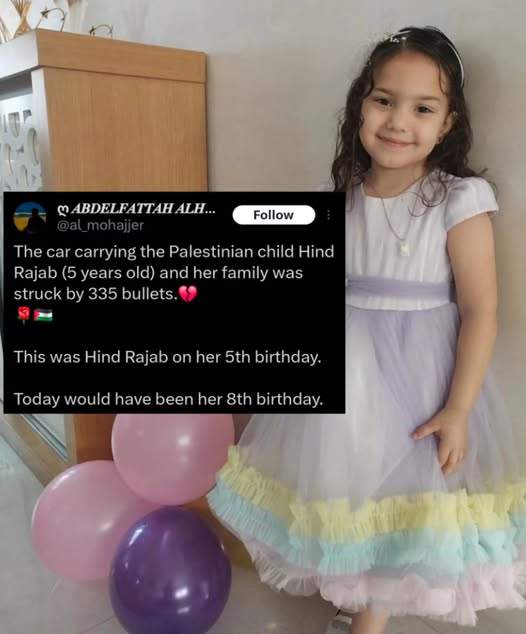
Hind Rajab on her 5th birthday in a white and rainbow dress with balloons at her feet. Tweet overlay: the car carrying Hind Rajab (5 years old) was struck by 335 bullets. Today would have been her 8th birthday.
What Her Case Reveals
This isn't a story about one dead child in one burning car on one terrible day. That framing is how the media buries it.
Hind Rajab's case is a window into the machinery of the genocide — the targeting of civilians fleeing on evacuation corridors, the deliberate killing of medical workers, the systematic destruction of anything that might document what is being done, and above all: the impunity. The complete, cemented, American-backed impunity that makes it possible to shoot a five-year-old 335 times and face no consequence whatsoever.
The question was never whether the IOF did this. The IOF did this. Their own internal review eventually confirmed that IOF tanks fired on the vehicle. The question was always what would happen to the people who ordered it and pulled the trigger.
The answer — as it has been for every bombing of a hospital, every strike on a journalist, every family wiped off the civil registry — is nothing.
She Had Dreams
Look at her.
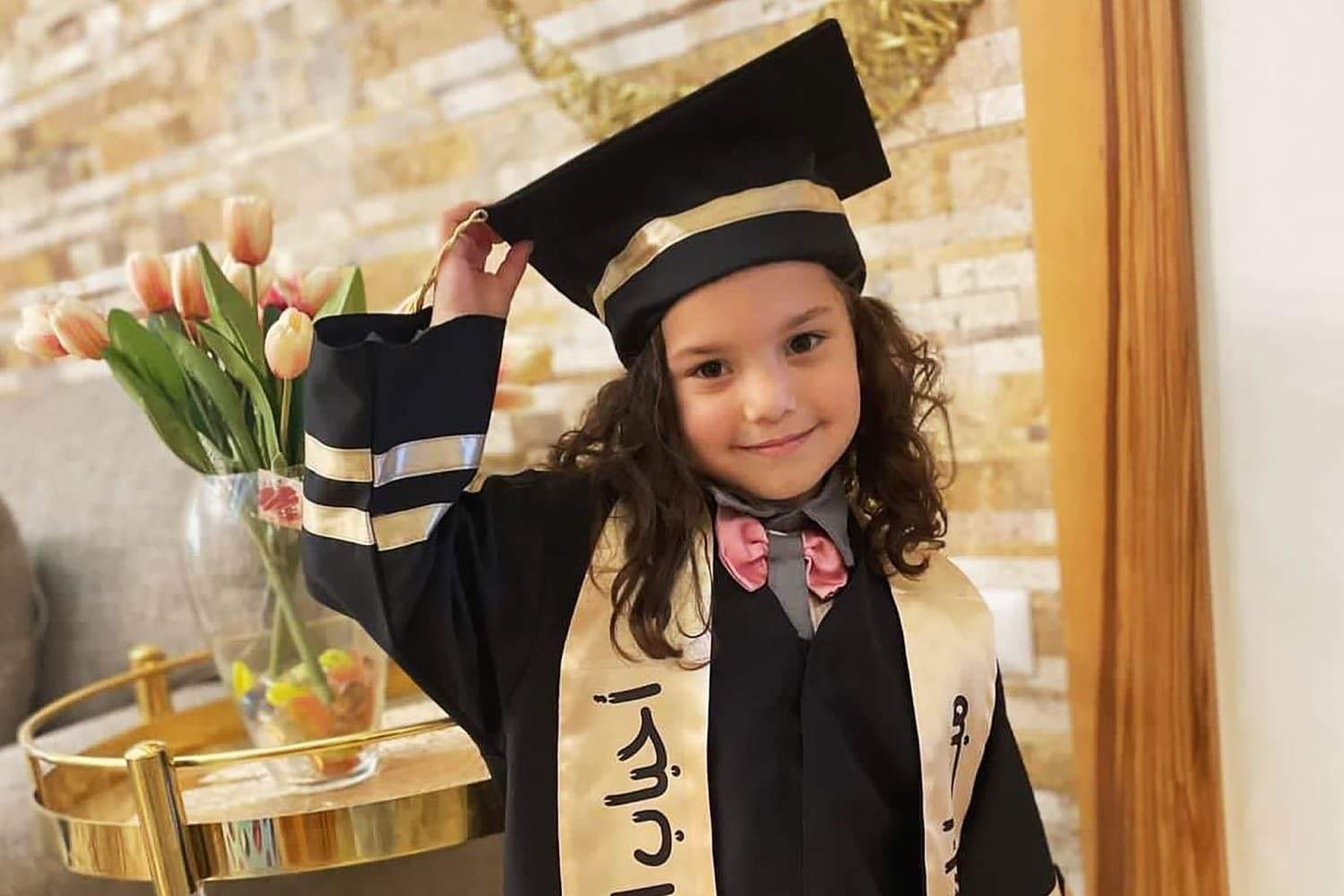
Hind Rajab in a graduation cap and gown with a gold Arabic-lettered sash, adjusting her cap tassel and smiling.
She graduated kindergarten. She wore a cap and gown. She adjusted the tassel the way every little kid does — with both hands, proud of themselves, not entirely sure what graduation means but sure it means something.
She went to school. She made art. She stood in her classroom uniform holding up her work to be photographed, the way children do when they want you to see what they've made.
She was not a symbol before she was murdered. She was a kid. That's the whole point. The genocide is murdering children who had kindergarten graduations and flower crowns and birthday parties with balloons, and the people doing the murdering have not faced a single meaningful consequence for any of it.

Hind Rajab in her school uniform — grey vest, pink shirt, pink bow tie — holding papers and smiling in her classroom.
The Architecture of Impunity
In the months after Hind's death, Israel conducted what it called an internal review. The conclusion: IOF tanks may have fired on the vehicle. No criminal charges. No court-martial. No accountability.
The PRCS documented the crime in real time. Coordinates were shared. The ambulance was marked. The IOF fired anyway — on the ambulance carrying the paramedics sent to rescue a five-year-old girl calling for help from a car filled with the bodies of her family.
Under international humanitarian law, this is a war crime. The deliberate targeting of medical personnel and vehicles is prohibited under the Geneva Conventions. The targeting of civilians attempting to flee is prohibited. What was done to Hind Rajab and to Yusuf Zeino and Ahmed al-Madhoun is prohibited.
None of that matters when the United States provides the weapons, the diplomatic cover, and the Security Council veto that guarantees no international accountability will ever reach the people who did this.
The Biden administration knew about Hind's case. The State Department issued carefully worded condolences. The weapons shipments continued.
The Trump administration — which replaced it — removed the word "genocide" from US government vocabulary entirely, defunded UNRWA, and accelerated military aid. The message to the IOF was not ambiguous: keep going.
This Is What Fighting Back Looks Like
The world did not stay silent about Hind Rajab. That silence belongs to governments and their press operations.
Ordinary people — on the streets of Chicago, London, Istanbul, Toronto, Cape Town — said her name. Protesters blocked weapons shipments. Dock workers refused to load munitions. Legal filings piled up in courts in The Hague, in Dublin, in South Africa. Young people who had never heard of the ICJ learned what a preliminary ruling meant because of what is being done to Palestinian children. Because of Hind.
The institutions designed to stop this — the UN Security Council, the International Criminal Court, Western governments that signed the Geneva Conventions — have largely failed. Some have actively obstructed.
But the movement hasn't stopped. It has gotten more disciplined, more organized, more internationalist. The connections are being drawn — between the weapons manufacturers, the politicians who authorize the aid, the media outlets that still write "clashes" when they mean "massacre." The people paying attention understand the system now in a way they didn't before October 2023.
That's what Hind Rajab's case did. Her name became something that could not be unsaid. 335 bullets is a number that does not let you pretend you didn't know.
What We Owe Her
Today would have been Hind Rajab's eighth birthday.
She would have been in second or third grade. She would have had opinions about things. She might have adjusted her graduation cap again — she clearly liked the ceremony. She would have grown into someone with a name that meant something to the people around her.
Instead, her name means something to millions of people who never got to meet her — because it was the name her murderers could not erase. Because she called for help while she was dying, and the whole world heard, and the whole world knows.
Accountability for what was done to Hind Rajab is not a moral nicety. It is the floor of civilization. If a state can fire 335 bullets into a car carrying a five-year-old girl, kill the paramedics sent to save her, and face no consequence — from its patron government, from international courts, from any institution with teeth — then those institutions are not protection for anyone. They are decoration.
Dismantling that impunity is not optional. It's the whole argument.
Say her name.
Hind Rajab.
She was five years old. She would have been eight.
We remember her.
Sources & Methodology(6 sources)
January–February 2024. Official PRCS documentation of the deaths of paramedics Yusuf Zeino and Ahmed al-Madhoun and of Hind Rajab, whose car was struck by 335 bullets by Israeli Occupation Forces.
2024. Forensic Architecture's reconstruction of the events of January 29, 2024, confirming IOF responsibility for the deaths of Hind Rajab and the two paramedics dispatched to rescue her.
April 2024. HRW investigation concluding that Israeli forces unlawfully killed Hind Rajab, Yusuf Zeino, and Ahmed al-Madhoun in Gaza City on January 29, 2024.
- +972 Magazine — The Killing of Hind RajabNews Article
2024. +972 Magazine's investigative coverage of the Hind Rajab case, IOF internal review, and the deliberate targeting of the PRCS ambulance.
2024. Middle East Eye coverage documenting Hind's phone call to PRCS, the family members killed around her, and international response.
2024. Electronic Intifada reporting on the Hind Rajab case, IOF denial and subsequent internal review, and ongoing impunity.
Frequently Asked Questions
- What happened to Hind Rajab?
- Hind Rajab, a five-year-old Palestinian girl, was killed on January 29, 2024, when Israeli Occupation Forces fired 335 bullets into the car she was in while fleeing Gaza City. She survived the initial attack, surrounded by the bodies of her family members, and called the Palestinian Red Crescent Society for help. Two paramedics — Yusuf Zeino and Ahmed al-Madhoun — were dispatched to rescue her and were also killed. Hind's body was found twelve days later.
- Who were the paramedics killed trying to rescue Hind Rajab?
- Yusuf Zeino and Ahmed al-Madhoun were the two Palestinian Red Crescent Society paramedics killed by Israeli forces on January 29, 2024, while responding to Hind Rajab's call for help. Their clearly marked ambulance had shared coordinates with the IOF before traveling to Hind's location.
- Was Israel held accountable for killing Hind Rajab?
- No. An Israeli internal review confirmed that IOF tanks fired on the vehicle, but resulted in no criminal charges, no court-martial, and no accountability. Human Rights Watch and Forensic Architecture both concluded the killings constituted war crimes under international humanitarian law.
- How old would Hind Rajab be today?
- Hind Rajab would have turned eight years old in 2026. She was five years old when she was killed on January 29, 2024.
- What does the Hind Rajab case reveal about the Gaza genocide?
- The case exposes the complete impunity enjoyed by Israeli forces — the deliberate targeting of civilians on evacuation routes, the killing of medical workers, and the US diplomatic cover and weapons support that shields Israel from international accountability.