

Meatpacking Workers Say Enough: Denver Strike Vote Is the Latest Front in the War on Corporate Meat
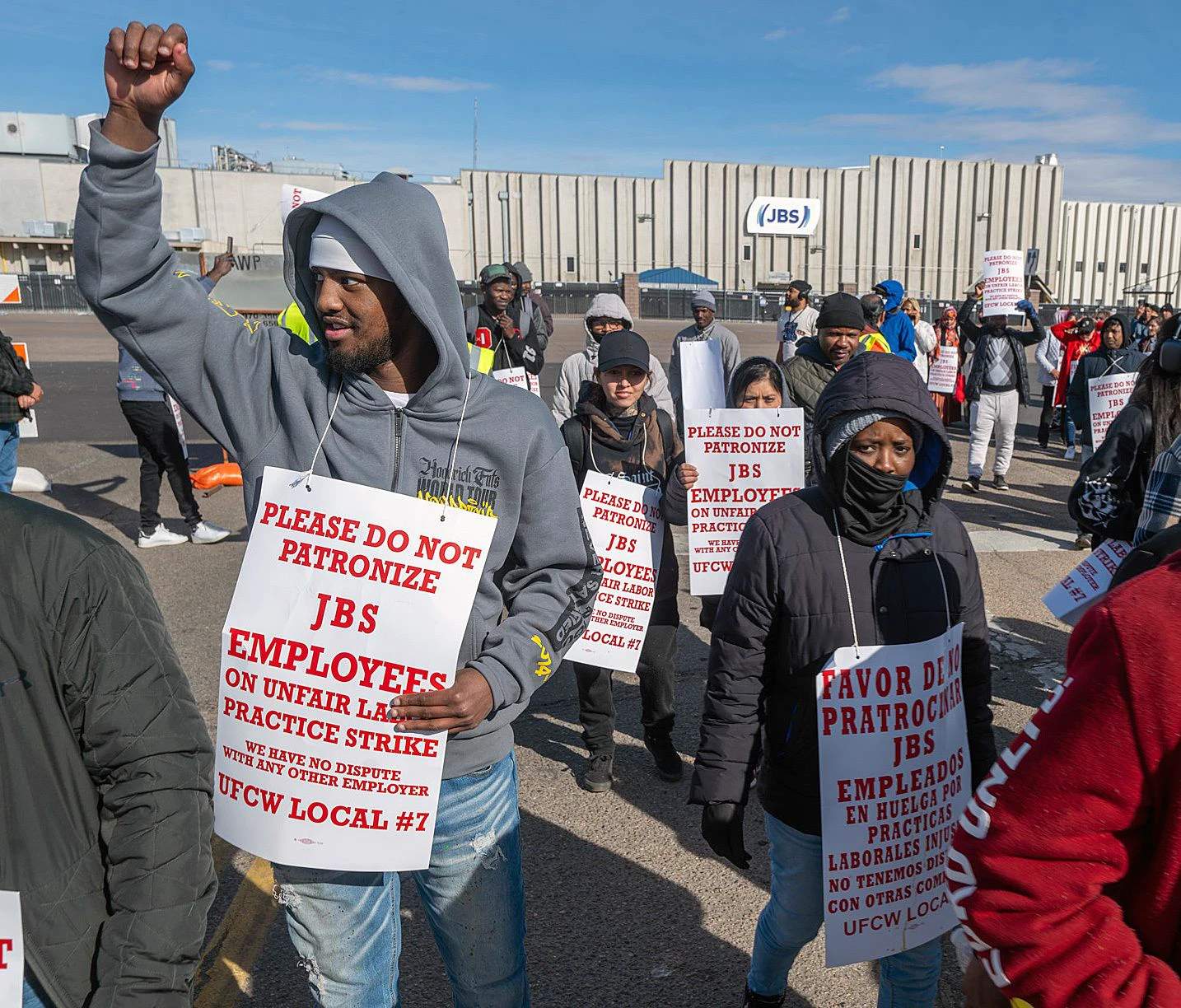
The short version: 97% of workers at a JBS-owned meat processing plant in Denver voted to authorize a strike on April 24, 2026. The vote comes less than two weeks after a historic three-week strike at JBS's Greeley plant — the first major meatpacking strike in 40 years. Workers are fighting unfair labor practices, retaliation, and dangerous conditions, including allegations of a human trafficking scheme targeting Haitian workers forced to work at breakneck speeds. JBS is part of the "Big Four" that controls 93% of the U.S. beef market.
---
On April 24, 2026, 97% of union workers at Denver Processing, a JBS-owned beef and pork plant, voted to authorize a strike. The vote wasn't close. It was a rejection, a repudiation, a declaration that workers had reached their limit.
The issues were familiar: unfair labor practices, retaliation against union representatives, bad-faith bargaining, dangerous working conditions. But what's happening in Denver isn't isolated. It's the latest eruption in a labor war that's been building for years — a war being fought by immigrant workers on the kill floors of America's most brutal industry.
And for the first time in 40 years, they're winning.
The Pattern: Strike After Strike
The Denver vote comes less than two weeks after the end of a three-week strike at JBS's Greeley, Colorado plant — the first major meatpacking strike in more than four decades. More than 3,800 workers walked out on March 16, 2026, shutting down one of the largest meat processing sites in the country. They returned to work on April 5 after JBS agreed to resume negotiations, ratifying a new two-year contract on April 12.
But the war didn't end there. It just moved.
Denver Processing, which supplies meat to Kroger-owned stores across the
southwestern United States, is now the front line. This would be the fifth strike at JBS facilities in four years. The pattern is clear: workers aren't backing down. They're escalating.
The union, United Food and Commercial Workers Local 7, has filed multiple Unfair Labor Practice charges against Denver Processing. The allegations are damning:
- Retaliation: The company disciplined a bargaining committee member for attending negotiation sessions — protected activity under federal law.
- Bad-faith bargaining: JBS repeatedly stalled negotiations, failed to respond to proposals on safety and work-life balance issues, and rushed to declare a final offer before meaningful bargaining could occur.
"Our members are united, and we are prepared to do what is necessary to hold this company accountable," said Natalia Gonzalez, a Denver Processing worker and UFCW Local 7 member.
JBS: The Corporate Villain
JBS is the world's largest meat processor. It's also one of the most ruthless.
At the Greeley plant, JBS tried a tactic straight out of the union-busting playbook. On March 9, 2026, managers called workers into a meeting and passed out form letters resigning their union membership. All they had to do was sign, show up for work, and cross the picket line — no more union representation.
When workers refused, managers told them to take all their personal possessions with them. The threat was clear: sign the letter or lose your job.
But the workers didn't break. They voted nearly 99% in favor of the strike.
That kind of unity doesn't come from wage disputes alone. It comes from years of systemic abuse — and JBS has made abuse its business model.
The Human Trafficking Scheme
The most damning allegation comes from a class-action lawsuit filed by Haitian workers at the Greeley plant. More than 1,200 Haitian workers were recruited in 2023 as part of what Local 7 describes as a human trafficking scheme designed to undercut the union and force new employees to work on the night shift at unfair speeds.
The lawsuit alleges that Haitian workers were segregated onto the night shift and forced to work at "dangerously fast speeds." While the day shift usually averages 300 head of cattle processed per hour, the night shift — where many Haitian workers are assigned — runs at 370 head per hour. It has reached as high as 440 head per hour.
"They put up the speed as fast as they need," Robenson Franc, a Haitian worker, told Mother Jones. "And regardless of the speed, he said, workers are expected to keep pace."
The result: debilitating repetitive stress injuries. Workers say lines run so fast there's no time to sharpen their knives, forcing them to work with dull blades that tear at muscle and bone instead of cutting cleanly.
JBS's response: deny, deflect, and dissemble. The company claims it has "implemented a process to provide newly sharpened knives frequently throughout the day" and plans to install "state-of-the-art knives" soon.
Workers aren't buying it.
The Big Four Monopoly
JBS isn't just a bad actor. It's part of a cartel that controls the American meat supply.
Today, just four companies — JBS, Tyson, Cargill, and National Beef, known as the Big Four — control as much as 93% of the beef market. This is more concentrated than when Upton Sinclair wrote The Jungle in 1906, which exposed the horrors of Chicago's meatpacking plants and led President Theodore Roosevelt to break up the "Meat Trust."
The consolidation is intentional. The Big Four have been sued by cattle ranchers, grocery chains, and McDonald's for alleged price fixing, wage suppression, and market manipulation. The lawsuits allege that the companies coordinate to depress cattle prices, suppress worker wages, and drive up the price of processed beef for consumers.
Beef prices have climbed steadily since the pandemic. In the last year, they've soared. Since Trump returned to the White House, the average price of steaks has climbed 15%. Ground beef is 20% higher — nearly seven times the increase in overall consumer prices.
Who's profiting? Not the workers. Not the ranchers. The corporations.
The Political Dimension
The labor war in meatpacking isn't just about economics. It's about power.
JBS was the single largest donor to Trump's second inauguration. The Trump administration has removed all restrictions on the speeds of poultry and pork production lines — a move that helps JBS's pork operations and Pilgrim's Pride, which JBS majority-owns. Now JBS is pushing to lift restrictions on beef production lines.
But the workers have a weapon of their own: the supply chain.
The Greeley plant accounts for 7% of America's beef. Denver Processing supplies grocery stores across the southwestern United States. If workers walk out, prices rise. If prices rise enough, the government might actually have to do something.
Trump has already called for an investigation into "Meat Packing Companies who are driving up the price of Beef through Illicit Collusion, Price Fixing, and Price Manipulation." The DOJ has announced an investigation into JBS and the Big Four. Senate minority leader Chuck Schumer has introduced legislation mandating a breakup of large meatpacking corporations.
The union is betting that if they can take enough production offline, they'll force the government's hand.
But it's a dangerous gamble.
The ICE Threat
The workforce at these plants is estimated to be 90% non-white immigrants. More than 1,200 Haitian workers at the Greeley plant have Temporary Protected Status, which the Trump administration is fighting to revoke before the Supreme Court.
If the Court allows the revocation, ICE could raid the plants during the strike — using the walkout as justification to deport workers who are fighting for safer conditions.
Kim Cordova, president of Local 7, has been here before. She was a union representative in 2006 when the plant, then owned by Swift & Company, became a central target of the first major ICE raid ever undertaken.
"Those raids," she said, "were a push by [President George W.] Bush, I believe, to make some sort of political statement — to come in and really go after the industry and these plants for what he believed were undocumented workers."
Today, all workers have documentation. At least, for now.
But the threat hangs over every picket line. Every worker knows that one Supreme Court decision could turn their fight for fair wages into a fight for their lives.
The Human Cost
What's at stake in these strikes isn't just wages. It's the basic humanity of the workers who feed America.
The conditions in these plants would make Upton Sinclair turn over in his grave. Workers stand on kill floors for hours, processing thousands of animals a day. They work with razor-sharp knives in freezing cold, doing the same repetitive motions until their bodies break. They're exposed to blood, feces, and chemicals. They're denied bathroom breaks. They're forced to work at speeds that make injury inevitable.
And when they get hurt? They're discarded.
JBS says it offers "wage increases and a one-time bonus" designed to provide "immediate financial support while also ensuring long-term stability." What they don't say is that they're offering stability for the company, not the workers.
What Comes Next
The strike authorization in Denver is a warning shot. Workers haven't set a date yet, but the message is clear: we're not going back to the old way of doing things.
If Denver Processing walks out, it will send ripples through grocery supply chains across Colorado and the Southwest. King Soopers and City Market could see meat shortages. Prices could rise. Consumers could feel the pain.
But the workers are betting that pain will be worth it. Because the alternative is a lifetime of abuse in plants where human beings are treated like machinery.
The first major meatpacking strike in 40 years ended with a new contract at Greeley. The second one is waiting in the wings. The question isn't whether workers will fight back. The question is how far corporate America will push them before the dam breaks.
JBS and the Big Four think they can break the unions. They think they can replace workers, speed up the lines, and squeeze every last drop of profit out of the food system.
But they're wrong. The workers on the kill floors have seen the future — and they're not going to let it happen to them.
The Denver strike authorization isn't just a vote. It's a declaration of war. And this time, the workers aren't going to lose.
---
Frequently Asked Questions
Q: Why are the Denver workers striking if they haven't set a strike date yet?
A: The strike authorization vote gives union leadership the authority to call a strike if negotiations don't improve. It's a show of unity and leverage — 97% of workers voted yes, which sends a powerful message to JBS that the workforce is prepared to walk out. The actual strike date will be set by the union if JBS continues to engage in bad-faith bargaining.
Q: What is JBS and why is it so powerful?
A: JBS is the world's largest meat processor, a Brazilian multinational that controls a massive share of the American beef market. Along with Tyson, Cargill, and National Beef, JBS is part of the "Big Four" that controls 93% of U.S. beef production. This monopoly power allows them to dictate prices to ranchers, suppress worker wages, and drive up consumer prices while posting record profits.
Q: How will this strike affect meat prices and availability?
A: The Denver plant supplies meat to Kroger-owned stores (King Soopers, City Market) across the southwestern United States. If workers strike, it could create localized shortages and price increases in Colorado and surrounding states. The Greeley plant alone accounts for 7% of America's beef supply. However, JBS has indicated it may try to redirect production to other facilities to minimize consumer impact.
Q: What's the "human trafficking scheme" involving Haitian workers?
A: A class-action lawsuit alleges that JBS recruited more than 1,200 Haitian workers in 2023 as part of a scheme to undercut the union and force them onto dangerous night shifts. Haitian workers were allegedly segregated into night shifts where line speeds ran at 370-440 head of cattle per hour, compared to 300 on the day shift. Workers report being forced to use dull knives due to time constraints, leading to repetitive stress injuries.
Q: What happens if the Supreme Court revokes Temporary Protected Status for Haitian workers?
A: More than 1,200 Haitian workers at the Greeley plant have Temporary Protected Status, which the Trump administration is fighting to revoke. If the Court allows the revocation, ICE could raid the plants during a strike — using the walkout as justification to deport workers who are fighting for safer conditions. This threat hangs over every picket line, turning a labor dispute into a fight for workers' very lives.
Sources & Methodology(7 sources)
April 24, 2026 - 97% of union workers at Denver Processing voted to authorize a strike. UFCW Local 7 filed Unfair Labor Practice charges citing retaliation and bad-faith bargaining. JBS offered wage increases and one-time bonus, warned strike may not achieve goals.
April 24, 2026 - Denver Processing is subsidiary of JBS where 4,000 workers walked off last month. Supplies Kroger stores throughout southwestern US. Quote from worker Natalia Gonzalez about company wasting time and retaliating.
April 25, 2026 - Strike could affect distribution to grocery stores across Colorado including Fort Collins, Loveland. Follows heightened labor tensions including Greeley strike. Potential ripple effects on Kroger-owned brands.
- Mother Jones - Workers in Colorado Have Shut Down One of the Nation's Biggest Meatpacking PlantsNews Article
March 16, 2026 - Comprehensive deep dive on JBS Greeley strike. First major meatpacking strike in 40+ years. Human trafficking scheme targeting Haitian workers. Line speeds 370-440 head/hour vs 300 on day shift. 7% of US beef from this plant. Big Four control 93% of market.
April 10, 2026 - Workers at Greeley meatpacking plant reached final collective bargaining agreement, ending weeks of friction with JBS USA. Three-week strike ended with new two-year contract ratified April 12.
April 5, 2026 - Workers at JBS agreed to return to work at beef plant in Greeley after company agreed to resume negotiations, bringing three-week picket to an end.
April 1, 2026 - More than 3,800 meatpacking workers in third week of strike. First major strike in meatpacking industry in 40 years. Workers protesting unfair and dangerous labor conditions at JBS USA.