Internationalist Piracy: Where States Failed, Ordinary People Enforced the Law
The Mediterranean is a graveyard for refugees and a lawless zone where capitalists traffic weapons used in genocide. Humanitarian aid is blocked. Israeli forces attack flotillas bound for Gaza with impunity. The international system does nothing.
On April 20, 2026, that changed.
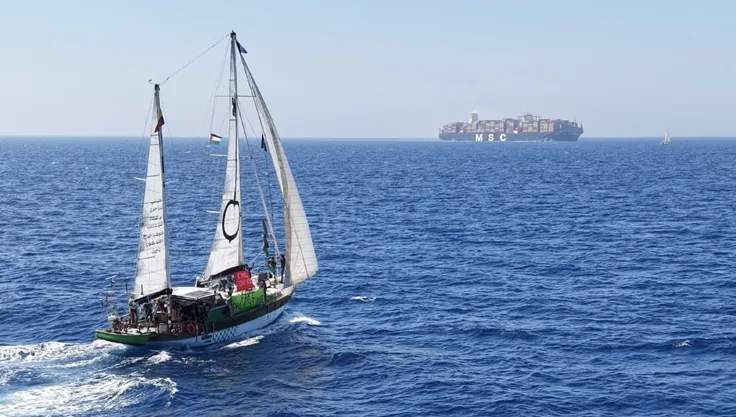
For the first time in history, civilians — ordinary people from 70 countries — directly intervened at sea to disrupt a state's military operations. The Global Sumud Flotilla, the largest humanitarian flotilla ever assembled, forced the MSC Maya — one of the world's largest container ships, nearly 400 meters long — to change course.
The MSC Maya was carrying high-quality alloy steel destined for the manufacture of heavy artillery in Israel. It was headed to the ports of Ashdod and Haifa. It never arrived.
More than a dozen vessels from the flotilla encircled the mega-ship in international waters. They transmitted a message to the crew:
"To the crew aboard the MSC Maya: You are heading toward occupied Palestine, carrying tools of death and destruction. Gaza is under siege and its population is suffering collective punishment. Your cargo will fuel an apartheid regime that is committing genocide. Turn back now. Choose humanity over complicity. Choose justice over occupation. The world is watching. The flotilla stands between you and war crimes."
The MSC Maya deviated from its trajectory. The disruption lasted less than three hours. The precedent will last forever.
The Ship of Death
MSC — Mediterranean Shipping Company — presents itself as commercially neutral. It's not.
An investigation by Al Jazeera and the Palestinian Youth Movement, based on commercial documents obtained through US import databases, revealed that MSC "regularly transported goods from companies located in Israeli settlements in the occupied Palestinian territory."
Between January 1 and November 22, 2025, MSC facilitated at least 957 shipments of goods from Israeli outposts to the United States. Of those shipments, 529 transited through European ports — 390 in Spain, 115 in Portugal, 22 in the Netherlands, and two in Belgium.
The steel in MSC's cargo holds wasn't just steel. It was the raw material for heavy artillery. It was ammunition for genocide.
The flotilla's statement was clear: MSC is "a key logistical hub for the Israeli occupation's military apparatus."
The System Works Exactly as Designed
The Geneva Convention. The Genocide Convention. The Arms Trade Treaty. Under international law, states are obligated to halt arms transfers to Israel.
They haven't. Not one.
The day after the flotilla's action, the European Union voted to maintain its association agreement with Israel — a deal that violates the EU's own stated principles and values. The Spanish government, which has spoken in support of Palestinian self-determination and passed decrees to that effect, has not banned these ships from transiting its ports. It has not halted the purchase of military supplies crucial to Israel's rearmament plans.
Mariona Tasquer, a student at the University of Barcelona and member of the Revolutionary Current of Spanish State Workers, put it bluntly: the Spanish government must put "an end once and for all to all commercial and military relations with the genocidal state of Israel."
They won't. Governments are allowing this to happen.
Saif Abukeshek, a Palestinian activist and member of the Global Sumud Flotilla steering committee, explained what this means:
"People need to react. Governments are allowing this to happen when they don't take action... Yesterday, the European Union voted to maintain the association agreement with Israel, which violates all the principles and values the European Union has, and still they voted to maintain it and not stop that association agreement. So, this, we were discussing always that when the system fails, civil society needs to step in."
Abukeshek quoted Fabien, one of the directors of Greenpeace, whose ship Arctic Sunrise is sailing with the flotilla to provide technical support: "It's not actually that the system is failing. The system is designed to do what it's doing right now, to maintain operation, to maintain the confiscation of resources and to oppress people."
The system isn't broken. It's doing exactly what it was built to do.
Internationalist Piracy
The flotilla calls it "internationalist piracy." They're reclaiming the term.
"Where states have failed to uphold international law, ordinary people have stepped in to enforce it."
This action was inspired by dockworkers who have "been on the frontlines of resisting unjust supply chains, using their collective power to halt the movement of goods tied to oppression and war." Workers in ports around the world — from South Africa under apartheid to Italian ports refusing weapons shipments to Israel today — have shown what collective action looks like.
The flotilla took that precedent to the high seas.
Leandro Lanfredi, from the Rio de Janeiro oil workers' union and part of the Permanent Revolution Current delegation on board, explained the significance just a mile from the freighter:
"We're denouncing a shipping company known for 'transporting weapons to the State of Israel and profiting from genocide,' while calling on 'workers around the world to rise up and go on strike to break off trade and diplomatic relations with Israel, just as we oil workers are fighting to ensure that not a single drop of oil goes to that genocidal state.'"
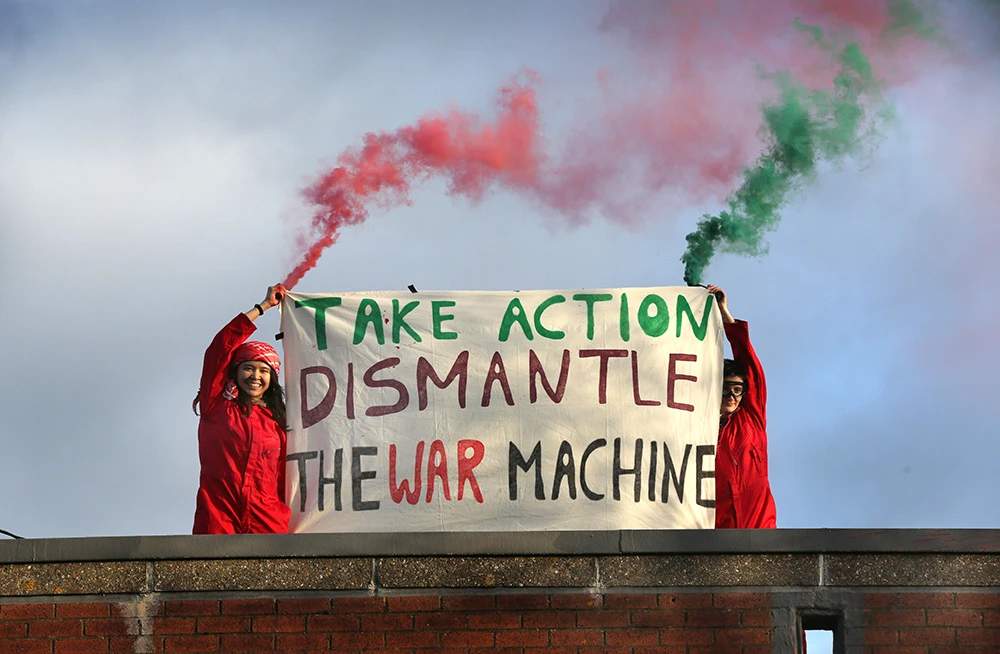
The Global Sumud Flotilla has called for replicating these attempts to break the chain of the war machine everywhere: truck routes, maritime routes, production plants. The logistics of genocide can be disrupted.
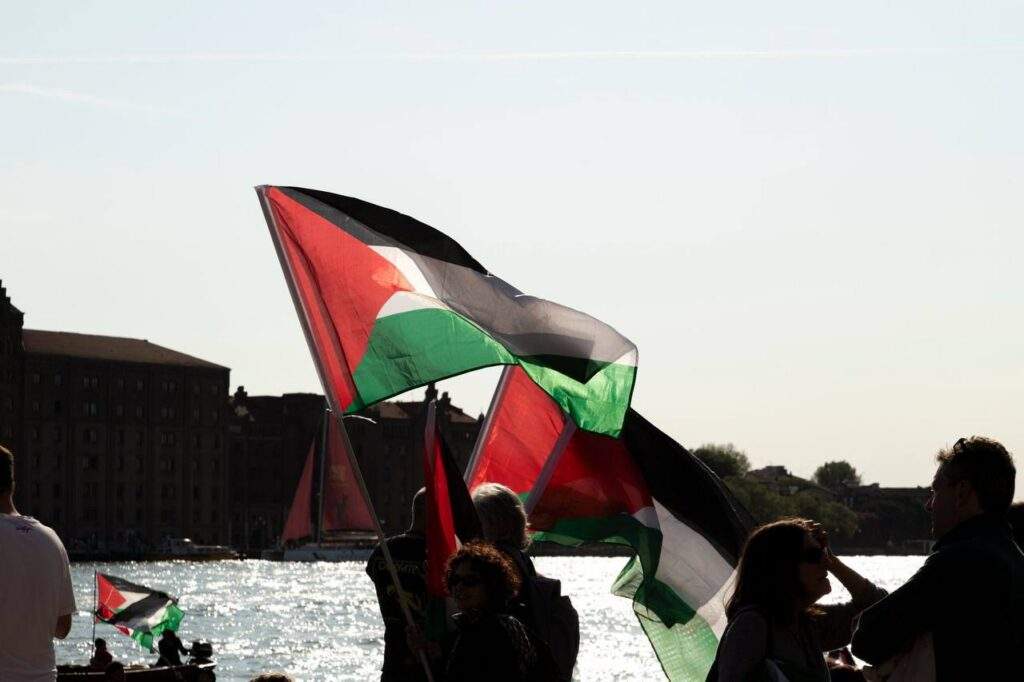
Flotilla departing for Gaza with supporters waving flags on shore.
Why This Matters
This was the first time in history that civilians, workers, and activists carried out an action on the high seas to try to disrupt a state's military operations.
Think about that for a moment.
Not a government. Not a navy. Not an international body. Ordinary people. Healthcare professionals, lawyers, engineers, oil workers, educators, transport workers. More than a thousand participants from 70 countries.
They approached a 400-meter mega-ship legally. They transmitted a message. They forced it to change course. They sent a weapon shipment off course. They saved lives.
And they did it because governments wouldn't.
Pujarini Sen, Greenpeace's project lead on board the Arctic Sunrise, explained why an environmental organization joined a mission to break the siege of Gaza:
"Greenpeace does target fossil fuel companies. But like I said, we also have a long history of nonviolent direct action. Having said that, fossil fuel companies also benefit from wars, from genocide. For example, Greenpeace in Norway has taken the fossil fuel giant Equinor to court because of their ties with the Delek Group, which is an Israeli company that enables the genocide. So we don't view these issues as separate. They're very interrelated."
The struggles are connected. The systems are connected. The resistance must be connected.
The New Language of Resistance
Abukeshek pushed back against the idea that the flotilla is merely "symbolic":
"And many people come to ask about the flotilla being a symbolic action. So many years we have of historical nonviolent direct action. It is very strange when we start to define nonviolent direct action with symbolism, the Salt March of Mahatma Gandhi, the hunger strikes of prisoners, the thousands and hundreds of thousands of people who marched around the street, the three years of strike in Palestine in 1936. And there is a long, long history. Those all are nonviolent direct action. The flotilla is just one action more within this process."
Nonviolent direct action is not symbolism. It's disruption. It's intervention. It's forcing the machinery of oppression to confront the people it's crushing.
The Global Sumud Flotilla's action on April 20 was proof that the war machine can be disrupted. The supply chain can be broken. The logistics of genocide can be stopped — not by governments, but by people.
This is a huge win for the movement. It's a proof of concept. It's a blueprint for action.
The Mediterranean was once a lawless zone where weapons trafficked freely while refugees drowned. On April 20, 2026, ordinary people enforced the law that governments refused to uphold.
Internationalist piracy. Where states failed, the people stepped in.
The flotilla stands between the war machine and its victims.
And the world is watching.
Sources & Methodology(5 sources)
April 21, 2026 - Freedom News report on the Global Sumud Flotilla's action against MSC Maya, including details on MSC's role as a logistical hub for Israeli military operations and the Al Jazeera/Palestinian Youth Movement investigation revealing 957 shipments from Israeli settlements to the US.
April 22, 2026 - Democracy Now! interview with Pujarini Sen (Greenpeace project lead) and Saif Abukeshek (Palestinian Global Sumud Flotilla steering committee) on board the Arctic Sunrise, discussing the MSC Maya disruption and why Greenpeace joined the flotilla.
April 20, 2026 - Left Voice report including the radio message transmitted to MSC Maya crew, quotes from Leandro Lanfredi (Rio de Janeiro oil workers' union) and Mariona Tasquer (University of Barcelona student), and details on MSC's ship-sharing agreements with ZIM.
- Contre-Attaque — La flottille pour Gaza bloque un navire transportant des armes vers IsraëlNews Article
April 20, 2026 - Contre-Attaque report in French on the MSC Maya disruption, highlighting the Mediterranean as both a graveyard for refugees and a lawless zone for weapons trafficking, and framing the action as 'internationalist piracy.'
April 20, 2026 - Official Global Sumud Flotilla press release announcing the unprecedented civilian intervention at sea that disrupted the MSC Maya cargo vessel en route to Ashdod and Haifa ports.
Frequently Asked Questions
- What is the Global Sumud Flotilla?
- The Global Sumud Flotilla is the largest humanitarian flotilla in history, consisting of dozens of boats and hundreds of participants from 70 countries. It launched from Catalonia on April 12, 2026, to break Israel's blockade of Gaza and deliver humanitarian aid. This is the third Global Sumud Flotilla.
- What happened to the MSC Maya?
- On April 20, 2026, more than a dozen vessels from the flotilla encircled the MSC Maya — a 400-meter mega-cargo ship flying the Panamanian flag — in international waters. The flotilla transmitted a message to the crew and forced the ship to change course, disrupting its delivery of high-quality alloy steel destined for the manufacture of heavy artillery in Israel.
- Why is this action significant?
- This is the first time in history that civilians, workers, and activists carried out an action on the high seas to disrupt a state's military operations. It proves that the war machine's supply chain can be disrupted — not by governments, but by ordinary people. It's a proof of concept and blueprint for future actions.
- What is MSC's role in the genocide?
- An investigation by Al Jazeera and the Palestinian Youth Movement revealed that MSC facilitated at least 957 shipments of goods from Israeli settlements to the US between January and November 2025. Of those, 529 transited through European ports. MSC is described as "a key logistical hub for the Israeli occupation's military apparatus" and transports steel used in the manufacture of heavy artillery.
- What is 'internationalist piracy'?
- The flotilla uses the term 'internationalist piracy' to describe their action, reclaiming a word typically associated with criminality. As they put it: "Where states have failed to uphold international law, ordinary people have stepped in to enforce it." The action frames civilians as enforcers of international law when governments refuse to do so.