

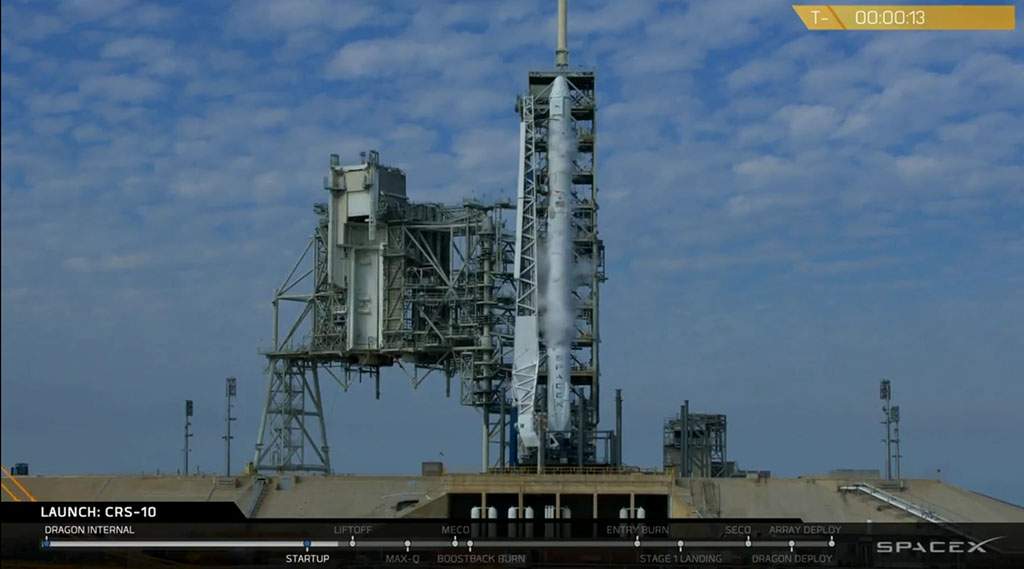
Today SpaceX, a space exploration company in the private sector, was force to abort launch of mission CRS-10. The launch was aborted at T- 0:13 to allow the SpaceX team to take a closer look at positioning of the second stage engine nozzle. This comes after a year of failed launches in 2016, including the loss of 2 Falcon 9 rockets, the same model used for CRS-10, a mission to resupply the International Space Station for NASA.
Recent Launch Attempts by SpaceX
September 1st, 2016 - Pad Explosion at Cape Canaveral
A SpaceX Falcon 9 rocket exploded on its Cape Canaveral launch pad during a test on September 1st, 2016. A problem occurred during fuelling and pressurisation of the upper stage liquid oxygen tank. In the resultant explosion, the stage ruptured and caused the two stages to collapse. Seemingly restrained by its umbilical connections to the service mast, the payload section began to pivot 10 seconds after the explosion and plummet to the ground alongside the first stage which had already collapsed onto the pad area.
Several secondary explosions were heard and felt in the area as various tanks and pressurised vessels in the launch vehicle and satellite ruptured. There were no casualties and the pad area had been evacuated as a standard procedure during pre-flight stage tests.
The payload comprised the 5.3-ton AMOS-6 communications satellite for the Israeli-based Spacecom organisation and was to have been used to bring broadband to sub-Saharan Africa as a replacement for Amos-2. The launch was scheduled for September 3rd. No one was injured in the explosion.
June 28th, 2015 - CRS-7 Mission Loss
Following a nominal liftoff, Falcon 9 experienced an overpressure event in the upper stage liquid oxygen tank approximately 139 seconds into flight, resulting in loss of mission. Prior to the mishap, the first stage of the vehicle, including all nine Merlin 1D engines, operated nominally. The Dragon spacecraft not only survived the second stage event, but also continued to communicate until the vehicle dropped below the horizon and out of range. SpaceX led the investigation with oversight from the FAA and participation from NASA and the U.S. Air Force.
January 14th, 2017 - Return to Flight
SpaceX celebrated the first flight of its Falcon 9 rocket in over four and a half months on Saturday, with a remarkably smooth launch from California. The return-to-flight mission after the accident in September 2016 carried Iridium NEXT satellites. Iridium NEXT will replace the original Iridium constellation, launched in the late 1990s. Each Falcon mission will carry 10 satellites, with a goal to complete deployment of the 72-satellite constellation by the end of 2017.
CRS-10 Dragon Resupply Mission
Mission Overview
SpaceX's Falcon 9 rocket will launch the Dragon spacecraft to low-Earth orbit to deliver critical cargo to the International Space Station for NASA. SpaceX is targeting a late morning launch of its tenth Commercial Resupply Services mission (CRS-10) from Launch Complex 39A (LC-39A) at NASA's Kennedy Space Center in Florida. The instantaneous launch window is on Saturday, February 18th at 10:01 a.m. EST, with a backup launch opportunity at 9:38 a.m. EST on Sunday, February 19. Dragon will separate from Falcon 9's second stage about 10 minutes after liftoff and attach to the station roughly two days later. The CRS-10 mission will be SpaceX's first launch from historic LC-39A at Kennedy Space Center. Following stage separation, the first stage of Falcon 9 will attempt to land at SpaceX's Landing Zone 1 (LZ-1) at Cape Canaveral Air Force Station, Florida.
The Dragon Spacecraft
Dragon will be filled with more than 5,000 pounds of supplies and payloads, including critical materials to directly support dozens of the more than 250 science and research investigations that will occur during Expeditions 50 and 51. Among the investigations are experiments with potential to help fight human disease, monitor climate data, and improve autonomous spacecraft docking with the orbiting laboratory. SpaceX CRS-10 is the tenth of up to 20 missions to the International Space Station that SpaceX will fly for NASA under the first CRS contract.
February 18, 2017 - Failure to Launch
Not much is being said yet about the launch abort. Twitter is the only source of information from SpaceX at this point in time - no official press release or anything of the sort. SpaceX and founder Elon Musk, also known for other major companies such as PayPal and Tesla Motors, are both suggesting the problem was very minor. The backup launch scheduled for 9:38 a.m. EST tomorrow morning is still scheduled to take place. We are expecting a press release or statement of some sort later this afternoon from SpaceX.
Despite a few failed launches over the last 2 years, SpaceX has a remarkably solid track record of successful launches - the most major failure being a test and not an actual launch. We will update this article with further statements about today's abort, as well as follow up with the results of tomorrow's launch attempt. Best of luck to the crews of SpaceX and Cape Canaveral.
Sources & Methodology(6 sources)
- SpaceX - CRS-10 launch webcastVideo / Audio
SpaceX official livestream of the CRS-10 launch attempt on February 18, 2017, documenting the T-13 second abort.
- SpaceX - About pageDocument
SpaceX official about page providing context on the company's mission and history.
SpaceX official investigation update on the June 28, 2015 CRS-7 Falcon 9 mission failure.
Wikipedia comprehensive list of all Falcon 9 and Falcon Heavy launches providing launch history context.
- SpaceX - CRS-10 press kitDocument
SpaceX official CRS-10 mission press kit PDF providing mission specifications and objectives.
The Verge article explaining what happened and why in the SpaceX Falcon 9 pad explosion.
Methodology
Breaking news coverage based on SpaceX livestream, official social media statements from SpaceX and Elon Musk, and publicly available mission documentation.
Frequently Asked Questions
- Why was the SpaceX CRS-10 launch aborted?
- The SpaceX Falcon 9 CRS-10 launch was aborted at T-13 seconds on February 18, 2017, to allow the SpaceX team to take a closer look at the positioning of the second stage engine nozzle. SpaceX and Elon Musk both indicated the problem appeared minor, and a backup launch window was maintained for 9:38am EST the following morning.
- What is the CRS-10 mission?
- CRS-10 (Commercial Resupply Services-10) is SpaceX's tenth mission to resupply the International Space Station for NASA. The Dragon spacecraft was set to carry more than 5,000 pounds of supplies and payloads to support over 250 science and research investigations during Expeditions 50 and 51. It was also to be the first SpaceX launch from historic Launch Complex 39A at Kennedy Space Center.
- What previous launch failures did SpaceX experience?
- SpaceX suffered two notable failures in 2015-2016: the CRS-7 mission failure on June 28, 2015, when an overpressure event in the upper stage liquid oxygen tank caused loss of mission; and the September 1, 2016 pad explosion at Cape Canaveral that destroyed the AMOS-6 satellite during fueling. SpaceX successfully returned to flight on January 14, 2017 with the Iridium NEXT mission.
- What was SpaceX's track record before CRS-10?
- Despite the CRS-10 abort, SpaceX maintained a remarkably solid overall track record. The company successfully returned to flight in January 2017 after the September 2016 pad accident, launching 10 Iridium NEXT satellites. The Falcon 9 first stage was also planned to attempt a landing at SpaceX's Landing Zone 1 at Cape Canaveral Air Force Station as part of the CRS-10 mission.